Showing posts with label books read in 2020. Show all posts

Monday, December 21, 2020

125. The Tailor of Gloucester


The Tailor of Gloucester. Beatrix Potter. 1903. 58 pages. [Source: Library] 

In the time of swords and periwigs and full-skirted coats with flowered lappets—when gentlemen wore ruffles, and gold-laced waistcoats of paduasoy and taffeta—there lived a tailor in Gloucester.
He sat in the window of a little shop in Westgate Street, cross-legged on a table, from morning till dark.
All day long while the light lasted he sewed and snippeted, piecing out his satin and pompadour, and lutestring; stuffs had strange names, and were very expensive in the days of the Tailor of Gloucester.
I enjoyed rereading Beatrix Potter's The Tailor of Glouchester. In this delightful Christmas tale, readers meet a tailor, a cat named Simpkin, and some lovely mice. It is several days before Christmas. He's working hard to finish a coat and waistcoat for the Mayor of Glouchester. The Mayor is getting married on Christmas day. The tailor has just enough money to finish the coat. Not a penny to spare. He sends his cat, Simpkin, with his money to buy what he needs: a little for himself (food: bread, sausage, milk) a little for his work (one twist of cherry-coloured silk). It is only after the fact that he questions whether he should have sent the cat or gone himself. The cat returns, but, in a mood. The cat is upset for he's discovered that the tailor freed the mice he had captured and hid under the teacups. The cat hides the twist. The man is upset, of course, and sick. He takes to his bed unable to work. The oh-so-thankful mice go to his shop and finish his work for him. But since they are one twist short, they are unable to finish completely. Still, they do what they can, and they do a wonderful job. The cat who spies them at work, I believe, has a change of heart and gives the twist to the old man on Christmas morning. He has just enough time to finish. The Mayor is very, very pleased. And the tailor's luck changes for the better, and his business is much improved. This one is a lovely, delightful read from start to finish.

 Quotes:

  • The tailor replied—"Simpkin, we shall make our fortune, but I am worn to a ravelling. Take this groat (which is our last fourpence) and Simpkin, take a china pipkin; buy a penn'orth of bread, a penn'orth of milk and a penn'orth of sausages. And oh, Simpkin, with the last penny of our fourpence buy me one penn'orth of cherry-coloured silk. But do not lose the last penny of the fourpence, Simpkin, or I am undone and worn to a thread-paper, for I have NO MORE TWIST."
  • "Simpkin," said the tailor, "where is my TWIST?" But Simpkin hid a little parcel privately in the tea-pot, and spit and growled at the tailor; and if Simpkin had been able to talk, he would have asked: "Where is my MOUSE?"
  • "Mew! scratch! scratch!" scuffled Simpkin on the window-sill; while the little mice inside sprang to their feet, and all began to shout at once in little twittering voices: "No more twist! No more twist!" And they barred up the window shutters and shut out Simpkin.
  • Then Simpkin went on tip-toe and took a little parcel of silk out of the tea-pot, and looked at it in the moonlight; and he felt quite ashamed of his badness compared with those good little mice! When the tailor awoke in the morning, the first thing which he saw upon the patchwork quilt, was a skein of cherry-coloured twisted silk, and beside his bed stood the repentant Simpkin!
  • The stitches of those button-holes were so neat—so neat—I wonder how they could be stitched by an old man in spectacles, with crooked old fingers, and a tailor's thimble. The stitches of those button-holes were so small—so small—they looked as if they had been made by little mice!    


© 2020 Becky Laney of Young Readers

Friday, December 18, 2020

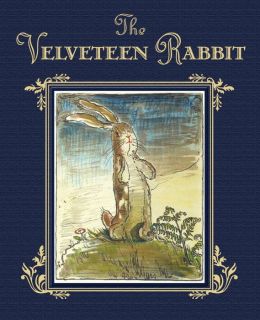
124. The Velveteen Rabbit

The Velveteen Rabbit. Margery Williams. Illustrated by William Nicholson. 1922/2014. Random House. 48 pages. [Source: Review copy]

Do you know what it is to be real? One little Christmas bunny will learn this and plenty of other life lessons in Margery Williams' classic tale The Velveteen Rabbit.

The Velveteen Rabbit opens with a young boy receiving a rabbit for a Christmas present. All is lovely for the rabbit that first day. But the toy is quickly forgotten. He becomes one toy of many, many, many toys. He's not exactly special to the boy or the other toys. In fact, I'd say the other toys bully him a bit. All except for the Skin Horse, the oldest toy in the nursery. It is this horse that tells the Rabbit all about being real, what it takes to be real, what it feels like, how it changes you, etc.
"Real isn't how you are made," said the Skin Horse. "It's a thing that happens to you. When a child loves you for a long, long time, not just to play with, but REALLY loves you, then you become Real." "Does it hurt?" asked the Rabbit. "Sometimes," said the Skin Horse, for he was always truthful. "When you are Real you don't mind being hurt." "Does it happen all at once, like being wound up," he asked, "or bit by bit?" "It doesn't happen all at once," said the Skin Horse. "You become. It takes a long time. That's why it doesn't often happen to people who break easily, or have sharp edges, or who have to be carefully kept. Generally, by the time you are Real, most of your hair has been loved off, and your eyes drop out and you get loose in the joints and very shabby. But these things don't matter at all, because once you are Real you can't be ugly, except to people who don't understand." "I suppose you are real?" said the Rabbit. And then he wished he had not said it, for he thought the Skin Horse might be sensitive. But the Skin Horse only smiled. "The Boy's Uncle made me Real," he said. "That was a great many years ago; but once you are Real you can't become unreal again. It lasts for always." (5-8)
The Velveteen Rabbit is one of my favorite Christmas books. I love the nursery magic. I love the ending. It was originally published in 1922. The story and illustrations in this edition are original. This is a beautiful edition of the book. One of the best I've seen.

The Velveteen Rabbit was published several years before A.A. Milne's Winnie the Pooh and House at Pooh Corner. Chances are if you enjoy one, you'll enjoy the other.

Do you have a favorite toy-come-to-life fantasy?


© 2020 Becky Laney of Young Readers

Monday, December 14, 2020

123. The Nutcracker of Nuremberg


Nutcracker of Nuremberg. Alexandre Dumas. Illustrated by Else Hasselris. Translated by Grace Gingras. 1844/1930/2013. Pook Press. 172 pages. [Source: Bought]

First sentence:  In the city of Nuremberg lived a much respected Chief Justice called President Silberhaus, which means "house of silver." He had two children, a nine-year-old boy, Fritz, and a daughter Marie who was seven and a half years old. 

 Premise/plot: Marie and Fritz receive a Nutcracker--to share--from Godfather Drosselmayer one Christmas. When the Nutcracker is injured--due to her brother's reckless play--Marie cares for him. She places him tenderly in a doll bed, and is so worried that she watches over him long past bedtime. What follows is either a very vivid dream--well, many, many, many dreams--or an incredible fantasy adventure involving the Nutcracker, vengeful mice, and one very wicked Mouse King. The story occurs over several weeks--not one night--and there is a story within a story. The inner story is extremely bizarre! It gives this Nutcracker a potential back story that will fascinate and captivate the young Marie. Is it true? Is it a fairy tale? 

My thoughts: The book opens with a preface, an excuse for the retelling. The author had taken his daughter to a birthday party. During the party, he made his escape and fell asleep in one of the rooms of the house. The children find him asleep and tie him up. To secure his release, he offers several bribes. The first--for candy--is rejected, as is the second--for fireworks in the park. But the third, well, the third is accepted. The children demand a fairy story. He warns that the story he's about to tell is not his own, not of his own making. But they don't care about originality. They want a GOOD, entertaining story.

In three parts, the tale of the Nutcracker is related to his young audience--who had already freed him. The first part introduces readers to Marie and her family. It is Christmas, of course, and she's taken a special interest in a Nutcracker. Her brother took an interest as well which led to the Nutcracker getting broken. Marie takes on the role of nurse, and this role continues even after the rest of the family has gone to bed. She remains behind in the living room (or equivalent) and reality becomes a bit blurred in what follows. It involves the Nutcracker and the rest of the toys coming to life and doing battle with mice led by a Mouse King. What readers learn is that somehow, someway, Marie gets injured--her hand, I believe--by broken glass. Marie remains in bed recuperating for the second and third parts of the story. Her godfather visits her and tells her the story of "The Nut Krakatuk and the Princess Pirlipate." This is a dark fairy tale of a king, queen, and princess cursed by mice seeking revenge, and, of what was done to try to break the curse. The third part of the story focuses once more on Marie, the Nutcracker, and the Mouse King. Several threats are made against the Nutcracker to Marie by the Mouse King, and several times she tries to appease him. For example, she gives in to his demand for all her candy, for all her dolls, etc. But it is inevitable: The Mouse King must do battle once and for all with the Nutcracker, and Marie, I believe, does find a sword for The Nutcracker. After the battle, the Nutcracker takes Marie away with him to a fantasy land where just about anything is possible....

I liked it. I did. But I'm not sure I loved, loved, loved it.

© 2020 Becky Laney of Young Readers

Friday, December 11, 2020

122. The Best Christmas Pageant Ever


The Best Christmas Pageant Ever. Barbara Robinson. 1972. HarperCollins. 128 pages. [Source: Bought]

First sentence: The Herdmans were absolutely the worst kids in the history of the world. They lied and stole and smoked cigars (even the girls) and talked dirty and hit little kids and cussed their teachers and took the name of the Lord in vain and set fire to Fred Shoemaker's old broken-down toolhouse. The toolhouse burned right down to the ground, and I think that surprised the Herdmans. They set fire to things all the time, but that was the first time they managed to burn down a whole building. I guess it was an accident. I don't suppose they woke up that morning and said to one another, "Let's go burn down Fred Shoemaker's toolhouse"...but maybe they did. After all, it was a Saturday, and not much going on.

Premise/plot: What happens to a small-town church pageant when the WORST kids in the world 'take over' and take all the leading roles in the nativity? Perhaps readers hearts--along with the Herdmans'--will grow three sizes.  (There are six Herdmans in all: Ralph, Imogene, Leroy, Claude, Ollie, and Gladys.)

My thoughts: This one is written in the first person. I don't know that we ever learn her name in the book. Usually that is the kind of thing that drives me CRAZY. Every character needs to have a name. But it doesn't bother me horribly in this one. Perhaps because it keeps the focus on where it belongs--the Herdmans as they discover the true meaning of Christmas for themselves.

The writing is WONDERFUL. It is funny--dare I say hilarious? Yet it's not without substance and heart. The text perhaps has the ability to reveal the self-righteous hypocrite lurking inside the heart of every professing believer OR every "professing" believer.

For whom did Jesus die? Who needs saving? Who is the gospel message for? Is it up to us to judge who is worthy--or unworthy--of hearing the gospel? Is the gospel unable to save the worst offenders, the biggest sinners?

The book itself is NOT preachy. Not in a didactic way. The book is not in any way promoting praying a little prayer, coming up an aisle, signing a pledge card, getting baptized.

The Sunday-school-and-church-attending children of a community are taking part in the annual Christmas pageant. During the pageant itself Scripture is read aloud. Also during the rehearsals, the pageant director reads the full nativity story aloud. Some questions are asked; some are answered. Some questions seem so out-of-the-box that there are no quick and easy answers.

There is a genuineness to this one. The Herdmans have never been "churched." They have not been exposed to any bible stories or songs. They have not heard Scripture read aloud before. They have not read the Bible for themselves. Their questions are not coming from a place of sneering or hostility. They are curious. They want to know. And this knowing brings with it feelings and reactions. Feelings and reactions that seem almost FOREIGN to the churched.

The book truly captures the getting-it moment, the moment when one realizes the true meaning of Christmas.


© 2020 Becky Laney of Young Readers

Wednesday, December 9, 2020

121. True Rescue A Storm Too Soon


True Rescue: A Storm Too Soon. Michael J. Tougias. 2021. [July] 128 pages. [Source: Review copy]

First sentence: Sixty-two-year-old Rudy Snel from Canada is standing in the warm Florida sunshine. He is outside an airport waiting to meet Jean Pierre de Lutz, the owner of a sailboat named the Sean Seamour II. The 44-foot sailboat will carry Rudy, Jean Pierre, and a third sailor from Florida to France.

Premise/plot: True Rescue: A Storm Too Soon also appears to be an early chapter book adaptation of another book--possibly an adaptation of an adaptation. Either way it's packed with intensity and action. It's set in May 2007--in the Atlantic Ocean. A small sail boat with three sailors are in a fight for their lives against Mother Nature. 

The book alternates between these three sailors and their would-be Rescuers. 

My thoughts: I definitely found this book--and the other True Rescue book I read--to be exciting and action-packed. Would recommend to those looking for an exciting nonfiction read. 


© 2020 Becky Laney of Young Readers

Tuesday, December 8, 2020

120. True Rescue: The Finest Hours


True Rescue: The Finest Hours: The True Story of a Heroic Sea Rescue. Michael J. Tougias and Casey Sherman. 2020. [December] 96 pages. [Source: Review copy]

First sentence: February 18, 1952 Captain John Fitzgerald could barely stay on his feet aboard his rocking ship, the 503-foot-long oil tanker named Pendleton. Fitzgerald had been in bad weather before, but nothing like the winter storm that was now raging off Cape Cod, Massachusetts.

 Premise/plot: The Finest Hours is an early chapter book adaptation of a young readers adaptation of an adult nonfiction title. It is part of a series of true survivor stories. The intensity of the action is HIGH. And the books highlight the courage, determination, grit shown, and to some degree miraculous nature of events. 

In this one, an oil tanker splits in two, the bow and stern separate--of course--and it's unclear to those on board if help will ever come....

By chance another oil tanker splits in two and is able to send out a message....but it is the Pendleton that is found...

The narrative shifts between those on board the tanker AND those of the Coast Guard sent to save them...

My thoughts: Very intense. Action-packed. Quick read. I liked it.  


© 2020 Becky Laney of Young Readers

Monday, December 7, 2020

119. Mrs. Noodlekugel


Mrs. Noodlekugel. Daniel Pinkwater. Illustrated by Adam Stower. 2012. 80 pages. [Source: Review copy]

First sentence: A tall building, with one apartment stacked on top of another — that is where Nick and Maxine came to live with their parents. They had not lived there very long when Maxine said to Nick, “Come to my room. I have discovered something.”

Premise/plot: Nick and Maxine, our hero and heroine, discover a delightful friend and potential babysitter in the eccentric next door neighbor, Mrs. Noodlekugel. What few adventures we have are certainly odd, unusual, whimsical, peculiar. For example, making cookies WITH mice and FOR mice.

“Now we will put the cookies in the oven,” Mrs. Noodlekugel said. “Before we light the oven, we will count the mice to make sure no mouse has fallen asleep on the cookie sheet.” “Has that ever happened?” Maxine asked. “No, because we count,” Mrs. Noodlekugel said.

My thoughts:  Apparently I read this one in 2012 and gave it one star. I completely forgot having read this one previously, and so when it showed up as a free book on kindle I downloaded it. I don't know if my mood was just completely different the second time around, or, if my reading tastes have changed through the years--but I wouldn't rate it one star now. I'm not sure I'd go over three stars. But it's not *that* bad. I mean, it's no Mrs. Piggle Wiggle. And there aren't that many adventures to be had in this one short book. It's all set up for further adventures. If the other books in the series are ever free, I'd definitely consider reading them as well.


© 2020 Becky Laney of Young Readers

Wednesday, December 2, 2020

118. Snail and Worm All Day


Snail and Worm All Day: Three Stories About Two Friends. Tina Kugler. 2019. 32 pages. [Source: Review copy]

First sentence: Hello! Hi! Guess what? It's the best day ever!

Premise/plot: Snail and Worm All Day contains three stories starring Snail and Worm. Best Day Ever reveals that Snail may just be an optimist--maybe. He may be having a not-so-great-day (he can't find his shoes) but everyone else is having a great day and that makes Snail very happy indeed (especially when he remembers he doesn't even wear shoes). The Spooky Cave is an adventure where Snail and Worm face the dangers--do they really???--of a dragon in a cave. Will they survive long enough to make it to nap time? In the third story, A Bedtime Story, the two work together to create a bedtime story. 

My thoughts: I really enjoyed this one. This is the third book--so far--in the series. I am definitely getting attached to the characters and this series. I love that the story relies so heavily on the illustrations. These are very funny stories--but only if you look past the text and find out what is really going on!!! 

© 2020 Becky Laney of Young Readers

Wednesday, November 25, 2020

117. Snail and Worm Again


Snail and Worm Again (Snail & Worm #2) Tina Kugler. 2017. 32 pages. [Source: Review copy]

First sentence: Hey! Wow! What is going on?

Premise/plot: Snail and Worm are back for three more stories in Tina Kugler's Snail and Worm Again. In the first story, Snail's Wings, Snail "grows" wings and prepares to fly away. But will he really??? In the second story, The Mirror, the two friends find a "mirror." What did they really find???? In the third story, Snail is Sad, Snail is having an off day because he doesn't feel all that special--to be exact, he doesn't think his shell is all that special. Can Worm cheer him up???

My thoughts: I enjoyed these three stories! I might even have enjoyed these three more than the original three. It's so hard to tell with books like these. The sequel books have a slight advantage in that you are already familiar with the characters and your expectations are usually right on. 

I love the humor in these stories--well in two of the three stories. I love that so much depends on the artwork itself instead of the text. Especially in The Mirror!

I would recommend this one!!!
 

© 2020 Becky Laney of Young Readers

Thursday, November 19, 2020

116. Snail and Worm


Snail and Worm: Three Stories About Two Friends. Tina Kugler. 2016. 32 pages. [Source: Review copy]

First sentence: Hello! Want to play? Let's play! TAG! You are it! Can you catch me? No! No! No!

Premise/plot: This early reader features three stories starring Snail and Worm. "Meet My Friend," the first story has Snail and Worm meeting each other and becoming playmates and friends. "Snail's Adventure," has snail and worm "climbing" a flower and "seeing" the world from a new perspective. "Meet My Pet," the third story, the two are discussing Worm's missing pet. This story is dependent on the illustrations--that's where the humor comes in!

My thoughts: I enjoyed this one! I did. I don't necessarily love the way these two look--the illustrations aren't quite my thing. But the text, the text, works well--really well. By the end of the book, I was delighted with this relationship.


© 2020 Becky Laney of Young Readers

Wednesday, November 18, 2020

115. Anne's School Days


Anne's School Days. Kallie George. Illustrated by Abigail Halpin. 2021. [July] 72 pages. [Source: Review copy]

First sentence: Everyone loved autumn in Avonlea. Especially Anne of Green Gables. “What a splendid day,” said Anne to Diana Barry as they walked to school. “Isn’t it good to be alive on a day like this?” Three weeks of school had gone by and, so far, Anne loved it. 

Premise/plot: Anne Shirley starts school in Avonlea in the third book in Kallie George's adaptation of L.M. Montgomery's classic Anne of Green Gables. She is adapting the classic novel into an early chapter book series. The series remains true in spirit--with a little condensing, okay a lot of condensing--to the original. In this one, Anne has a few adventures and misadventures in school regarding a certain Gilbert Blythe. Will she ever forgive him for calling her Carrots???

My thoughts: LOVE. I won't try to hide my bias. I can't. It would be like me playing a game of "poor, poor kitty." (If you don't know about the game, you could read about it here.) I love, love, love, love, love, crazy love L.M. Montgomery's books. I particularly LOVE the character of Anne Shirley. And Gilbert, well, don't get me started on how much I LOVE him. I love how the book focuses on two or three incidents instead of trying to tell every single one. It keeps the pace going. (That being said, I wouldn't have minded seeing Anne's green hair make an appearance. But editing matters, and George stayed on task.)

I highly recommend this one!

Quotes:

Anne turned away and quickly forgot about Gilbert. Instead, she gazed off and started imagining. Anne loved imagining. This time, she dreamed she was a fancy lady with puffed sleeves and glossy black hair. All of a sudden, she was tugged out of her daydream. It was Gilbert. He had slid over and now he was pulling her braid! “Carrots,” he whispered. Anne froze. Anne’s red hair was her lifelong sorrow. That was the worst name Gilbert could call her. The worst name anyone could call her.


© 2020 Becky Laney of Young Readers

Tuesday, November 17, 2020

114. Ballerina Bess


Ballerina Bess. Dorothy Jane Mills and Dorothy Z. Seymour. 1965. 25 pages. [Source: Bought]

First sentence: This is Bess. Bess wants to dance. Bess wants to be a ballerina.

Premise/plot: Young readers meet Bess who wants to be a ballerina. Ballerina Bess is from the Early-Start Preschool Reader series. It has a 25 word vocabulary.

My thoughts: I had this one and Ann Likes Red growing up. While I think I prefer Ann Likes Red a little better, this one is still a lot of fun if you like vintage children's books. (It was published in 1965.)

Simple can be a great thing when you are learning to read. Words need to be either sight words (common frequency like is, was, the, this, etc.), or easy to sound out. To read a whole book on your own can be a great confidence booster.

One thing that I just noticed now as an adult is that there are a few pages where LEGS are missing. On one page readers clearly see Bess dancing ON HER TOES. And on the very next page, Bess is missing BOTH LEGS as she's shopping at a store. The sales clerk has legs, but Bess and her mother DO NOT. And on the next page. Bess, her mom, and the sales clerk are all missing legs. But fortunately Bess' legs return for the next page when she's dancing once more.

Text: 4 out of 5
Illustrations: 3 out of 5
Total: 7 out of 10


© 2020 Becky Laney of Young Readers

Wednesday, November 11, 2020

112. Are You My Mother?


Are You My Mother? P.D. Eastman. 1962. 64 pages. [Source: Bought]

First sentence: A mother bird sat on her egg. The egg jumped. "Oh oh!" said the mother bird. "My baby will be here! He will want to eat." 

Premise/plot: A baby bird wanders around looking for its mother in P.D. Eastman's classic early reader. The bird makes the rounds asking ARE YOU MY MOTHER? to every one he/she meets....every THING she/he meets. (The bit with the SNORT might just be my favorite bit.) Will the bird ever be reunited with his/her mother???

My thoughts: I LOVE, LOVE, LOVE this one. I do. Especially the bit where the bird asks the SNORT if it is his mother. Highly recommended.


© 2020 Becky Laney of Young Readers

Tuesday, November 10, 2020

111. Ann Likes Red


Ann Likes Red. Dorothy Z. Seymour. Illustrated by Nancy Meyeroff. 1965. 28 pages. [Source: Bought]

First sentence: Ann likes red. Red! Red! Red! "A blue dress, Ann?" "I like red," said Ann.

Premise/plot: Ann and her mom have gone shopping. Anne likes RED, RED, RED. What will she buy? Perhaps a RED dress, a RED hat, a RED belt, RED sandals!

My thoughts: I LOVED, LOVED, LOVED, LOVED this one as a child. I did. I think I had the book memorized I read it so much. I was quite THRILLED to find a copy recently. Though I had forgiven my mom for giving *my* copy away, I am so happy to have found a new copy.

Yes, the book is simple: just sixteen words to tell the whole story. But apparently 16 words are more than enough to tell a GOOD story when you know what you're doing.

And I will admit the book has a very VINTAGE feel. Some might say dated, but I prefer VINTAGE.

Text: 5 out of 5
Illustrations: 3 out of 5
Total: 8 out of 10


© 2020 Becky Laney of Young Readers

110. Noisy Nora


Noisy Nora. Rosemary Wells. 1973. 32 pages. [Source: Bought]

First sentence: Jack had dinner early; Father played with Kate; Jack needed burping; So Nora had to wait. First she banged the window, then she slammed the door, then she dropped her sister's marbles on the kitchen floor.

Premise/plot: Nora is "the middle mouse" and she is feeling FRUSTRATED and OUT OF SORTS. Would anyone even miss her if she ran away?

My thoughts: I enjoyed this one. I did. There's something unforgettable about it--namely the last line, "'But I'm back again!' said Nora with a monumental crash." Max and Ruby are probably still my favorite characters created by Rosemary Wells. But I do love Nora. 

It does have the word 'dumb' so if you are in a 'dumb-free' household, you might want to know ahead of time before reading it aloud so you know to switch the word. 

© 2020 Becky Laney of Young Readers

Wednesday, November 4, 2020

109. Go To Bed, Monster!


Go to Bed, Monster! Natasha Wing. Illustrated by Sylvie Wickstrom. 2007. 40 pages. [Source: Review copy]

First sentence: One night, Lucy tossed and turned. She could not, would not, did not want to go to bed. "I want to draw," she said.

Premise/plot: Lucy does NOT want to go to bed. She draws what turns out to be a monster instead. The two have MANY adventures. But when she's ready to go bed--finally--he doesn't want to go to bed. Can a sleepy Lucy convince not sleepy Monster to go to bed? What will it take to get them both sound asleep?

My thoughts: I loved this one. I first read it years ago. I even interviewed the author! It was a cute, funny, charming, delightful book. I never tire of a good bedtime book. I do recommend this one. I wish there was a board book edition of it available!

 Text: 5 out of 5

Illustrations: 5 out of 5

Total: 10 out of 10


© 2020 Becky Laney of Young Readers

Monday, October 26, 2020

108. The Retake


The Retake. Jen Calonita. 2021. [February] 272 pages. [Source: Review Copy]

First sentence: I held my cell phone high in the air to get the optimal angle and snapped a photo of me sticking my tongue out. Then I sent it to my best friend, Laura, pleased that the picture was cropped so tight I wouldn’t give away my surprise. 

Premise/plot: Zoe and Laura are best, best, best friends and always will be...won't they? This middle grade coming of age novel stars Zoe Mitchell. It's the dawn of seventh grade, and things aren't looking the greatest for these bffs. Zoe is worried--and rightly so--that her best friend has moved on during the summer. (Zoe vacationed with her family while Laura starred as Molly in a production of Annie and made a bunch of new friends.) The novel opens with drama...and stays consistently dramatic throughout as Zoe tries again and again and again and again and again--via a time travel app on her phone--to repair the friendship and set things "right." Is this friendship doomed? And will Zoe be able to make peace if it is? Are there other classmates with best friend potential?

My thoughts: I LOVE, LOVE, LOVE, LOVE, LOVE, LOVE, LOVE the premise of this one. I was fascinated with the idea of a time traveling app. (It would be DANGEROUS in real life, I am certain.) This time travel app works through the photos on her photo stream. The app can transport her to (and from) any moment(s) captured in photos. This gives her quite a few possibilities or opportunities to relive experiences and perhaps make changes. But all changes--no matter how small--have consequences. I am really so glad that we travel back to the future each time to see what those consequences are. 

The premise worked for me. I found it fascinating, compelling, and relatable. Who wouldn't want chances to fix the past and "set things right"?!?! This one is focused exclusively on fixing or repairing a friendship that is falling apart.

What I ended up loving even more, however, is the relationship between the two sisters--Zoe and her older sister Taryn. I honestly can't say that family was the main emphasis in this one--but the sister relationship IS key. I loved seeing all the alternate futures where these two are closer...and how in seeking to restore her friendship with Laura...she's learning--albeit unawares--how to repair her friendship with her sister. 

I thought this was a great coming of age story.


© 2020 Becky Laney of Young Readers

Wednesday, October 21, 2020

107. The Hundred and One Dalmatians


The Hundred and One Dalmatians. Adapted by Peter Bently. Based on the novel by Dodie Smith. Illustrated by Steven Lenton. 2019. 32 pages. [Source: Review copy]

First sentence: Once there were two Dalmatians named Pongo and Missis. They lived with Mr. and Mrs. Dearly in a big house in London.

Premise/plot: Pongo and Missis have fifteen lovable pups. These pups are stolen by the OH SO EVIL Cruella de Vil. Though at first they don't know WHO took their pups or WHY. Pongo and Missis team up with dogs across England to find and rescue their pups. Will they make it back to the Dearlys--with their pups--in time for Christmas?

This picture book is neither the original novel nor the classic Disney animated film. It blends from both but is in some points unique. It condenses and abridges. This is to be expected, of course. But surely it wouldn't have hurt to keep Sergeant Tibs!!!

My thoughts: I liked this one. I didn't love, love, love it. I didn't dislike it--not really. It is NOT the Disney film. It is NOT the book. Once you settle into the fact that Bently is telling the story his way, then it's easier to appreciate. Sadly I don't think any of the dogs--or puppies--gets enough time to shine and stand out as individuals with personalities. This is the case with both the book and the movie. The doggie perspective is in part what makes the original so very charming and lovable. The picture book is a bit more distant and isn't told from any of the dog's perspectives.

I did like the illustrations.  

Text: 3 out of 5

Illustrations: 3 out of 5

Total: 6 out of 10


© 2020 Becky Laney of Young Readers

Wednesday, October 14, 2020

106. The Case of the Disappearing Pets


The Case of the Disappearing Pets (Mina Mistry Investigates) Angie Lake. Illustrated by Ellie O'Shea. 2021. [March] Sweet Cherry. 240 pages. [Source: Review copy]

First sentence: Like every year, at school the first week of October is Showcase Your Pets week. 

Premise/plot: Mina Snotbridge (aka Mina Mistry) is a young girl who solves mysteries when she's not hanging out with her friends. In this chapter book, Mina is trying to discover WHAT happened to all the pets in town. A handful of her classmates have had pets disappear including her very best friend. (Holly's hamster, Harriet, is MISSING.) Who has taken all the pets? Was there foul play? 

My thoughts: This chapter book for elementary-aged students is a fun and light mystery. The book has a lot of illustrations and uses a fun layout--the chapters are log entries in her case book. 

The book is a little over-the-top at times, but it's all in good fun. (For example, Harriet the Hamster has a LARGE wardrobe with plenty of accessories.) Older readers may wonder why the first thought is that someone has kidnapped the hamster instead of the hamster just escaping from the cage and is now loose in the house. But, of course, that would be a less fun mystery to solve! 

I liked this one well enough.


© 2020 Becky Laney of Young Readers

Friday, October 9, 2020

105. The Starlight Barking


The Starlight Barking. Dodie Smith. 1967. 160 pages. [Source: Bought]

First sentence: Not long ago there lived in Suffolk a hundred and one Dalmatians whose adventures had once thrilled all the dogs of England.

Premise/plot: The Starlight Barking is the sequel to One Hundred and One Dalmatians by Dodie Smith. Pongo plays a starring role in this psychedelic animal fantasy. 

The book opens with Pongo, Missis, Perdita, and Prince realizing that their humans are asleep and won't wake up. They soon realize that it isn't just Mr. and Mrs. Dearly and the other humans at Heaven Hall who won't wake up. After traveling to th19e neighboring farm and visiting the General sheepdog, they realize ALL are asleep excepting dogs.  

This in and of itself would be weird and bizarre. But that's just the tippy-tippy-tip of the iceberg. Soon after arriving at the farm, they receive their first communication from their daughter, Cadpig. Not by twilight bark or starlight bark--or any other time of day bark--but by telepathy. And not only can they send out their thoughts to specific dogs--but to all dogs everywhere. But that's not quite enough. All dogs--at least the dogs that have been updated to their new awesome abilities--can also SWOOSH (Smith's word for fast zooming/flying). They can also group-think. Think DOCTOR STRANGE plus STAR WARS. 

So why out of the blue do dogs have these new powers and abilities? And do these new powers come at a cost?

 My thoughts: I have two questions. That's a lie. I'll start with two questions. Question one: how did this get published in the first place in 1967. Was there already a signed contract with Dodie Smith to write a sequel to 101 Dalmatians? Did someone actually read the manuscript and think it was a great book? Were they under the influence when they read the manuscript? (See I told you more than two questions!)

Question two: How does this book keep getting republished? That is perhaps the more important question. The copy I have is from 1970. But looking at GoodRead's all editions, I see reprints in 1970, 1972, 1976, 1988, 1994, 1996, 1997, 2003, 2006, 2011, 2015, and 2017. The most recent being an audio book. 

 Before I go all spoiler-y, I just want to talk about reader's expectations and SEQUELS. First, authors are under no obligation to the reader--though they may be with the publisher?--to write a sequel in the first place. Second, authors should have the freedom of creativity to write what they want to write and experiment with their style and plot and characters. Maybe Smith really, really, really wanted to try her hand at writing science fiction. BUT. Are sequels the best place to change things up completely and really go all topsy-turvy with content? Shouldn't sequels be somewhat similar to the original? The first book is delightful, charming, packed with adventure, has a cutesy charm. This second book is just...there are no words for how bizarre and crazy it is.


I feel the covers of the book are not HONEST representation of the content. I feel that readers might see the cover and think they're getting one thing when in reality they are getting something else.   


This one comes closest maybe to being honest.

So Smith's book in the end comes with a heavy agenda. 

S

P

O

I

L

E

R

What follows is very spoiler-y so this is your last chance to avoid spoilers.

The book turns into a HUMANS ARE GOING TO DESTROY THE PLANET AT ANY MOMENT AND IT IS IN DOG'S BEST INTEREST TO NOT BE ON PLANET EARTH WHEN MANKIND IN HIS STUPIDITY RUINS IT FOR EVERYBODY AND EVERYTHING. 

The question that Pongo and all the other dogs must face is do they want to stay on Earth with their people, with their humans, with their pets, despite the possible risks because they are man's best friend and super-super-loyal or do they want a guaranteed blissful life on another planet/star with a Being that can use mind-control?

 I am all for being against nuclear war--who isn't?--but the book is just BIZARRE.

© 2020 Becky Laney of Young Readers