Showing posts with label vintage books. Show all posts

Tuesday, April 22, 2025

39. Umbrella

39. Umbrella. Taro Yashima. 1958/1977. 40 pages. [Source: Bought]

First sentence: Momo is the name of a little girl who was born in New York. The word Momo means "the peach" in Japan where her father and mother used to live. On her third birthday Momo was given two presents--red rubber boots and an umbrella! They pleased her so much that she even woke up that midnight to take another look at them.

Premise/plot: Momo received two gifts for her third birthday: red rubber boots and an umbrella. She loves, loves, loves her presents and she wants to use them right away! But of course it is not raining! Momo reluctantly waits and waits for the rain to come. One day it does!

Favorite quotes:

On the umbrella, raindrops made a wonderful music she never had heard before--
Bon polo
Bon polo
Ponpolo ponpolo
Ponpolo ponpolo
Bolo bolo ponpolo
Bolo bolo ponpolo
Boto boto ponpolo
Boto boto ponpolo
My thoughts: Whenever I'm asked what my favorite picture book from childhood is, I know exactly how to answer! Umbrella! I love, love, love the rhythm of it. The illustrations are amazing! I think I judge all other books by this one!

Text: 5 out of 5
Illustrations: 5 out of 5
Total: 10 out of 10


© 2025 Becky Laney of Young Readers

Tuesday, March 19, 2024

39. The Paper Doll Wedding


The Paper Doll Wedding. Hilda Miloche and Wilma Kane. 1954. 20 pages. [Source: Bought] [Vintage Golden Book, Little Golden Activity Book] 

First sentence: Are you coming to the wedding to see the bride and groom? Then hurry, do please hurry. It will be this afternoon.

Premise/plot: This INTERACTIVE Little Golden Book was published in 1954. At the front of the book, there's a page of paper dolls: the bride, the groom, the bridesmaid, the flower girl, and a cake topper. At the back of the book, there are clothes for the paper doll to wear--if you cut them out. There is also a paper trunk to construct to store the clothes. In the middle of this one is the story of the wedding. There are slots (if you choose to cut them) to slide your doll into the story. It essentially is a 'let's pretend' wedding scenario. 

My thoughts: I bought this one for $1. It was missing the flower girl, but all the other dolls were there. The clothes had not been cut out. I enjoy this one mainly for the vintage illustrations AND the premise. This is exactly the kind of book that I would have enjoyed as a kid. It's the kind of book that I can easily imagine my grandma buying for me. It would almost make sense--in a way--to want to buy two. One to play with and enjoy, and one to keep intact. The original cost was a quarter. I don't know how expensive (or inexpensive) a paper doll book would have been in the early to mid 1950s. The story was sweet and charming.


© 2024 Becky Laney of Young Readers

Sunday, July 16, 2023

185. Space Cat Visits Venus


Space Cat #2: Space Cat Visits Venus. Ruthven Todd. Illustrated by Paul Galdone. 1955. 87 pages. [Source: Library] [Chapter book; Vintage; Classic]

First sentence: Flyball was the only cat in Luna Port, the first city built on the Moon. He was the only cat on the whole Moon. And he was a famous cat, for with his friend Captain Fred Stone, now Colonel Stone, he had travelled on the first rocket ever to go from Earth to the Moon.

Premise/plot:  Flyball (the cat) and Colonel Fred Stone (the human) are the first to travel to Venus in this early chapter book originally published in 1955. In the first book, these two become the first to travel to the Moon. In fact, these two now live on the Moon--at least part time. But now in this second book, they are getting ready for more firsts. The rocket that will send them to Venus is being built on the Moon. And soon these two will be on their way. What will they find?

My thoughts: I was so disappointed in this second book. I found the first book charming enough. I did. This second one was slightly duller than I'd prefer. What they find on Venus is plants, plants, and more plants. Granted some of these plants are highly evolved and communicative. There's one that can read thoughts, for example. But at the end of the day, the two are just essentially looking at a lot of exotic space plants. Flyball also seems less cat-like in this one. Perhaps because the first book started with him being just a normal, super-curious cat that happened to wander into Fred Stone's life and just happened to become a space-travelling kitty. The origin story works for me better than this.


© 2023 Becky Laney of Young Readers

Thursday, January 5, 2023

5. The Milly-Molly-Mandy Storybook.


The Milly-Molly-Mandy Storybook. Joyce Lankester Brisley. 1928. 224 pages. [Source: Library]

First sentence: Once upon a time there was a little girl. She had a Father, and a Mother, and a Grandpa, and a Grandma, and an Uncle, and an Aunty; they all lived together in a nice white cottage with a thatched roof.

Premise/plot: Milly Molly Mandy stars in a collection of stories. This book was originally published in 1928. There are other Milly Molly Mandy books. The stories--at least in this initial collection--are episodic. Each story stands more or less on its own. It features (relatively) the same cast of characters: her immediate family (see above) and her friends Toby and Susan. 

The stories in this collection:

  • Milly-Molly-Mandy Goes Errands (I would personally say go ON errands, but the table of contents says otherwise)
  • Milly-Molly-Mandy Spends a Penny
  • Milly-Molly-Mandy Meets Her Great-Aunt
  • Milly-Molly-Mandy Goes Blackberrying
  • Milly-Molly-Mandy Goes to a Party
  • Milly-Molly-Mandy Enjoys a Visit
  • Milly-Molly-Mandy Goes Gardening
  • Milly-Molly-Mandy Keeps Shop
  • Milly-Molly-Mandy Gives A Party
  • Milly-Molly-Mandy Gets to Know Teacher
  • Milly-Molly-Mandy Goes to a Fete
  • Milly-Molly-Mandy Has A Surprise
  • Milly-Molly-Mandy Goes to A Concert
  • Milly-Molly-Mandy's Mother Goes Away
  • Milly-Molly-Mandy Goes to the Sea
  • Milly-Molly-Mandy Minds a Baby
  • Milly-Molly-Mandy Goes on an Expedition
  • Milly-Molly-Mandy Helps to Thatch a Roof
  • Milly-Molly-Mandy Keeps House
  • Milly-Molly-Mandy and the Blacksmith's Wedding
  • Milly-Molly-Mandy Has a New Dress

My thoughts: I enjoyed this one thoroughly. I did. It is old-fashioned for sure. These stories are like licks on a lollipop. I don't know that any one story stands out as wow or amazing. But taken together there is something satisfying about spending time with Milly-Molly-Mandy. I'm not sure how much appeal this character will have for young children or children. Perhaps if introduced to the stories by someone who passionately loves these characters, these books, and takes the time to pass on the tradition???

This is a book that I [and probably plenty of other adults] could imagine being read by their grandparents when they were little. And that adds an element of sentimentality perhaps. 

© 2023 Becky Laney of Young Readers

Thursday, February 4, 2021

12. The Tale of Miss Kitty Cat


The Tale of Miss Kitty Cat. Arthur Scott Bailey. 1919. 92 pages. [Source: Bought]

First sentence: The rats and the mice thought that Miss Kitty Cat was a terrible person. She was altogether too fond of hunting them. They agreed, however, that in one way it was pleasant to have her about the farmhouse. When she washed her face, while sitting on the doorsteps, they knew—so they said!—that it was going to rain. And then Mrs. Rat never would let her husband leave home without taking his umbrella.

Premise/plot: The Tale of Miss Kitty Cat is a vintage early chapter book. The setting is Farmer Green's farm and it primarily focuses on Miss Kitty Cat's adventures and misadventures. While Mrs. Green and her son, Johnny, often give her pets and enjoy her company, the family dog, Spot, is less desirable a companion. Spot likes to chase Miss Kitty Cat, and she has little tolerance for his nonsense. 

There are twenty-four chapters in all, but the chapters are super short. 

My thoughts: I found this vintage chapter book charming! I thought Miss Kitty Cat was a great narrator. I could easily believe it was written from a cat's point of view!

Quotes: 

When Miss Kitty Cat awoke from her nap she got up and stretched herself. In her opinion, a nap was no nap at all if one didn't stretch after taking it. "There's nothing like a good stretch to make a person limber," she often remarked.

"I declare!" Farmer Green's wife cried one day. "Somebody's been stealing my cream in the buttery."

The buttery was a big bare room on the shady side of the house, where great pans of milk stood on a long table. When the cream was thick enough on the milk Mrs. Green skimmed it off and put it in cans. At one end of the buttery there was a trap door in the floor. When the trap was raised you could look right down into a well. And into its cool depths Mrs. Green dropped her cans of cream by means of a rope, which she fastened to a beam under the floor, so the tops of the cans would stay out of the water.

Mrs. Green made butter out of that cream. So it was no wonder she was upset when she discovered that some one had meddled with one of her pans of milk.

"It can't be the cat," said Farmer Green's wife. "The buttery door has been shut tight all the time."

Miss Kitty Cat was right there in the kitchen while Mrs. Green was talking to her husband. And it was easy to see that Miss Kitty agreed with her mistress. She came close to Mrs. Green and purred, saying quite plainly that she was a good, honest cat and that she deserved to be petted. At least, that was what Mrs. Green understood her to mean.

Often, after that, Mrs. Green discovered traces of the thief in the buttery. Flecks of cream on the side of a milk pan, drops of cream on the table, smudges of cream now and then on the floor! Such signs meant something. But Farmer Green's wife couldn't decide what.

And another strange thing happened. Miss Kitty Cat lost her appetite for milk. She would leave her saucer of milk untasted on the kitchen floor.

Now and then Mrs. Green picked Miss Kitty up and looked closely at her face. At such times Miss Kitty purred pleasantly. She did not seem to be the least bit disturbed.

One evening, after dark, Johnnie Green went into the buttery to get a pail. The moment he opened the door there was a crash and a clatter inside the room.

Johnnie jumped back quickly.

"There's somebody in the buttery!" he shouted.

But when his father brought a light they found no one there. A tin dipper lay on the floor.

"When you opened the door it must have jarred the dipper off the edge of the table," said Farmer Green.

"Meaow!" said a voice behind them. There stood Miss Kitty Cat, saying that everything must have happened exactly as Farmer Green said.

"She couldn't have been in here, could she?" Farmer Green puzzled. "Come, Kitty!" And he picked up Miss Kitty and held her where the light fell full upon her face. "Clean as a whistle!" said Farmer Green. "I guess she just followed us in." He set her down again. And once more, with a plaintive meaow she agreed with him perfectly.


Farmer Green's wife threw away pan after pan of milk, because she knew somebody had been stealing cream off the top of them. At least, she told Farmer Green to feed the milk to the pigs, because she wasn't going to make butter of any cream that had been tampered with by goodness knew whom or what. And old dog Spot said that feeding good creamy milk to the pigs was just the same as throwing it away. He made that remark to Miss Kitty Cat, adding that it was a shame that somebody was stealing cream and declaring that he hoped to catch the thief.

Miss Kitty Cat made no reply whatsoever.

"Don't you hope I'll catch the guilty party?" Spot asked her.

"Please don't speak to me!" Miss Kitty Cat exclaimed impatiently. "I don't enjoy your talk; and you may as well know it."

"Very well!" said Spot. "But when I catch him I'll let you know."

"She's jealous," Spot thought. "She knows I'm a good watch dog. And she can't bear the idea of my catching a thief."

It was hard, usually, to tell how Miss Kitty Cat felt about anything. She was a great one for keeping her opinions to herself. It seemed as if she wanted to be let alone by every one except Farmer Green's family.

Having boasted about catching the cream thief, old dog Spot began to watch the buttery very carefully. Search as he would, he couldn't find a chink anywhere that was big enough even for a mouse to squeeze through.

One day he happened to catch a glimpse of something moving under the roof of the shed next the buttery. To his amazement he saw Miss Kitty Cat slip through an old stove-pipe hole that pierced the great chimney which led down into the buttery, where there was an ancient fireplace which hadn't been used for years and years. Miss Kitty Cat crept along a tiebeam and hid herself in a pile of odds and ends that somebody had stowed high up under the roof and left there to gather dust and cob-webs.

"Ah, ha!" said Spot under his breath. "This is interesting."

When Miss Kitty Cat visited the kitchen a little later there wasn't a speck of dirt on her coat. And her face was spotless. No one would have guessed that she had ever made her way through an old chimney.

Old dog Spot said nothing to her then. But he chuckled to himself. He had a plan that pleased him hugely.

All this happened on a morning. And late that afternoon when Miss Kitty Cat wasn't anywhere to be seen, and Farmer Green's wife opened the buttery door to get a pitcher of cream for supper, Spot suddenly began to bark in the shed. He scrambled up a stepladder that leaned against the wall and stood on the top of it while he pawed the air frantically, as if he were trying to fly.

The noise brought Mrs. Green hurriedly out of the buttery. And she was just in time to see Miss Kitty Cat peer out of the old stove-pipe hole, with a creamy look about her mouth.

Well, the cat was out of the bag at last. Or perhaps it would be more exact to say that Miss Kitty was out of the buttery. Anyhow, it was very plain to Mrs. Green that she had been in the buttery only a moment before, lapping thick cream off a pan of milk. And she hadn't had time to wash her face.

After that Farmer Green stopped up the stove-pipe hole. And soon Miss Kitty's appetite for milk returned. When Mrs. Green set out her saucer of milk for her Miss Kitty lapped it up greedily—and even licked the saucer clean.

Old dog Spot watched her with a grin.

"I let you know when I caught the cream thief, just as I promised you I would," he jeered.

Miss Kitty wiped her face very carefully before replying.

"Don't boast!" she said. "It's a disagreeable thing to do.... Besides, I knew—long before you did—who was taking Mrs. Green's cream."

© 2021 Becky Laney of Young Readers

Tuesday, November 10, 2020

111. Ann Likes Red


Ann Likes Red. Dorothy Z. Seymour. Illustrated by Nancy Meyeroff. 1965. 28 pages. [Source: Bought]

First sentence: Ann likes red. Red! Red! Red! "A blue dress, Ann?" "I like red," said Ann.

Premise/plot: Ann and her mom have gone shopping. Anne likes RED, RED, RED. What will she buy? Perhaps a RED dress, a RED hat, a RED belt, RED sandals!

My thoughts: I LOVED, LOVED, LOVED, LOVED this one as a child. I did. I think I had the book memorized I read it so much. I was quite THRILLED to find a copy recently. Though I had forgiven my mom for giving *my* copy away, I am so happy to have found a new copy.

Yes, the book is simple: just sixteen words to tell the whole story. But apparently 16 words are more than enough to tell a GOOD story when you know what you're doing.

And I will admit the book has a very VINTAGE feel. Some might say dated, but I prefer VINTAGE.

Text: 5 out of 5
Illustrations: 3 out of 5
Total: 8 out of 10


© 2020 Becky Laney of Young Readers

Monday, February 24, 2020

29. The Little Airplane

The Little Airplane. (Mr. Small #3) Lois Lenski. 1938. 56 pages. [Source: Library] [picture book]

First sentence: Pilot Small has a little airplane. He keeps it in the hangar at the airport.

Premise/plot: Pilot Small stars in Lois Lenski’s The Little Airplane, a picture book originally published in 1938. While there was something simplistic about Cowboy Small and the Little Sailboat, I found this one to be technical and complex. It offers a perhaps dated but nonetheless detailed look at piloting a small aircraft.

My thoughts: This one offers the slightest of stories. It is packed with information. I can imagine little boys with dreams of flying one day might have really enjoyed this one.

Text:3/5
Illustrations:3/5
Total:6/10


© 2020 Becky Laney of Young Readers

Friday, February 21, 2020

28. Cowboy Small

Cowboy Small. (Mr. Small #7) Lois Lenski. 1949. 56 pages. [Source: Library] [picture book]

First sentence: “Hi, there!” calls Cowboy Small.

Premise/plot: Cowboy Small is a picture book originally published in 1949. This simple book for new, young readers follows Cowboy Small over a few days and night. What does a cowboy do? How does he dress? What does he eat? Where does he sleep?

My thoughts: Context is key. When this one was published westerns were super popular in books (especially for older readers), on the radio, at the movies, and soon to be television. I can imagine little boys reading this in the 1950s and really enjoying it. It is written and illustrated by Lois Lenski an author I typically associate with children’s novels like Strawberry Girl.

Text:3/5
Illustrations:3/5
Total:6/10


© 2020 Becky Laney of Young Readers

Thursday, February 20, 2020

27. The Little Sailboat

The Little Sailboat. (Mr. Small #2) Lois Lenski. 1937. 56 pages. [Source: Library][picture book]

First sentence: Captain Small has a sailboat. He keeps it anchored offshore.

Premise/plot: The Little Sailboat stars Captain Small; it was originally published in 1937. It gives readers a day in the life of Captain Small. He rows in a rowboat (twice) and sails in a sailboat. He fishes, naps, swims, and eats lunch. The text is super simple. The book packs a lot of information about boating.

My thoughts: I found this one to be a dull read. Tinker the dog is by far the most interesting part of the book. The illustrations are cute if you enjoy vintage Illustrations.

Text:2/5
Illustrations:3/5
Total:5/10


© 2020 Becky Laney of Young Readers
Wednesday, February 19, 2020

26. The Little Fire Engine

The Little Fire Engine. (Mr. Small #6) Lois Lenski. 1946. 56 pages. [Source: Library] [picture book]

First sentence: Fireman Small has a little fire engine.

Premise/plot: There is a fire in town! Fireman Small and the other firemen rush to the scene. Can this house be saved?!

My thoughts: What a mess of a book. While the other books offer some seemingly real information that seems legitimate, this one tells you how not to fight a fire, how not to react to your house catching on fire. The sad thing? You can’t tell if Lenski meant this book to be so ridiculous?!

For example, this family goes in and out of their house bringing out furniture and possessions. But they only bother rescuing two out of their three children. Did they not do a head count? Was she the middle child? Is she not their own child but a visiting friend? Perhaps this thoughtlessness could be excused if they weren’t intent on bringing out all their stuff. If they had escaped the flames and were standing on the side pleading save my child!!! But no. They seem unaware there is even a third child. Another example is that within two minutes of the fire being put out, he tells them they can move everything back in.

Text:1/5
Illustrations:3/5
Total: 4/10


© 2020 Becky Laney of Young Readers
Wednesday, February 20, 2019

The Jolly Jingle Book

The Jolly Jingle Book. Leroy F. Jackson. Illustrated by Clare McKinley. 1951/1961. Rand McNally. 30 pages. [Source: Bought]

Premise/plot: The Jolly Jingle Book is a collection of rhyming poems for young children. The poems are often silly and focus on imaginative play.

Poems included:
"Away Down South"
"Ginger"
"The Fuzzies"
"Milky Moo"
"The Banyan Tree"
"Going to the Fair"
"Whimpy Crimpy, Curl"
"Granny Faddle"
"Clatter Street"
"Wicked Willie"
"Isn't it Grand?"
"Chatter Chin"
"The House Beside the Mill"
"The Wooly Owl"
"Sugar"
"Miss Topsy Turvy"
"Going Home"
"I Like the Moon"

My thoughts: I chose this one for the illustrations. I love, love, love vintage illustrations. The poems range from fun to extremely silly and ridiculous. These aren't poems that take themselves too seriously. I can appreciate that.

Ginger
Ginger is a scalawag,
Ginger is a pup;
He got into the cellarway
And ate the sausage up.
He got into the cubbyhole
And carried off a shoe;
There's hardly any naughty trick
That Ginger doesn't do. 

The Wooly Owl
The wooly owl is very wise;
He says that sugar's good for flies,
That pumpkin seeds and Spanish moss
Will never make good applesauce.

Sugar
I want sugar on my oatmeal
And sugar on my bread,
I'll turn into a sugar stick
Some day, my grandma said.
Sugar by the spoonful
And sugar by the bowl--
I wouldn't trade a lump of sugar
for a car of coal. 

© 2019 Becky Laney of Young Readers

Monday, February 18, 2019

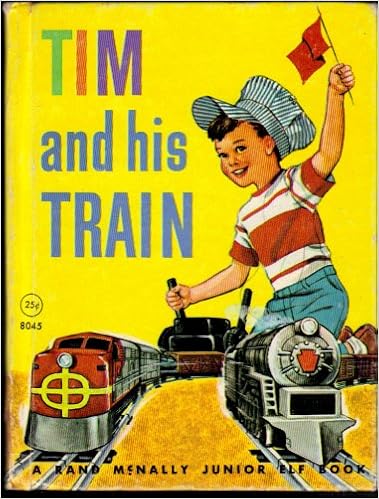
Tim and His Train

Tim and His Train. E.C. Reichert. Illustrated by Fiore Mastri. 1949. Rand McNally. 30 pages. [Source: Bought]

 First sentence: Tim loved trains. He and his Dad had just returned from a visit to the railroad yards. Tim's head was full of thoughts of streamliners, turntables, switching engines, signal towers, and all of the other interesting sights he had seen.

Premise/plot: Tim receives an electric train for his birthday. Does he love, love, love it? YES, yes he does.

My thoughts: This has a LOT of text. Dad has a LOT of information to pass along to his son before the real play can begin. At times this felt a bit like an advertisement for a toy train with a few instructions rolled in. But not necessarily in a bad way.

I am not particularly a train enthusiast myself. But I do know plenty of people in my life who are--of all ages.

I do LOVE vintage children's books. That is one reason I bought Tim and His Train. This one was originally published in 1949. I've seen it listed as 1959, but I can read Roman numerals. And I can't see how MCMXLIX could be anything other than 1949.

© 2019 Becky Laney of Young Readers

Monday, March 26, 2018

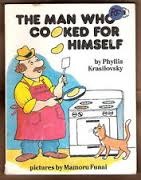
The Man Who Cooked For Himself

The Man Who Cooked For Himself. Phyllis Krasilovsky. Illustrated by Mamoru Funai. 1981. Parents Magazine Press. 42 pages. [Source: Bought]

 First sentence: There once was a man who lived with his cat in a little house on the edge of a wood. He didn't have a wife or children so he always cooked his own supper, cleaned the house by himself, and made his own bed. The man didn't even have a car or a telephone. But he had a friend who visited him every few days bringing him the things he needed.

Premise/plot: What will happen to 'the man' when his friend goes on a summer vacation for three weeks? The friend brings over one last bunch of groceries before he leaves. But will the man's list be thorough enough? long enough?

My thoughts: It's a strange little book. But a strangely charming little book at that. Is it realistic? Yes and no. When the man is hungry and desperate for food, he happens upon a pond where he can fish, wild blueberries, an apple tree, an oak tree, and some watercress. With just a paperclip and some string he catches four fish. As the story went on, the illustrations became hilarious. Readers see the man bent over picking up apples--apples stuffed into his pockets until they're bulging. The man--in the end--learns a valuable lesson about laziness--DON'T--and on how to live off the land.

Text: 3.5 out of 5
Illustrations: 3.5 out of 5
Total: 7 out of 10

© 2018 Becky Laney of Young Readers