Monday, December 15, 2025
110. A Christmas Sonata
110. A Christmas Sonata. Gary Paulsen. Illustrated by Leslie Bowman. 1992. 80 pages. [Source: Library] [3 stars][Christmas, historical, family drama]
First sentence: It comes on everybody at a certain time in their life not to believe in Santa Claus.
Premise/plot: This is a short novella for children presumably though probably not best appreciated by children. A boy and his mother travel to spend Christmas with relatives in Minnesota. His cousin is dying and this will be his last Christmas. His father is away fighting in the Second World War. He's decided that Santa is NOT real. And his cousin is also unsure if Santa is real. Both are skeptical but a tiny bit hopeful. Will he believe in Santa or not?
My thoughts: This was a strange read. On the bright side it was a very short read. I think it might work better as a Christmas special or movie. This is a bittersweet story though perhaps kids may not pick up on that as much as adults? Or maybe they would. I'm glad I read it, but, I can't imagine rereading it.
© 2025 Becky Laney of Young Readers
Monday, November 3, 2025
104. I Survived the Dust Bowl, 1935
104. I Survived the Dust Bowl, 1935. Lauren Tarshis. 2025. 144 pages. [Source: Library] [4 stars, historical fiction, series book]
First sentence: Eleven-year-old Ray Nicholson stared in horror at the massive cloud racing across the sky. It was a mountain of churning blackness that rose up thousands of feet in the air. It stretched out as far as Ray could see.
Premise/plot: I Survived the Dust Bowl, 1935, is set in the Texas Panhandle. Ray Nicholson is the protagonist. He and his friends are eye-witness to the struggles facing the community: the drought, the dust storms, dust pneumonia and other lung issues, the economy, etc. Ray is in the middle of running away from home--trying to catch a train to California--when a BIG dust storm comes that gives him a new outlook on life.
My thoughts: I liked this one well enough. I think the I Survived series--this is the twenty-fifth I believe--definitely have a time and place in libraries--public, school, classroom, and personal. Young readers often go through a phase where predictable series are EVERYTHING. Binge-reading though a beloved series is such an important stage. And I think the series as a whole is definitely good. I enjoy this series because it always includes some nonfiction back matter to supplement the story. Yet it isn't a separate companion book like another series.
© 2025 Becky Laney of Young Readers
Tuesday, April 11, 2023
87. Betsy-Tacy
Betsy-Tacy. Maud Hart Lovelace. Illustrated by Lois Lenski. 1940. 144 pages. [Source: Library]
First sentence: It was difficult, later, to think of a time when Betsy and Tacy had not been friends.
Premise/plot: Betsy meets Tacy, her new neighbor, at her fifth birthday party. The two girls become instant best friends, near sisters. These two are inseparable. They want to do everything together--always together. This book focuses on their time together--at home, at school, etc. The book concludes with the two meeting another little girl near their own age, Tb.
My thoughts: I have no memory of reading Betsy-Tacy growing up. I'd heard of the book series certainly. But if I'm honest, I thought it was literally about ONE girl named Betsy-Tacy. These books are set around the turn of the twentieth century. Yes, it was published originally in 1940...but Betsy and company would have been born in the 1890s.
The book is interesting in that it feels TIMELESS and time-specific. The two things shouldn't both be true. The book feels timeless because it captures childhood realistically--family life, friendship, thoughts and feelings about school. Some things never change. It feels time-specific because of the descriptions and illustrations. It feels delightfully historic. I like that about it.
One thing that struck me, and it's a slight spoiler, is that Tacy has a sibling--younger, I believe--die. This would have been more common during this time period. I loved how this was handled.
© 2023 Becky Laney of Young Readers
Sunday, March 26, 2023
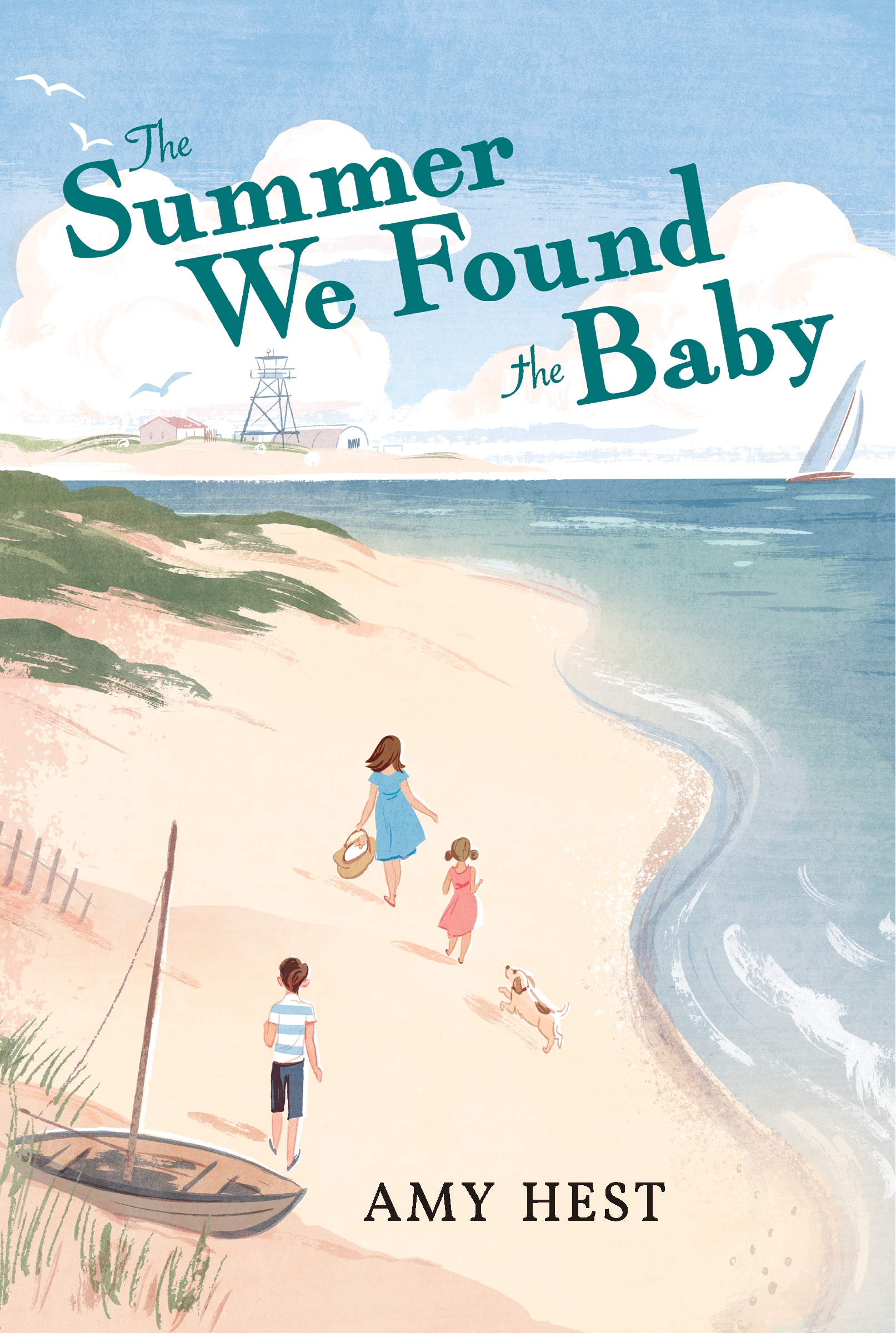
73. The Summer We Found the Baby
The Summer We Found The Baby. Amy Hest. 2020. 192 pages. [Source: Library]
First sentence: I'm the one who found her. A real, live baby girl and I saw her first. I saw the basket. Right over there, on the steps of the new children's library. A tiny little baby! All by herself in that basket! She was so brave, though. She wasn't even crying. I just wanted to hold her awhile. I didn't mean to take the baby.
Premise/plot: This children's book is set during the Second World War. It opens on a summer day--August 31. Three children (Julie and Martha Sweet, and their neighbor, Bruno Ben-Eli) find a baby in a basket on the steps of the [new] children's library. Each chapter features narration by all three--Julie, Martha, Bruno. Each chapter reveals details fleshing out their story. Everything leads to the big day--August 31. As you might have guessed, this one is not a linear or chronological story. Readers learn about the characters, the story, the setting--slowly but surely.
My thoughts: I really loved this one! I did. There were a few [subtle] moments of sadness. But nothing overwhelming or heavy. Observant readers can read behind the lines as to how the characters might be feeling. It has a great premise--children finding an 'abandoned' baby on the steps to the public library. It has dimensional characters--I really loved getting to know all three protagonists. I loved the complex relationships. Readers learn relatively early on that Bruno and Julie have fallen out; they were friends once, but no more. I love how human all these characters are. I felt empathy for all three.
© 2023 Becky Laney of Young Readers
Friday, March 3, 2023
56. Rosetown
Rosetown. Cynthia Rylant. 2018. 149 pages. [Source: Library]
First sentence: Wings and a Chair Used Books was where Flora Smallwood's mother worked three afternoons a week. Inside, it had a purple velveteen chair by the window for anyone who wanted to stay awhile, and Flora, who sometimes felt quite acutely the stress of being nine years old, and sensitive, loved this chair. Mondays, Wednesdays, and Fridays were her favorite day because of it.
ETA: I first read Rosetown in August 2021. I loved it then. I loved it now. I may have even loved it more the second time around. I definitely noticed more details the second time around. Still highly recommend this one!
Premise/plot: Flora Smallwood (9)
lives in Rosetown, Indiana--the year, 1972. She loves vintage books and
reading, and she loves hanging out with her new friend, Yury. What she
doesn't love is change--at least not too much change, too quickly.
My
thoughts: Rosetown is a character-driven book. Flora, our protagonist,
is adjusting to being a fourth grader AND to her parents separating AND
to life without her dog (Laurence). The book takes place over a school
year. The focus is on family and friends.
I loved, loved,
loved the WRITING. Rylant (one of my favorite authors) just has a way
with words. I believed in Flora's voice from the first page. By the end
of the second chapter I knew were were kindred spirits. I knew that
Flora was going to end up being a good, good friend.
Here's a quote from chapter two:
What
Flora noticed at once on the first day of fourth grade had been the
sudden confidence all the former third graders seemed to have found, and
she wondered where they had found it. Nearly all of her classmates
appeared to be taller, louder, stronger, and possessed of a sureness of
opinion that had been entirely absent the year before. The stumblers,
the wanderers, and the floaters of third grade had suddenly,
mysteriously, found their feet. They weren't afraid of school anymore.
Or maybe of anything. All of this made Flora a little shy. She missed
the uncertainty. Fortunately, a new and uncertain person had arrived in
room 22, and with him Flora was beginning to build that precious thing
called friendship. His name was Yury, which set him apart right away.
His Eastern European name, combined with the burden of being the new
boy, made Yury a very uncertain fourth-grade person indeed. He wore
large round glasses, which made him look rather owl-like. And he was
very smart, like an owl, beneath all of the new-boy uncertainty. Flora
knew this right away because he was clever....but he shared his
cleverness with only one person in fourth grade: Flora. He sat behind
her in class, so it was easy for him to whisper to the back of her head.
Yury whispered, Flora smiled, and the seeds of friendship were planted.
I highly recommend Rosetown. I loved everything about it!
© 2023 Becky Laney of Young Readers
Tuesday, February 7, 2023
29. The Secret School
The Secret School Avi. 2001. 157 pages. [Source: Library]
First sentence: On a cool Monday morning in early April 1925, Ida Bidson, aged fourteen, carefully guided her family's battered Model T Ford along a narrow, twisting dirt road in Elk Valley, Colorado. "Brake and clutch!" she shouted. Ida, only four-feet-eleven and unable to reach the floor of the car, knelt on the torn seat and gripped the steering wheel tightly. Her seven-year-old brother, Felix, hunched on the floor before her and used his hands to push the brake and clutch pedals down.
Premise/plot: Ida desperately wants the chance to go to high school. Ultimately she wants to go to "normal school" and get her teaching certificate as well. But this eighth grader may not get the chance to graduate eighth grade dashing all her future dreams. Why? Well, their current teacher is leaving abruptly--a family emergency. The school board had decided to end the term early. The two eighth graders wouldn't get a chance to take their final [final, final] exams and graduate. The two wouldn't be permitted to go on to high school the next school term. But Ida, well, she has BIG dreams. And when someone suggests that she should be their teacher for the rest of the term, well, it makes a lot of sense. It has risks, for sure. She'll be a secret teacher at a secret school. Will she get a chance to take her exam? Will she be going to high school after all?
My thoughts: I love, love, love stories of one-room schoolhouses. This one was a PERFECTLY PERFECT fit for me. I loved getting to know Ida. I loved getting to know all her classmates/students. I felt the story was fleshed out. It felt very REAL. I cared about these students and their families. I wanted more, more, more.
I don't know WHY I'm just now discovering this one. But I am super thankful I read it.
© 2023 Becky Laney of Young Readers
Tuesday, July 26, 2022
110. Endurance in Antarctica
Endurance in Antarctica (Survival Tails #2) Katrina Charman. 2018. 272 pages. [Source: Library]
First sentence: Samson panted, trying to stay cool as he kept pace with the dogs at the front of the pack. Each dog was determined to stay one step ahead of the others, trying to prove himself.
Premise/plot: The second Survival Tail book stars the [sledding] dogs for the Antarctica expedition led by Ernest Shackleton. It is narrated primarily by two dogs--Samson and Bummer. A third dog, Sally, occasionally pops in with her point of view. The novel opens in 1914--but their journey will not be a quick one, a safe one, or even remotely go according to plan. The ship, Endurance, becomes trapped/bound in sea ice--for months if not a full year. Ultimately, the ship goes down--the men do not. But what is to become of man...and beast...without a ship?
My thoughts: I have extremely mixed feelings on this one. I do. I've read up on Shackleton and the Endurance. And read up quite recently--a couple books this year alone. So I know very well what does happen to the dogs [and ship's cat]. It was not good...at all...especially from their point of view. So the author has had to lie for about eighty percent of this book. The focus is almost exclusively on the dogs. And so if you are curious about the human explorers...this isn't for you.
© 2022 Becky Laney of Young Readers
Thursday, March 17, 2022
42. The Sheep, the Rooster, and the Duck
The Sheep, the Rooster, and The Duck. Matt Phelan. 2022. 240 pages. [Source: Library]
First sentence: A carriage drawn by a single horse sped down a forest road.
Premise/plot: The Sheep, the Rooster, and the Duck is historical fantasy set in nineteenth century France. (The prologue is set in 1783, the main action occurs two years later.) In some ways, it can best be described as animal fantasy. It does star a talking sheep, rooster, and duck after all. But it is so much more than that. The animals enlist two young children--a boy and a girl--to help them battle evil, if you will. The plot centers around protecting Benjamin Franklin (who is still in France) and to some extent saving the world. So it's animal fantasy, but it's more than animal fantasy if that makes any kind of sense.
My thoughts: I wanted to love this one. I did. I thought it sounded outlandish yet perfectly delightful. Yet it remains an almost for me. I almost fell head over heels in love with the characters. I almost fell in with the logic of this one. But for whatever reason it left me puzzled and confused here and there. Not a lot. Just a tad bit here, a tiny bit there. Enough that it started to add up slowly but surely. Perhaps a second reading would help. OR perhaps if the book included a list of characters and the tiniest clues to help me keep every person well placed in my mind. I understand the book is supposed to be about possible spies and definite deceptions and possible betrayals and such. So perhaps readers are supposed to be left guessing???
I still enjoyed this one more than not. Just not wholeheartedly.
© 2022 Becky Laney of Young Readers
Monday, February 21, 2022
31. Survival in the Wilderness (Great Escapes #4)
Survival in the Wilderness (Great Escapes #4) Steven Otfinoski. 2020. 128 pages. [Source: Library]
First sentence: It was now or never. The young men reached for the cord connected to the gas valve. He gave it a sharp tug and listened as the helium in the balloon rushed out with a loud hiss.
Premise/plot: Survival in the Wilderness is a fictionalized account of three navy lieutenants--Walter Hinton, Louis Kloor, and Stephen Farrell--and their failed "routine" training flight in a hot air balloon. It is based on a true story. (The structure is true enough based on records we have, but all dialogue has been fictionalized.) The story is set in December 1920. The balloon went off course--way, way, way off course--and the balloon ended up crashing in Canada. These three would have to work together in order to survive...
My thoughts: This one is for those who love reading survival stories and/or adventure stories. The setting is the Canadian wilderness in winter. Three men battling the elements--and sometimes arguing about how to best battle the elements--and looking for any sign of civilization. As I mentioned earlier, the year is 1920. This is still the age of Arctic/Antarctic exploration. But these men weren't looking for that kind of adventure; nor were they prepared...not even slightly.
I personally found it an interesting read. I have never really given any thought to the military's use--at the times--of the hot air balloon. This was a "routine" training flight that went very, very wrong. But plenty of training flights went right. Just something to think about. This one also makes use--though this might need a trigger warning--messenger pigeons.
© 2022 Becky Laney of Young Readers
Friday, August 6, 2021
108. Rosetown
Rosetown. Cynthia Rylant. 2018. 149 pages. [Source: Library]
First sentence: Wings and a Chair Used Books was where Flora Smallwood's mother worked three afternoons a week. Inside, it had a purple velveteen chair by the window for anyone who wanted to stay awhile, and Flora, who sometimes felt quite acutely the stress of being nine years old, and sensitive, loved this chair. Mondays, Wednesdays, and Fridays were her favorite day because of it.
Premise/plot: Flora Smallwood (9) lives in Rosetown, Indiana--the year, 1972. She loves vintage books and reading, and she loves hanging out with her new friend, Yury. What she doesn't love is change--at least not too much change, too quickly.
My thoughts: Rosetown is a character-driven book. Flora, our protagonist, is adjusting to being a fourth grader AND to her parents separating AND to life without her dog (Laurence). The book takes place over a school year. The focus is on family and friends.
I loved, loved, loved the WRITING. Rylant (one of my favorite authors) just has a way with words. I believed in Flora's voice from the first page. By the end of the second chapter I knew were were kindred spirits. I knew that Flora was going to end up being a good, good friend.
Here's a quote from chapter two:
What Flora noticed at once on the first day of fourth grade had been the sudden confidence all the former third graders seemed to have found, and she wondered where they had found it. Nearly all of her classmates appeared to be taller, louder, stronger, and possessed of a sureness of opinion that had been entirely absent the year before. The stumblers, the wanderers, and the floaters of third grade had suddenly, mysteriously, found their feet. They weren't afraid of school anymore. Or maybe of anything. All of this made Flora a little shy. She missed the uncertainty. Fortunately, a new and uncertain person had arrived in room 22, and with him Flora was beginning to build that precious thing called friendship. His name was Yury, which set him apart right away. His Eastern European name, combined with the burden of being the new boy, made Yury a very uncertain fourth-grade person indeed. He wore large round glasses, which made him look rather owl-like. And he was very smart, like an owl, beneath all of the new-boy uncertainty. Flora knew this right away because he was clever....but he shared his cleverness with only one person in fourth grade: Flora. He sat behind her in class, so it was easy for him to whisper to the back of her head. Yury whispered, Flora smiled, and the seeds of friendship were planted.
I highly recommend Rosetown. I loved everything about it!
© 2021 Becky Laney of Young Readers
Saturday, July 24, 2021
86. I Survived the Sinking of the Titanic, 1912
I Survived The Sinking of the Titanic, 1912. Lauren Tarshis. Illustrated by Scott Dawson. 2010. 112 pages. [Source: Library]
First sentence: The Titanic was sinking. The gigantic ship had hit an iceberg. Land
was far, far away. Ten-year-old George Calder stood on the deck. He
shivered because the night was freezing cold. And because he was scared.
More scared than he'd ever been before.
Premise/plot: George, our young hero, is sailing with his sister, Phoebe, and his Aunt Daisy on board the Titanic. The good news? The title reassures readers that George will in fact survive to tell the tale. The bad news? Well, the other characters may or may not be so lucky. (After all, this isn't We Survived The Sinking of the Titanic.)
The book chronicles George's last day on the Titanic (well, really more like the last day and a half). During this time, he fits in a flashback with a panther. (I'm not lying).
My thoughts: I would respect the I Survived series more if they didn't try to do too much. Like fit in a flashback episode with a panther. I remember another I Survived story fitting in a flashback with a rattle snake (or possibly another kind of dangerous, poisonous snake). Because if you're in the middle of a blizzard, of course, you're going to take your mind off of it by thinking about snakes. I've only read a handful of books maybe there are more examples? Maybe these are two rare exceptions? Quite possibly I'm just not the target audience for these!
I do like the humor and lightness of this one. There's not really a sense of DREAD and DOOM. After having read a YA book where there is an overwhelming sense of dread and doom, it was a relief to take a few steps back and settle into a book where there's some comfort in knowing that the book characters aren't going to die even if they are on the Titanic.
It's not that I disliked the book or thought it awful--I didn't. I will say that ANY book (or almost any book) that gets a young person interested in both a) HISTORY and b) reading history and historical fiction is worth it. I mean that.
© 2021 Becky Laney of Young Readers
Friday, February 12, 2021
16. War and Millie McGonigle
War and Millie McGonigle. Karen Cushman. 2021. [April] 224 pages. [Source: Review copy]
First sentence: George lifted the slimy creature to his mouth and bit it right between the eyes. I’d seen him and the other Portuguese octopus fishermen do that a hundred times, but it still made me shudder. “Doesn’t that taste muddy and disgusting?” “Nah,” he said, wiping his mouth on his sleeve. “Only salty. I told you, this way he don’t die but only sleeps, stays fresh ’til he’s cooked.” George threw the octopus into a bucket and slid over to another hole in the mud.
Premise/plot: War and Millie McGonigle is a coming of age middle grade historical novel set in California in late 1941 and early 1942. Our heroine, Millie McGonigle, is struggling. Why? Perhaps the better question may be why not?!?! Her grandmother has died. Her sister, Lily, is sick and "stealing" all the attention and love of her parents. Horrible things are happening around the world. What if America enters the war? What if there are really Japanese or German spies?
Millie takes all her anxiety and directs it to her BOOK OF DEATH. Yes, this young heroine likes to make a list of the dead and/or to draw the dead she discovers. She strolls along the beach and sketches all the dead things she finds. (And she's sure to make a great first impression on all the new people she meets as she interrogates them to find out if anyone has died lately so she can record it for her book.)
My thoughts: The cover isn't nearly morbid enough to match the contents of this weird coming of age novel. (If I'm being honest I feel the cover is being intentionally deceptive.) Millie is obsessed with death. OBSESSED.
Her parents don't seem to notice how morbid their daughter has become since the grandma's death. Perhaps because authentically enough the whole family is struggling emotionally and mentally. It's the Depression. They're barely barely making enough money to get by. They eat fish every single day. And one of their daughters is sickly and always needing extra care, extra attention, extra money. Again they are broke, broke, super broke. So perhaps the fact that they're not really connected enough to notice Millie's morbidity isn't all that surprising.
So the whole book is about Millie drawing dead things (like dead dogs, dead octopi, dead flowers, etc.) and making lists of dead people.
It stays dark for so long--despite the cheerful looking cover--that when Millie does finally, finally, finally see some hope for the future....you may be out of patience.
S
P
O
I
L
E
R
This book has a disturbing BEYOND DISTURBING hideously EVIL AND WRONG chapter where her brother brings her a DEAD AND DECAYING DOG that he and his friend have dug up to bring her so that she has something new to draw for her book. Think about it. DISTURBING on so many levels. Even worse is that this is a detailed, descriptive chapter so if you have even the teeny tiniest liking for dogs you'd be disgusted, outraged, and ready to throw the book across the room.
© 2021 Becky Laney of Young Readers
Wednesday, November 18, 2020
115. Anne's School Days
Anne's School Days. Kallie George. Illustrated by Abigail Halpin. 2021. [July] 72 pages. [Source: Review copy]
First sentence: Everyone loved autumn in Avonlea. Especially Anne of Green Gables. “What a splendid day,” said Anne to Diana Barry as they walked to school. “Isn’t it good to be alive on a day like this?” Three weeks of school had gone by and, so far, Anne loved it.
Premise/plot: Anne Shirley starts school in Avonlea in the third book in Kallie George's adaptation of L.M. Montgomery's classic Anne of Green Gables. She is adapting the classic novel into an early chapter book series. The series remains true in spirit--with a little condensing, okay a lot of condensing--to the original. In this one, Anne has a few adventures and misadventures in school regarding a certain Gilbert Blythe. Will she ever forgive him for calling her Carrots???
My thoughts: LOVE. I won't try to hide my bias. I can't. It would be like me playing a game of "poor, poor kitty." (If you don't know about the game, you could read about it here.) I love, love, love, love, love, crazy love L.M. Montgomery's books. I particularly LOVE the character of Anne Shirley. And Gilbert, well, don't get me started on how much I LOVE him. I love how the book focuses on two or three incidents instead of trying to tell every single one. It keeps the pace going. (That being said, I wouldn't have minded seeing Anne's green hair make an appearance. But editing matters, and George stayed on task.)
I highly recommend this one!
Quotes:
Anne turned away and quickly forgot about Gilbert. Instead, she gazed off and started imagining. Anne loved imagining. This time, she dreamed she was a fancy lady with puffed sleeves and glossy black hair. All of a sudden, she was tugged out of her daydream. It was Gilbert. He had slid over and now he was pulling her braid! “Carrots,” he whispered. Anne froze. Anne’s red hair was her lifelong sorrow. That was the worst name Gilbert could call her. The worst name anyone could call her.
© 2020 Becky Laney of Young Readers
Saturday, November 14, 2020
113. Stranger on the Home front
Stranger on the Home Front. Maya Chhabra. 2021. [January] 160 pages. [Source: Review copy]
First sentence: Margaret Singh and her family were late, as usual. They came to Stockton from San Francisco every year for the festival, and every year they got lost somewhere between the train station and the gurdwara. Margaret’s stomach rumbled, but there wouldn’t be any food till they got there. Father stopped a couple of passersby to ask for directions. “Excuse me, do you know where the Sikh temple is?” One of the strangers looked like he was going to say something impatient, but then he caught sight of Margaret and Mother. He looked at them curiously, as if putting two and two together—Father, the clean-shaven East Indian, wearing a hat rather than a turban; Mother, the white woman; and Margaret, their daughter. Margaret had watched people go through this process a thousand times. A man from India with a white wife was an unusual sight in California.
Premise/plot: Stranger on the Home Front is historical fiction; it is set in California roughly 1916 through 1918 or possibly 1919. The heroine, Margaret, is the daughter of an Indian immigrant. Her father strongly desires independence for India. But how far will he go to support a revolution or break from British rule? The book isn't solely about her father's dream for India. Largely it is about Margaret's desire to truly belong--just as she is--within her community, her school, her country.
Margaret has a best friend, Bettina, is of German descent and things are getting rough for her as well.
My thoughts: I enjoyed this one. It does bring back memories of the Dear America series. (I think this is a good thing.) It is set during World War I. (The two world wars are of special interest to me). I like the focus on home life and school life. It does include a glossary at the beginning of the novel.
© 2020 Becky Laney of Young Readers