Showing posts with label children's classic. Show all posts

Monday, January 5, 2026

1. The Animals of Farmer Jones


1. The Animals of Farmer Jones. Leah Gale. Illustrated by Richard Scarry. 1942. 32 pages. [Source: Bought, 4 stars, Golden Books, children's classic, farm stories]

First sentence: It is supper time on the farm. The animals are very hungry. But where is Farmer Jones?

Premise/plot: The Animals of Farmer Jones is a classic Little Golden Book. This one was originally published in 1942. Half the book is spent visiting ALL the animals on the farm--every one must make its sound after all--who want to know where Farmer Jones is. The other half of the book focuses on Farmer Jones visiting ALL the animals and feeding them.

My thoughts: Is this the most thrilling farm book? Perhaps it isn't. But it has all the elements you'd expect: a wide variety of farm animals, all the animal sounds, repetition of the text, predictability. The illustrations are by Richard Scarry. They are fabulous illustrations.

If reading about farm animals is part of your life now as a parent, a grandparent, a guardian, then you might as well read a few classics as well.

© 2026 Becky Laney of Young Readers

Wednesday, June 4, 2025

58. The Monster at the End of the Book


58. The Monster At The End of This Book. Jon Stone. Illustrated by Michael J. Smollin. 1971. Golden Books. 32 pages. [Source: Bought]

First sentence: What did that say? On the first page, what did that say? Did that say there will be a Monster at the end of this book? It did? Oh, I am so scared of Monsters!!!

Premise/plot: Grover does NOT, I repeat does NOT, want you to keep reading this book. Grover tries--but will he fail?!--to keep readers from turning pages. Is there really a monster at the end of the book?

My thoughts: This one is a classic for a reason. It is a FUN, DELIGHTFUL, SILLY read for parents to share with little ones. It is a great example of an again-again book--a book that almost begs you to read it again and again and again and again. Does one ever tire of Grover?

Text: 5 out of 5
Illustrations: 4 out of 5
Total: 9 out of 10


© 2025 Becky Laney of Young Readers

Wednesday, April 23, 2025

40. The Saggy Baggy Elephant


40. The Saggy Baggy Elephant. Kathryn and Byron Jackson. Illustrated by Gustav Tenggren. 1947. 24 pages. [Source: Library] [5 stars, picture book, golden book, children's classic]

First sentence: A happy little elephant was dancing through the jungle. He thought he was dancing beautifully, one-two-three-kick. But whenever he went one-two-three, his big feet pounded so that they shook the whole jungle. And whenever he went kick, he kicked over a tree or a bush.

Premise/plot: Sooki, an elephant, LOVES to do his one-two-three kick. The other animals, however, not so much loving it. In fact, their words--intentional or not--discourage him in many ways by their critical nature. He begins to feel like he doesn't quite belong. What joy when he finds other elephants who are just like him!

My thoughts: I love this one. I can't believe I've never reviewed it before! I definitely grew up with this classic Little Golden Book.


© 2025 Becky Laney of Young Readers

Sunday, July 16, 2023

185. Space Cat Visits Venus


Space Cat #2: Space Cat Visits Venus. Ruthven Todd. Illustrated by Paul Galdone. 1955. 87 pages. [Source: Library] [Chapter book; Vintage; Classic]

First sentence: Flyball was the only cat in Luna Port, the first city built on the Moon. He was the only cat on the whole Moon. And he was a famous cat, for with his friend Captain Fred Stone, now Colonel Stone, he had travelled on the first rocket ever to go from Earth to the Moon.

Premise/plot:  Flyball (the cat) and Colonel Fred Stone (the human) are the first to travel to Venus in this early chapter book originally published in 1955. In the first book, these two become the first to travel to the Moon. In fact, these two now live on the Moon--at least part time. But now in this second book, they are getting ready for more firsts. The rocket that will send them to Venus is being built on the Moon. And soon these two will be on their way. What will they find?

My thoughts: I was so disappointed in this second book. I found the first book charming enough. I did. This second one was slightly duller than I'd prefer. What they find on Venus is plants, plants, and more plants. Granted some of these plants are highly evolved and communicative. There's one that can read thoughts, for example. But at the end of the day, the two are just essentially looking at a lot of exotic space plants. Flyball also seems less cat-like in this one. Perhaps because the first book started with him being just a normal, super-curious cat that happened to wander into Fred Stone's life and just happened to become a space-travelling kitty. The origin story works for me better than this.


© 2023 Becky Laney of Young Readers

Monday, July 10, 2023

164. A Doll for Marie


A Doll for Marie. Louise Fatio. Illustrated by Roger Duvoisin. 1957/2015. 32 pages. [Source: Library] [Picture Book, Classic]

First sentence: In the city of Paris, there lived a doll who sighed from morning to night. She was born long ago, when our great-grandmothers lived. She wore a handsome dress of faded red silk, with long lace pantalets that came down to her pretty shoes, and a plumed hat on her blond curls. She was indeed a precious antique doll. But, alas, she was also a very lonely doll. 

Premise/plot: A [nameless] doll lives at an antique shop. She longs to belong to a girl--to be loved, cherished, treasured, played with. There is one such girl in the neighborhood, Marie, but both doll and girl know this isn't to be. She's much too "valuable" to be purchased by a poor girl. She's purchased--by someone to be an antique showpiece...but it is thanks to some mischievous pets that this doll finds her forever home with Marie.

My thoughts: I thought the story was charming and delightful in an old-fashioned, vintage way. This one was first published in the 1950s. It is a bit on the text heavy side. But as an adult, of course, I don't mind a bit. I don't know if today's generation is much interested in porcelain dolls. But I enjoyed this one very much.


© 2023 Becky Laney of Young Readers

Friday, May 12, 2023

107. Great Mouse Detective: Basil of Baker Street


Basil of Baker Street. (Great Mouse Detective). Eve Titus. 1958. 113 pages. [Source: Library]

First sentence:  The mystery of the missing twins could never have been solved by an ordinary detective. But Basil, of course, was far from ordinary.

Premise/plot: Basil and Dr. David Q. Dawson share a house with Sherlock Holmes. Basil, the great detective, is a mouse who learns from the best of the best. Dr. David Q. Dawson is his sidekick, his Watson, if you will. In this early chapter book--illustrated, of course, the two solve the case of two missing children--Agatha and Angela. This is a case that will put them in some degree of danger--particularly from owls--but they will stay on the case and follow all the clues...

My thoughts: I enjoyed this one. I think I would have probably loved it even more as a kid. It just LOOKS like a delightful, fun, animal fantasy. (And fortunately, it is nothing like Stuart Little.) As an adult, I do have a few questions as to how this mouse society works. The infrastructure between the human world and the mouse world--I've got questions. It makes sense that his mouse city would all be housed either in the basement or the attic of Sherlock Holmes' place, but, I'm not sure HOW he gets around to all the places he gets. And I think there's even trains? I don't know. The more I thought about this one, the more questions I had. But it was in some ways just a delight.


© 2023 Becky Laney of Young Readers

Thursday, April 13, 2023

90. Caps for Sale

Caps for Sale. Esphyr Slobodkina. 1940. 48 pages. [Source: Childhood Copy]

First sentence: Once there was a peddler who sold caps. But he was not like an ordinary peddler carrying his wares on his back. He carried them on top of his head. First he had on his own checked cap, then a bunch of gray caps, then a bunch of brown caps, then a bunch of blue caps, and on the very top a bunch of red caps.

Premise/plot: One morning--after having no luck selling his caps--he decides to take a detour, a walk in the country. This leads to a nap, of course! While under a tree--sleeping--some naughty monkeys steal almost all of his caps!!! Can the peddler outsmart the monkeys?

My thoughts: My mom loved to read this one aloud!!! She did a great job voicing the angry peddler yelling at the monkeys! It's a fun book and very silly.


© 2023 Becky Laney of Young Readers

Tuesday, April 11, 2023

87. Betsy-Tacy


Betsy-Tacy. Maud Hart Lovelace. Illustrated by Lois Lenski. 1940. 144 pages. [Source: Library]

First sentence: It was difficult, later, to think of a time when Betsy and Tacy had not been friends.

Premise/plot: Betsy meets Tacy, her new neighbor, at her fifth birthday party. The two girls become instant best friends, near sisters. These two are inseparable. They want to do everything together--always together. This book focuses on their time together--at home, at school, etc. The book concludes with the two meeting another little girl near their own age, Tb.

My thoughts: I have no memory of reading Betsy-Tacy growing up. I'd heard of the book series certainly. But if I'm honest, I thought it was literally about ONE girl named Betsy-Tacy. These books are set around the turn of the twentieth century. Yes, it was published originally in 1940...but Betsy and company would have been born in the 1890s. 

The book is interesting in that it feels TIMELESS and time-specific. The two things shouldn't both be true. The book feels timeless because it captures childhood realistically--family life, friendship, thoughts and feelings about school. Some things never change. It feels time-specific because of the descriptions and illustrations. It feels delightfully historic. I like that about it.

One thing that struck me, and it's a slight spoiler, is that Tacy has a sibling--younger, I believe--die. This would have been more common during this time period. I loved how this was handled. 

© 2023 Becky Laney of Young Readers

Monday, April 10, 2023

86. Horton Hatches the Egg


Horton Hatches The Egg. Dr. Seuss. 1940/1968. Random House. 64 pages. [Source: Library]

First sentence:

Sighed Mayzie, a lazy bird hatching an egg:
"I'm tired and I'm bored
And I've kinks in my leg
From sitting, just sitting here day after day.
It's work! How I hate it!
I'd much rather play!
I'd take a vacation, fly off for a rest
If I could find someone to stay on my nest!
If I could find someone, I'd fly away--free..."

Plot/Premise: Mayzie does not want to hatch her own egg. So Horton, the elephant, steps in and does the job for her. It isn't that he loves the work either. But..."an elephant's faithful one-hundred percent!" He said that he'd take care of the egg, and he will. Because he always means what he says and says what he means. He's faithful through and through. What will happen when the egg hatches? Will Horton's steadfastness be rewarded?

My thoughts: I love this one. I do. I have loved this one since childhood. I'm not sure I could choose which Horton book I like best: Horton Hatches an Egg or Horton Hears a Who. Both illustrate great lessons. I don't mind the lessons so much in either one of these!

His previous book, The King's Stilts, was about balancing work and play. And again, we see those themes at work in Horton Hatches An Egg. Mayzie is an incredibly selfish and lazy bird. She tricks the good-hearted Horton into sitting on her nest and hatching her egg. She lies to him as well, promising that she'll only be gone for a short amount of time, she has every intention of coming back soon. Horton is a great contrast. He endures much, suffers much. But he's calm and steadfast. He's diligent and faithful--disciplined. 

I never noticed in my childhood HOW LONG Horton is sitting on that egg! At least three--if not all four seasons--go by! That is quite a LONG wait. I don't imagine that it is at all realistic for any species of bird. Of course, it didn't take away the enjoyment of the story.

I love the surprise ending. Do you?

Have you read Horton Hatches An Egg? Did you like it? love it? hate it? Do you prefer it to Horton Hears A Who? Or do you--like me--love both books almost equally? I'd love to hear your thoughts!


© 2023 Becky Laney of Young Readers

85. Pat the Bunny


Pat the Bunny. Dorothy Kunhardt. 1940. 18 pages. [Source: Library]

First sentence: Here are Paul and Judy. They can do lots of things. You can do lots of things, too.

Premise/plot: Pat the Bunny is an interactive book for very young children. It was originally released in 1940. I don't know how many other books for VERY young children existed at the time. (Certainly not as many as there are in recent decades). But this is one of the books from 1940 that has lived on, if you will, from its original publication and become somewhat iconic. (Though perhaps less so these days? I know it was iconic in my own childhood.)

Judy and Paul do "lots" of things. "Judy can pat the bunny. Now YOU pat the bunny." Judy can play peek-a-boo with Paul. Now YOU play peek-a-boo with Paul. Paul can smell the flowers. Now YOU smell the flowers."

My thoughts: Pat the Bunny is one of the books I remember my mom reading to me. I could NOT find my own copy--perhaps long destroyed????--for the purposes of review. Though it has been decades since I last read Pat the Bunny, I remembered more than half the activities. I think, for some generations at least, this book is iconic. I'm not sure it is *still* iconic for the past few generations. Is this still being bought and read today? Has it been replaced with other board books, other interactive books in the past fifteen to twenty years? Perhaps. I don't know. I know that Guess How Much I Love You and Love You Forever are certainly become icons. Goodnight Moon--an older title--is still an ever-present icon. 

This one is a spiral bound interactive, "activity" book. I haven't heard any outlandish stories about it being canceled, but, honestly it wouldn't shock me if there was someone out there somehow, somewhere who could find reasons to take offense at this one.


© 2023 Becky Laney of Young Readers

Sunday, February 12, 2023

40. Space Cat


Space Cat. Ruthven Todd. Illustrated by Paul Galdone. 1952. 80 pages. [Source: Library]

First sentence: The little gray kitten had always been the most adventurous member of his family. He had been the first to explore the roof of the apartment building where he lived with his brothers and sisters. There he had sat for hours admiring the face of the Cat in the Moon until his mother had dragged him in by the scruff of his neck. The next day he had managed to maroon himself on top of the flagpole on the roof and the Fire Department had had to be called to take him down.

Premise/plot: When a [cute, adorable, super-curious] gray kitten befriends Captain Fred Stone, he gets a new name, "Flyball," a new home, and new adventures. Flyball accompanies his human to the moon and back. Their adventure on the moon isn't without some peril--good thing Flyball is there to save the day. 

My thoughts: This charming little book was written in 1952. It is always interesting/intriguing to see how the public [writers, readers] imagined space exploration to be like. This one was written, published, and enjoyed long before NASA sent anyone to the moon--or even into orbit. This qualifies both as science fiction and fantasy. It is told through the perspective of the cat. There are plenty of men [military men] talking rockets, rockets, and more rockets. 

I enjoyed this one. The illustrations are wonderful.


© 2023 Becky Laney of Young Readers

Sunday, February 5, 2023

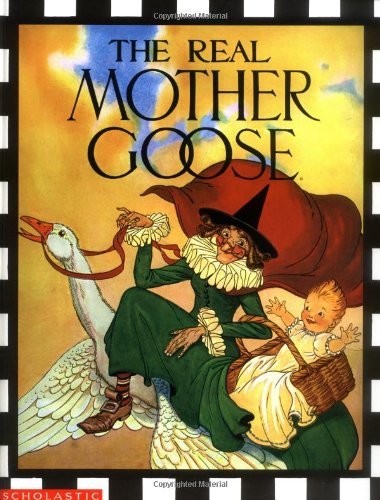
27. The Real Mother Goose


The Real Mother Goose. Illustrated by Blanche Fisher Wright. 1916. 128 pages. [Source: Library]

First sentence: Little Bo-Peep has lost her sheep. And can't tell where to find them; Leave them alone, and they'll come home, and bring their tails behind them.

Premise/plot: This Mother Goose collection was originally published in 1916. Its cover (and interior illustrations) are recognizable by generations. There are hundreds of poems/verses. 

My thoughts: I enjoyed reading The Real Mother Goose. While I was familiar with some of the Mother Goose rhymes, there were so many that were new to me. The rhymes do vary in quality and relevance. (I'm not sure little ones need to be familiar with each and every poem in this collection in order to "know" their Mother Goose properly). Here are a few of my favorites:

The Tarts
The Queen of Hearts,
She made some tarts,
All on a summer's day;
The Knave of Hearts,
He stole the tarts,
And took them clean away.
The King of Hearts
Called for the tarts,
And beat the Knave full sore;
The Knave of Hearts
Brought back the tarts,
And vowed he'd steal no more. (107)
Sing a Song of Sixpence
Sing a song of sixpence,
a pocket full of rye;
Four-and-twenty blackbirds
Baked in a pie!
When the pie was opened
The birds began to sing;
Was not that a dainty dish
To set before the king?
The king was in his counting-house
Counting out his money;
The queen was in the parlor,
Eating bread and honey.
The maid was in the garden,
Hanging out the clothes;
When down came a blackbird
And snapped off her nose. (62)
The Bunch of Blue Ribbons
Oh, dear what can the matter be?
Johnny's so long at the fair.
He promised to buy me a bunch of blue ribbons,
To tie up my bonny brown hair. (127)
Do you have a favorite Mother Goose rhyme?


© 2023 Becky Laney of Young Readers

Sunday, January 22, 2023

16. Cornelli


Cornelli. Johanna Spyri. 1892. 120 pages. [Source: Bought]

First sentence: Spring had come again on the banks of the Iller-Stream, and the young beech trees were swaying to and fro. One moment their glossy foliage was sparkling in the sunshine, and the next a deep shadow was cast over the leaves. A strong south wind was blowing, driving huge clouds across the sun.

Premise/plot: Cornelli Hellmut is an easy-going, pleasant daughter until her father goes away on an extended business trip leaving his cousin, Kitty Dorner, and another young woman, Miss Grideelen, to "educate" Cornelli. He returns to find Cornelli radically changed--and not for the better. He's puzzled, but thinks the solution is to send her away to boarding school. Dear, kind, loving Martha is a godsend. She is able to talk a little sense into both of them....

So Martha--dear that she is--let her spare room to a (sick) city boy, Dino Halm. (This was while Director Hellmut was away on business).  Dino and Cornelli become good friends despite a less than great first impression. So soon after her father's return, he receives a letter from Dino's mother requesting Cornelli come for a visit. (This is the kind of visit that happened on Gilligan's Island, not really, but still). 

When father and daughter are reunited--about eighteen months later???--he's in for a big surprise. (But this time a good one). 

My thoughts: I absolutely love, love, love Dino's family--his mom, Agnes, Niko, and Mux. I really like Cornelli. I did love Martha. So many of the characters just felt like FRIENDS within a short period of time. 

The story is old-fashioned certainly. It was originally published in 1892. It definitely has Christian themes and values. But I don't think it is as insufferable as it could have been. (I'll try to explain). The book that comes to mind is Elsie Dinsmore by Martha Finley. It is NOT as insufferable as that. (I made it through the first book and part of the second book). To clarify, having Christian themes and values does not make it automatically insufferable. It doesn't. But I think characters have to be developed (they are) and the dialogue has to be strong (it is). 

The book does have a tied in a neat bow ending. (I don't mind). There are some characters that are absolutely clueless and you wonder how they function at life. (The dad). There are some characters that you just want to yell and scream at (like the cousin and her friend). But I found it an engaging read. Definitely glad I read this one.

© 2023 Becky Laney of Young Readers

Sunday, January 8, 2023

8. Lyle, Lyle, Crocodile


Lyle, Lyle, Crocodile. Bernard Waber. 1965. 48 pages. [Source: Library]

First sentence: This is the house. The house on East 88th Street. Mr. and Mrs. Primm and their son Joshua live in the house on East 88th Street. So does Lyle. Listen: Swish, swash, splash, swoosh! That's Lyle... Lyle the Crocodile.

Premise/plot: Lyle, Lyle, Crocodile is the second book in the picture book series by Bernard Waber. Lyle's adventures and misadventures continue. The main 'story' of this one is the one-sided conflict with their neighbors--Mr. Grump and his cat Loretta. It is a BIG conflict. No matter how much Lyle wants to make friends, well, these two aren't having it. Mr. Grump even manages to have Lyle taken away to the zoo!!!! Will Lyle ever be reunited with his family????

My thoughts: I love and adore this one!!!! I do. It is such an AWESOME read. I enjoyed the first book. I did. But this one had me at hello. It was packed with action and adventure. The plot shares some similarities with the recent movie, however, it has some major differences as well. [Perhaps the powers that be thought it was too melodramatic how Lyle is finally able to make friends with the Grumps.] 

I highly recommend this one. It's never too late to go back and read picture books you may have missed out on. And of course, if you grew up with Lyle the Crocodile, it may be time to revisit these.


© 2023 Becky Laney of Young Readers

Saturday, January 7, 2023

7. The House on East 88th Street


The House on East 88th Street. Bernard Waber. 1962. 48 pages. [Source: Library]

First sentence: This is the house. The house on East 88th Street. It is empty now, but it won't be for long. Strange sounds come from the house. Can you hear them? Listen: Swish, swash, splash, swoosh...

Premise/plot: The Primm family is moving into the house on East 88th Street. [Mr. and Mrs. Primm and their son, Joshua]. What should they discover in their house???? Lyle, Lyle crocodile! Though the family is at first a bit shocked and confused, it's soon the new normal. OF COURSE the crocodile belongs there! Of course, he's just going to fit right in--not only with them as a family, but with the whole neighborhood, the city. 

This is the origin story of Lyle, Lyle Crocodile. We meet Hector P. Valenti who seems to come and go in Lyle's life. In this first story, after making great friends with the Primm family, he is rushed away by Valenti...but the life of fame is not agreeable....not really. 

My thoughts: I recently watched the film Lyle, Lyle Crocodile. I had not--to my recollection--read any of the Lyle books growing up. [Though it's entirely possible that I had them read to me at a young age--from the library--and have just forgotten.] I would say the movie blends the plot of House on East 88th Street and Lyle, Lyle Crocodile. It also connects the dots and fills in the blank. The picture books do not necessarily start at the beginning of Lyle's story. It begins with the Primm family moving in. The movie is all Lyle's story. 

I enjoyed this one very much. I especially loved the art.


© 2023 Becky Laney of Young Readers

Thursday, January 5, 2023

5. The Milly-Molly-Mandy Storybook.


The Milly-Molly-Mandy Storybook. Joyce Lankester Brisley. 1928. 224 pages. [Source: Library]

First sentence: Once upon a time there was a little girl. She had a Father, and a Mother, and a Grandpa, and a Grandma, and an Uncle, and an Aunty; they all lived together in a nice white cottage with a thatched roof.

Premise/plot: Milly Molly Mandy stars in a collection of stories. This book was originally published in 1928. There are other Milly Molly Mandy books. The stories--at least in this initial collection--are episodic. Each story stands more or less on its own. It features (relatively) the same cast of characters: her immediate family (see above) and her friends Toby and Susan. 

The stories in this collection:

  • Milly-Molly-Mandy Goes Errands (I would personally say go ON errands, but the table of contents says otherwise)
  • Milly-Molly-Mandy Spends a Penny
  • Milly-Molly-Mandy Meets Her Great-Aunt
  • Milly-Molly-Mandy Goes Blackberrying
  • Milly-Molly-Mandy Goes to a Party
  • Milly-Molly-Mandy Enjoys a Visit
  • Milly-Molly-Mandy Goes Gardening
  • Milly-Molly-Mandy Keeps Shop
  • Milly-Molly-Mandy Gives A Party
  • Milly-Molly-Mandy Gets to Know Teacher
  • Milly-Molly-Mandy Goes to a Fete
  • Milly-Molly-Mandy Has A Surprise
  • Milly-Molly-Mandy Goes to A Concert
  • Milly-Molly-Mandy's Mother Goes Away
  • Milly-Molly-Mandy Goes to the Sea
  • Milly-Molly-Mandy Minds a Baby
  • Milly-Molly-Mandy Goes on an Expedition
  • Milly-Molly-Mandy Helps to Thatch a Roof
  • Milly-Molly-Mandy Keeps House
  • Milly-Molly-Mandy and the Blacksmith's Wedding
  • Milly-Molly-Mandy Has a New Dress

My thoughts: I enjoyed this one thoroughly. I did. It is old-fashioned for sure. These stories are like licks on a lollipop. I don't know that any one story stands out as wow or amazing. But taken together there is something satisfying about spending time with Milly-Molly-Mandy. I'm not sure how much appeal this character will have for young children or children. Perhaps if introduced to the stories by someone who passionately loves these characters, these books, and takes the time to pass on the tradition???

This is a book that I [and probably plenty of other adults] could imagine being read by their grandparents when they were little. And that adds an element of sentimentality perhaps. 

© 2023 Becky Laney of Young Readers

Monday, August 8, 2022

126. Richard Scarry's 5 Minute Stories


Richard Scarry's 5 Minute Stories. Richard Scarry. 2022. [May] 160 pages. [Source: Library]

First sentence: Huckle and Lowly got out of bed.

There are many, many themed books in the 5 Minute Stories series. I typically don't seek them out for review. (For better or worse. Maybe I've been judging too many books by their covers.) But when I saw this book of RICHARD SCARRY stories, well, I knew I needed to read it. (I grew up on Richard Scarry). 

These are not new stories. Just a new arrangement of previously published stories. But I wasn't mad about it. Not at all. 

The stories in this collection are:

  • The Busy Day
  • Pig Will and Pig Won't
  • A Visit with Tillie
  • Sergeant Murphy's Safety Rules
  • Dolly's Birthday Party
  • Lowly Worm's Horrid Pests
  • Good Friends and Neighbors
  • A Day at the Fire Station
  • A Day at the Police Station
  • Postman Pig and His Busy Neighbors
  • The Pig Family
  • Going Shopping
  • Corn on the Cob
  • Guess Who?
  • The Birthday Party
  • Pig Won't's Decision
  • Sergeant Murphy and the Banana Thief
  • Ma Pig's New Car

Pig Will and Pig Won't get a LOT of time. There are so many different stories focused on Pig Will and Pig Won't. And the stories seem very repetitive and same-same. If I was reading this aloud to a child--say at bedtime--there's enough time between Pig Will and Pig Won't stories that it wouldn't be a big deal. And the stories are enjoyable--just very repetitive. 

I definitely LOVED, loved, loved some of these stories. Some of them are hilarious. I really enjoyed a Day at the Fire Station and Ma Pig's New Car. 

© 2022 Becky Laney of Young Readers

Friday, December 17, 2021

180. Mr. Willowby's Christmas Tree


Mr. Willowby's Christmas Tree. Robert E. Barry. 1963. Random House. 32 pages. [Source: Library]

Mr. Willowby's Christmas tree came by special delivery. Full and fresh and glistening green--the biggest tree he had ever seen. He dashed downstairs to open the door--This was the moment he'd waited for.

I loved, loved, loved Mr. Willowby's Christmas Tree. It celebrates giving in a fun and playful way. Mr. Willowby starts off a long chain of giving when he chops off the top of his too-tall Christmas tree. A tree that is splendid in every other way. He gives the tree-top to the upstairs maid. She's delighted. Very delighted. How thoughtful! How cheery! But the tree is too-tall for her small room. The top must go! Chances are you can predict at this point how the story will go. But that doesn't mean it is in any way less delightful. This little tree-top gets passed down and re-trimmed again and again and again and again and again. And it's just WONDERFUL to see how much happiness and cheer it brings to others.

I loved the premise. I loved the writing. The rhyming was delightful. It worked very well for me! I think this one would make a great read-aloud. I also loved how uplifting it is. (After reading Baboushka and the Three Kings, I needed a cheery story!)

Why didn't someone tell me about this wonderful and charming picture book?! Why?! Well, I am glad to have discovered it now!

Which Christmas books would you consider classic? Which would you recommend?


© 2021 Becky Laney of Young Readers

Friday, December 3, 2021

172. A Chair for My Mother


A Chair for My Mother (Rosa Books #1) Vera B. Williams. 1982. 32 pages. [Source: Library]

First sentence: My mother works as a waitress in the Blue Tile Diner. After school sometimes I go to meet her there. Then her boss, Josephine, gives me a job too. I wash the salts and peppers and fill the ketchups. One time I peeled all the onions for the onion soup. When I finish, Josephine says, "Good work, honey," and pays me. And every time, I put half of my money into the jar.

Premise/plot: Rosa and her family (mother, grandmother) save up their coins in a jar so they can buy a chair. I believe this is after a previous fire destroyed their home.

My thoughts: I remember--vaguely--A Chair For My Mother being a Reading Rainbow book. I'm not sure when I first read it for myself. But every now and then I'll be in a mood to seek out the story again.

In many ways, it is a simple story. The family is hard-working and patient. Filling the jar will not be quick and easy. Every day the family looks ahead to the goal--the day the jar will have enough money so they can go together and pick out a chair. The mindset in some ways is so different from the "modern" or "contemporary" [entitled] outlook of if I want it, I'll buy it NOW. And this is something that is actively encouraged, buy it TODAY, pay for it later. It is always refreshing to pick this one up. 

I also love the subtle [and simple] celebration of family.


© 2021 Becky Laney of Young Readers
Friday, August 6, 2021

107. Mr. Brown Can Moo! Can You?


Mr. Brown Can Moo! Can You? Dr. Seuss. 1970. 32 pages. [Source: Library]
 

First sentence:  Oh, the wonderful things Mr. Brown can do! He can go like a cow. He can go MOO MOO. Mr. Brown can do it. How about you?

Premise/plot: Mr. Brown knows so many wonderful noises. But do you? Mr. Brown shows little readers all the noises he can make, and, he challenges them to copy him.

My thoughts: This is one of my all-time favorite, favorite, favorite Dr. Seuss books. If I am ever harsh, cruel, or mean in one of my reviews about a rhyming picture book, blame Dr. Seuss. Well, the school of Dr. Seuss anyway. (I also love, love, love, love HAND, HAND, FINGERS, THUMB by Al Perkins.)

There are differences between the book-book and the board book of Mr. Brown Can Moo! Can You? Just something to keep in mind. 

And completely off topic, Mr. Brown certainly looks a lot like Mr. Noodle from Elmo's World.

© 2021 Becky Laney of Young Readers