Showing posts with label classic children's books. Show all posts

Sunday, January 22, 2023

16. Cornelli


Cornelli. Johanna Spyri. 1892. 120 pages. [Source: Bought]

First sentence: Spring had come again on the banks of the Iller-Stream, and the young beech trees were swaying to and fro. One moment their glossy foliage was sparkling in the sunshine, and the next a deep shadow was cast over the leaves. A strong south wind was blowing, driving huge clouds across the sun.

Premise/plot: Cornelli Hellmut is an easy-going, pleasant daughter until her father goes away on an extended business trip leaving his cousin, Kitty Dorner, and another young woman, Miss Grideelen, to "educate" Cornelli. He returns to find Cornelli radically changed--and not for the better. He's puzzled, but thinks the solution is to send her away to boarding school. Dear, kind, loving Martha is a godsend. She is able to talk a little sense into both of them....

So Martha--dear that she is--let her spare room to a (sick) city boy, Dino Halm. (This was while Director Hellmut was away on business).  Dino and Cornelli become good friends despite a less than great first impression. So soon after her father's return, he receives a letter from Dino's mother requesting Cornelli come for a visit. (This is the kind of visit that happened on Gilligan's Island, not really, but still). 

When father and daughter are reunited--about eighteen months later???--he's in for a big surprise. (But this time a good one). 

My thoughts: I absolutely love, love, love Dino's family--his mom, Agnes, Niko, and Mux. I really like Cornelli. I did love Martha. So many of the characters just felt like FRIENDS within a short period of time. 

The story is old-fashioned certainly. It was originally published in 1892. It definitely has Christian themes and values. But I don't think it is as insufferable as it could have been. (I'll try to explain). The book that comes to mind is Elsie Dinsmore by Martha Finley. It is NOT as insufferable as that. (I made it through the first book and part of the second book). To clarify, having Christian themes and values does not make it automatically insufferable. It doesn't. But I think characters have to be developed (they are) and the dialogue has to be strong (it is). 

The book does have a tied in a neat bow ending. (I don't mind). There are some characters that are absolutely clueless and you wonder how they function at life. (The dad). There are some characters that you just want to yell and scream at (like the cousin and her friend). But I found it an engaging read. Definitely glad I read this one.

© 2023 Becky Laney of Young Readers

Monday, March 16, 2020

40. The Bully of Barkham Street

The Bully of Barkham Street. Mary Stolz. 1963. 208 pages. [Source: Library] [j realistic fiction; realistic fiction; friendship; school; bullying]

First sentence: Martin Hastings wriggled at his desk.

Premise/plot: Readers perhaps first met Martin Hastings in Stolz’s The Dog on Barkham Street. The Bully of Barkham Street is a companion novel told from a different character’s point of view.

Martin is an unhappy boy who is constantly being picked on by teachers, his sister, his parents. Everyone has a problem with him. Everyone thinks he’s the problem. And that’s a problem. He’s caught in a pattern, a cycle. He doesn’t like it, but doesn’t know how to end it.

Edward Frost, the boy next door, teases him, calls him names, insults him every single time they see each other. There’s no getting away from it. Why can’t Eddie just stop.

Martin hates everything about his life. He decides quite wisely that he can only change himself. He cannot make other people see him differently, treat him differently....but he can change his own behavior and attitude and hope that someone will eventually see that he’s changed.

My thoughts: I loved this one. I just loved it. It made me love Martin. I liked seeing him redeemed. I liked seeing his view of some of the same events. I wanted to yell at his parents a few times, more than a few times. But the truth is, all the characters are human. It would not be much of a stretch to believe that there are reasons they behave the way they do. They may be just as unhappy in their cycle of yelling, fussing, being stressed and frustrated. Perhaps they want to run away from themselves too.


© 2020 Becky Laney of Young Readers

Tuesday, September 10, 2019

Sam the Minuteman

Sam the Minuteman. Nathaniel Benchley. Illustrated by Arthur Lobel. 1969. 64 pages. [Source: Library]

First sentence: About two hundred years ago a boy named Sam Brown lived with his parents on a farm in Lexington, Massachusetts, near Boston.

Premise/plot: This one is about the start of the American Revolution; it depicts the conflict between the British soldiers stationed in Boston and the American minutemen. Sam Brown is a boy who follows in his father’s footsteps fighting side by side with his dad. It is told from the perspective of youth and innocence.

My thoughts: This I Can Read book is illustrated by Arnold Lobel. That is initially what drew me to choosing this one from the library shelf. I enjoy history. Almost always have. The narrative is not super engaging from a modern perspective. It is a little dry. But the illustrations are classic Lobel. I am glad I read this one.

© 2019 Becky Laney of Young Readers

Tuesday, April 16, 2019

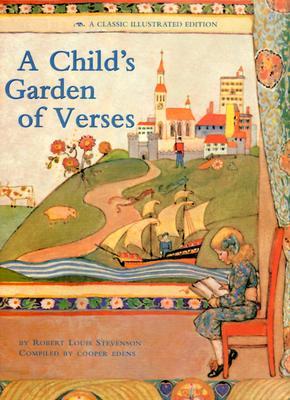
A Child's Garden of Verses

A Child's Garden of Verses. Robert Louis Stevenson. 1885. 67 pages. [Source: Bought]

First sentence:
"Bed In Summer"
In winter I get up at night
And dress by yellow candlelight.
Premise/plot: A Child's Garden of Verses is a collection of children's poems by Robert Louis Stevenson. Some of his best poems are often featured in other collections that have been published through the decades. Even if you've never "read" this one in its entirety, chances are you'll be familiar with a handful of these poems. For example, "My Shadow," and "The Swing."

My thoughts: This is one of my mom's favorites. I recently handed her a copy of Kidnapped to read. She told me that her FAVORITE Stevenson book was A Child's Garden of Verses. She then proceeded to start quoting lines from five or six different poems.

I liked this one. I definitely found myself loving one or two of these poems. Not all of the poems hold up well. (I speak of the poem entitled "Foreign Children.") But plenty of his poems are still worth reading.
Picture Books in Winter
Summer fading, winter comes--
Frosty mornings, tingling thumbs
Window robins, winter rooks,
And the picture story-books.

Water now is turned to stone
Nurse and I can walk upon;
Still we find the flowing brooks
In the picture story-books.

All the pretty things put by,
Wait upon the children's eye,
Sheep and shepherds, trees and crooks,
In the picture story-books.

We may see how all things are,
Seas and cities, near and far,
And the flying fairies' looks,
In the picture story-books.

How am I to sing your praise,
Happy chimney-corner days,
Sitting safe in nursery nooks,
Reading picture-story books?
Block City

What are you able to build with your blocks?
Castles and palaces, temples and docks.
Rain may keep raining, and others go roam,
But I can be happy and building at home.
Let the sofa be mountains, the carpet be sea,
There I'll establish a city for me:
A kirk and a mill and a palace beside,
And a harbor as well where my vessels may ride.
Great is the palace with pillar and wall,
A sort of a tower on top of it all,
And steps coming down in an orderly way
To where my toy vessels lie safe in the bay.
This one is sailing and that one is moored:
Hark to the song of the sailors on board!
And see on the steps of my palace, the kings
Coming and going with presents and things!


© 2019 Becky Laney of Young Readers

Tuesday, January 29, 2019

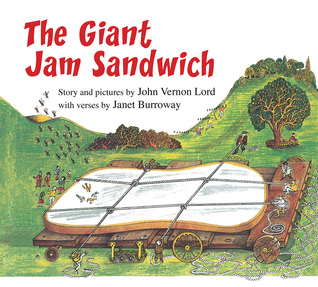
The Giant Jam Sandwich

Board book: The Giant Jam Sandwich. Janet Burroway. Story and Pictures by John Vernon Lord. 1972/2018. Houghton Mifflin Harcourt. 28 pages. [Source: Review copy]

First sentence: One hot summer in Itching Down, Four million wasps flew into town.

Premise/plot: I would NOT want to be in Itching Down when FOUR MILLION wasps flew into town. I wouldn't want to be there for even ONE HUNDRED THOUSAND wasps. Would you? This classic picture book is told in rhyme. Though the situation is far from ideal, the text is DELIGHTFUL.

My thoughts: I LOVE, LOVE, LOVE this one. It is so much fun. I love the rhythm and rhyme of it. From cover to cover it just works. Not all books written in rhyme do work. Some seem to struggle a bit here and there. This one is practically perfect in every way.

Quotes:
A truck drew up and dumped out butter,
And they spread it out with a flap and a flutter.
Spoons and spades! Slap and slam!
And they did the same with the strawberry jam.
Suddenly the sky was humming!
All four million wasps were coming!
They smelled that jam, they dived and struck!
And they ate so much that they all got stuck.
Original audience born circa 1968 to 1970.

Text: 5 out of 5
Illustrations: 4 out of 5
Total: 9 out of 10

© 2019 Becky Laney of Young Readers

Tuesday, January 22, 2019

Now We Are Six

Now We Are Six. A.A. Milne. 1927. 102 pages. [Source: Review copy]

First sentence: When you are reciting poetry, which is a thing we never do, you find sometimes, just as you are beginning, that Uncle John is still telling Aunt Rose that if he can't find his spectacles he won't be able to hear properly, and does she know where they are; and by the time everybody has stopped looking for them, you are at the last verse, and in another minute they will be saying, "Thank you, thank you," without really knowing what it was all about.

Premise/plot: This is A.A. Milne's second volume of poetry written for children. His first was When We Were Very Young.

My thoughts: While I don't absolutely love, love, love Milne's two poetry collections as much as I love his two Pooh novels, I do appreciate them. My favorite poems from Now We Are Six include:

  • Busy
  • Binker
  • Us Two
  • The Engineer
  • The End
From Busy
I think I am a Muffin Man. I haven't got a bell.
I haven't got the muffin things that muffin people sell.
Perhaps I am a Postman. No, I think I am a Tram.
I'm feeling rather funny and I don't know what I am--
BUT
Round about
And round about
And round about I go--
All around the table,
The table in the nursery--
Round about
And round about
And round about I go;
I think I am a Traveller escaping from a Bear;
I think I am an Elephant,
Behind another Elephant
Behind another Elephant who isn't really there...
 From Binker
Binker--what I call him--is a secret of my own,
And Binker is the reason why I never feel alone.
Playing in the nursery, sitting on the stair,
Whatever I am busy at, Binker will be there.
Oh, Daddy is clever, he's a clever sort of man,
And Mummy is the best since the world began,
And Nanny is Nanny, and I call her Nan--
But they can't
See
Binker.
From Us Two
Wherever I am, there's always Pooh,
There's always Pooh and Me.
Whatever I do, he wants to do,
"Where are you going today?" says Pooh:
"Well, that's very odd, 'cos I was too.
Let's go together," says Pooh, says he.
"Let's go together," says Pooh.

Original audience born circa 1920 to 1924.

© 2019 Becky Laney of Young Readers

Saturday, January 19, 2019

When We Were Very Young

When We Were Very Young. A.A. Milne. 1924. 100 pages. [Source: Review copy]

First sentence: At one time (but I have changed my mind now) I thought I was going to write a little Note at the top of each of these poems, in the manner of Mr. William Wordsworth, who liked to tell his readers where he was staying, and which of his friends he was walking with, and what he was thinking about, when the idea of writing his poem came to him.

Premise/plot: When We Were Very Young is a collection of poems dedicated to A.A. Milne's son, Christopher Robin Milne, aka Billy Moon. It was, I believe, Milne's first work for children. It wouldn't be his last.

My thoughts: If I loved poetry more, I think I would appreciate When We Were Very Young more than I do. I found the introduction charming. It does contain plenty of poems that I like, love, or even adore. Poems that are easier perhaps to adore if you were lucky enough to have heard them sung. (Winnie the Pooh: 17 Songs from the Pooh Song Book: Starring Jack Gilford. The album features: "Sing Ho! For the Life of A Bear," "Cottleston Pie," "Lines Written By A Bear of Very Little Brain," "Oh! The Butterflies are Flying," "I Lay On My Chest," "3 Cheers for Pooh," "They All Went Off To Discover the Pole," "Christopher Robin is Going," "Missing," "In the Fashion," "Halfway Down," Buckingham Palace," "Politeness," "The Christening," "Brownie," "Lines and Squares," and "Vespers."). My favorite poems from When We Were Very Young are:
 
Buckingham Palace
Lines and Squares
Politeness
Missing
Halfway Down
Teddy Bear

From Teddy Bear
A bear, however hard he tries,
Grows tubby without exercise.
Our Teddy Bear is short and fat
Which is not to be wondered at;
He gets what exercise he can
By falling off the ottoman,
But generally seems to lack
The energy to clamber back.
From Missing
Has anybody seen my mouse?
I opened his box for half a minute,
Just to make sure he was really in it,
And while I was looking, he jumped outside!
I tried to catch him, I tried, I tried...
I think he's somewhere about the house.
Has anyone seen my mouse?
From Buckingham Palace
They're changing guard at Buckingham Palace--
Christopher Robin went down with Alice.
Alice is marrying one of the guard.
"A soldier's life is terrible hard,"
Says Alice.
Do you have a favorite Milne poem? 

Original audience born circa 1918-1922. 

© 2019 Becky Laney of Young Readers

Tuesday, December 4, 2018

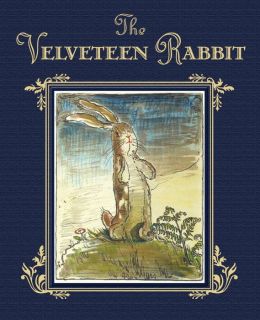
The Velveteen Rabbit

The Velveteen Rabbit. Margery Williams. Illustrated by William Nicholson. 1922/2014. Random House. 48 pages. [Source: Review copy]
 First sentence: THERE was once a velveteen rabbit, and in the beginning he was really splendid. He was fat and bunchy, as a rabbit should be; his coat was spotted brown and white, he had real thread whiskers, and his ears were lined with pink sateen.

Premise/plot: Do you know what it is to be real? One little Christmas bunny will learn this and plenty of other life lessons in Margery Williams' classic tale The Velveteen Rabbit.

The Velveteen Rabbit opens with a young boy receiving a rabbit for a Christmas present. All is lovely for the rabbit that first day. But the toy is quickly forgotten. He becomes one toy of many, many, many toys. He's not exactly special to the boy or the other toys. In fact, I'd say the other toys bully him a bit. All except for the Skin Horse, the oldest toy in the nursery. It is this horse that tells the Rabbit all about being real, what it takes to be real, what it feels like, how it changes you, etc.

"Real isn't how you are made," said the Skin Horse. "It's a thing that happens to you. When a child loves you for a long, long time, not just to play with, but REALLY loves you, then you become Real." "Does it hurt?" asked the Rabbit. "Sometimes," said the Skin Horse, for he was always truthful. "When you are Real you don't mind being hurt." "Does it happen all at once, like being wound up," he asked, "or bit by bit?" "It doesn't happen all at once," said the Skin Horse. "You become. It takes a long time. That's why it doesn't often happen to people who break easily, or have sharp edges, or who have to be carefully kept. Generally, by the time you are Real, most of your hair has been loved off, and your eyes drop out and you get loose in the joints and very shabby. But these things don't matter at all, because once you are Real you can't be ugly, except to people who don't understand." "I suppose you are real?" said the Rabbit. And then he wished he had not said it, for he thought the Skin Horse might be sensitive. But the Skin Horse only smiled. "The Boy's Uncle made me Real," he said. "That was a great many years ago; but once you are Real you can't become unreal again. It lasts for always." (5-8)

My thoughts: The Velveteen Rabbit is one of my favorite Christmas books. I love the nursery magic. I love the ending. It was originally published in 1922. The story and illustrations in this edition are original. This is a beautiful edition of the book. One of the best I've seen.

The Velveteen Rabbit was published several years before A.A. Milne's Winnie the Pooh and House at Pooh Corner. Chances are if you enjoy one, you'll enjoy the other.

Do you have a favorite toy-come-to-life fantasy?


© 2018 Becky Laney of Young Readers

Thursday, August 30, 2018

Freight Train

Freight Train. Donald Crews. 1978. 26 pages. [Source: Borrowed]

First sentence: A train runs across this track. Red caboose at the back. Orange tank car next. Yellow hopper car.

Premise/plot: Freight Train is a concept book teaching colors, a train-themed concept book teaching colors. It received a Caldecott Honor in 1979, I believe. If I had to guess the most memorized picture book ever, I bet it would be Freight Train or Goodnight Moon. What do you think it would be?

My thoughts: What's not to love about this children's classic? It wasn't the first train book, it certainly won't be the last. What is it about kids and trains?!

Text: 4 out of 5
Illustrations: 4 out of 5
Total: 8 out of 10

© 2018 Becky Laney of Young Readers

Wednesday, August 29, 2018

Millions of Cats

Millions of Cats. Wanda Gag. 1928. Penguin. 40 pages. [Source: Book I Bought]

Once upon a time there was a very old man and a very old woman. They lived in a nice clean house which had flowers all around it, except where the door was. But they couldn't be happy because they were so very lonely. 
"If we only had a cat!" sighed the very old woman. "A cat?" asked the very old man. "Yes, a sweet little fluffy cat," said the very old woman. "I will get you a cat, my dear," said the very old man.
And he set out over the hills to look for one. 

Millions of Cats is a Newbery Honor book from 1929.

Premise/Plot: A very old man and a very old woman long for a cat. The husband goes on a quest to bring back a "sweet little fluffy cat" to please them both. Is his quest successful? Yes. A little too successful. For in fact he finds

Cats here, cats there,
Cats and kittens everywhere,
Hundreds of cats,
Thousands of cats,
Millions and billions and trillions of cats.
How is he ever to choose just ONE cat from so many?! Especially since as he picks up or pets each one he sees, he finds it to be the prettiest cat. He can't bring himself to leave any of the cats behind. But it isn't practical to bring home hundreds, thousands, millions, billions, and trillions of cats. You can probably guess what his wife's response will be! Surely, they can't keep them all. For better or worse, he lets the cats decide amongst themselves. One scrawny cat remains, but, it may be the best one of all.

My thoughts: I loved this one growing up. I loved the repetition. I thought it was a fun story. I didn't--at the time--take the man's conclusion that the trillions of cats ate each other up literally. Is the book violent? Perhaps. Perhaps not. See for yourself.  "They bit and scratched and clawed each other and made such a great noise that the very old man and the very old woman ran into the house as fast as they could. They did not like such quarreling." This one might pair well with Eugene Field's "The Duel." (The gingham dog and the calico cat).

Have you read Millions of Cats? Did you like it? love it? hate it?

Text: 5 out of 5
Illustrations: 4 out of 5
Total: 9 out of 10


© 2018 Becky Laney of Young Readers

Friday, May 18, 2018

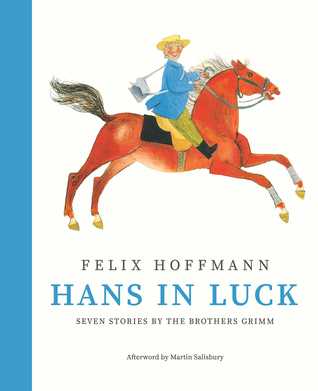
Hans in Luck: Seven Stories by the Brothers Grimm

Hans in Luck: Seven Stories by the Brothers Grimm. Two are retold by Felix Hoffman. Illustrated by Felix Hoffman. 2017. NorthSouth books. 256 pages.

Premise/plot: Hans In Luck is a fairy tale collection featuring seven previously published picture books written and illustrated by Felix Hoffman. Rapunzel was originally published in 1949. The Wolf and the Seven Little Kids was originally published in 1957. Sleeping Beauty was originally published in 1959. The Seven Ravens was originally published in 1962. King Thrushbeard was originally published in 1969. Tom Thumb was originally published in 1972. Hans in Luck was originally published in 1975. Felix Hoffman. The two stories retold by Hoffman are Rapunzel and Hans In Luck.

Felix Hoffman was one of Switzerland's most important children's book illustrators of the twentieth century. The book includes a brief biography and afterword which helps place his work in context. 

My thoughts: I enjoyed reading this collection. My favorite story was Hans in Luck. My next favorite story was probably The Wolf and the Seven Little Kids. I have so many memories of my mom retelling The Wolf and the Seven Little Kids. (She also does an awesome Three Billy Goats Gruff.) I think the only story I wasn't familiar with was King Thrushbeard. It reminded me of The Taming of the Shrew--for better or worse.

Text:  4 out of 5
Illustrations: 3 out of 5
Total: 7 out of 10

© 2018 Becky Laney of Young Readers

Thursday, April 26, 2018

A Friend Is Someone Who Likes You

A Friend Is Someone Who Likes You. Joan Walsh Anglund. 1958/2017. Houghton Mifflin Harcourt. 40 pages. [Source: Review copy]

First sentence: A friend is someone who likes you. It can be a boy... It can be a girl... or a cat... or a dog... or even a white mouse.

Premise/plot: A Friend is Someone who Likes You was originally published in 1958. It was recently republished in a teeny-tiny size. The theme is friendship. The opening pages keep it quite simple, but, as the book progresses so does its complexity.

My thoughts: I liked it. The illustrations are sweet. The theme is sweet as well. It doesn't say everything there is to say on the subject of friendship. But what it does say is true enough. I have never found a special friend in the wind, a tree, or a brook. But I can easily imagine Anne Shirley doing so! My friends were mainly BOOKS. This little book doesn't include books as potential friends. But I forgive it that slight sin!

Last sentence: But everyone...everyone in the whole world has at least one friend. Where did you find yours?

Two of my closest, dearest friends were "found" because of a mutual love of books. 

© 2018 Becky Laney of Young Readers

Friday, January 19, 2018

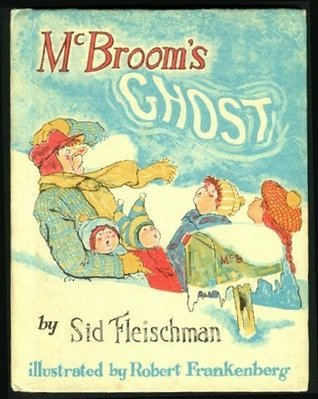
McBroom's Ghost

McBroom's Ghost Sid Fleischman. Illustrated by Robert Frankenberg. 1971. 48 pages. [Source: Bought]

First sentence:  Ghosts? Mercy, yes--I can tell you a thing or three about ghosts. As sure as my name's Josh McBroom a haunt came lurking about or wonderful one-acre farm. I don't know when that confounded dry-bones first moved in with us, but I suspicion it was last winter. An uncommon cold winter it was, too, though not so cold that an honest man would tell fibs about it. Still, you had to be careful when you lit a match. The flame would freeze and you had to wait for a thaw to blow it out.

Premise/plot: Does McBroom's one-acre farm have a ghost? Perhaps. This read-aloud gem takes place over two winters, I believe. In this one, McBroom has to solve the mystery of is-there-a-ghost-haunting-the-farm? AND solve a problem he is having with his neighbor and his hogs.

My thoughts: I would recommend this one to anyone who has read and loved McBroom's Wonderful One-Acre Farm, Three Tall Tales (1966). I love, love, love McBroom as a narrator. And the adventures he has with his family on the farm are quite unbelievable.

Quotes:
I don't intend to stray from the facts, but I distinctly remember one day Polly dropped her comb on the floor and when she picked it up the teeth were chattering. 
The temperature kept dropping and I must admit some downright unusual things began to happen. For one thing smoke took to freezing in the chimney. I had to blast it out with a shotgun three times a day. And we couldn't sit down to a bowl of Mama's hot soup before a crust of ice formed on top. The girls used to set the table with a knife, a fork, a spoon--and an ice pick. 
Then the big freeze set in. Red barns for miles around turned blue with the cold. 


© 2018 Becky Laney of Young Readers

Sunday, August 27, 2017

Too Big

Too Big. Ingri d'Aulaire and Edgar Parin d'Aulaire. 1945/2008. NYR Children's Collection. 40 pages. [Source: Library]

First sentence: There once was a boy and he was TOO BIG. He could not get into his little pants because he was TOO BIG. He could not get into his little coat because he was TOO BIG.

Premise/plot: The boy in this story has outgrown all his favorite things. He's just too big now. But being too big won't keep him from dreaming big.

My thoughts: Too Big was originally published in 1945. I personally love the vintage illustrations. I particularly love the cat and dog. I want to crawl into the book and just play with them and pet them. Half the illustrations are in color, the other half are in black and white. The story itself is very simple. To be honest, there's not much text to it at all! This being for better or worse. The repetition is strong with this one. Some sentences worked better for me than others. For example, it's easy to outgrow clothes, shoes, hats, etc. But the authors use the phrase "too big" to also stand in for "big enough to know better." (So he's too big to play rough with the cat.) The whole sequence with the horse just confused me. (Another thing I found confusing, why does the boy's milk glass read GOOD BOY?)

Text: 3 out of 5
Illustrations: 4 out of 5
Total: 7 out of 10


© 2017 Becky Laney of Young Readers

Sunday, November 13, 2011

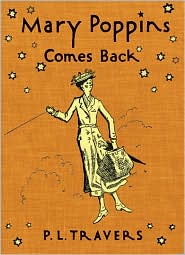
Mary Poppins Comes Back

Mary Poppins Comes Back. P.L. Travers. 1935. Harcourt. 315 pages.

It was one of those mornings when everything looks very neat and bright and shiny, as though the world had been tidied up overnight. 

In the spring, I read (and loved) P.L. Travers Mary Poppins. I found it delightful and thoroughly satisfying. I also found it quote-worthy!!! I was surprised by how much I loved it.

There are a handful of sequels to the original novel, and I hope to read them all!!!

The first sequel is Mary Poppins Comes Back. Mary Poppins returns when the Banks family needs her most. Mr. Banks is losing it--a little bit--and Mrs. Banks is having putting up with her husband and all four kids. (Turns out there may be a reason! A fifth child makes an appearance halfway through this one!)  The chapters are a bit episodic as in the previous novel, but for me they are even more delightful!!! By far my favorite chapter was the second one, "Miss Andrew's Lark" in which Mr. Banks' governess arrives for a visit...

Some of my favorite quotes (from the whole book):

"I want to know how you've been behaving since I went away," remarked Mary Poppins sternly. Then she took out the Thermometer and held it up to the light.
"Careless, thoughtless, and untidy," she read out. Jane stared.
"Humph!" said Mary Poppins, and thrust the Thermometer into Michael's mouth. He kept his lips tightly pressed upon it until she plucked it out and read.
"A very noisy mischievous, troublesome little boy."
"I'm not," he said angrily.
For answer she thrust the Thermometer under his nose and he spelt out the large red letters.
"A-V-E-R-Y-N-O-I-S---"
"You see?" said Mary Poppins looking at him triumphantly. She opened John's mouth and popped in the Thermometer.
"Peevish and Excitable." That was John's temperature.And when Barbara's was taken Mary Poppins read out the two words "Thoroughly spoilt."
"Humph!" she snorted. "It's about time I came back!"
Then she popped it quickly in her own mouth, left it there for a moment, and took it out. "A very excellent and worthy person, thoroughly reliable in every particular." (22)

"She was called Miss Andrew and she was a Holy Terror!"
"Hush!" said Mrs. Banks, reproachfully.
"I mean--" Mr. Banks corrected himself, "she was--er--very strict. And always right. And she loved putting everybody else in the wrong and making them feel like a worm. That's what Miss Andrew was like!" (32)

"Well?" she said gruffly smiling a thin smile. "I don't suppose you know who I am?"
"Oh, yes we do!" said Michael. He spoke in his friendliest voice for he was very glad to meet Miss Andrew. "You're the Holy Terror!" (39)

"Doing nothing takes a great deal of time! All the time, in fact!" (156)

I would definitely recommend this one!!!

© 2011 Becky Laney of Young Readers

Saturday, October 1, 2011

Umbrella

Umbrella by Taro Yashima. 1958/2004. Penguin. 40 pages. 

Momo is the name of a little girl who was born in New York. The word Momo means "the peach" in Japan where her father and mother used to live. On her third birthday Momo was given two presents--red rubber boots and an umbrella! They pleased her so much that she even woke up that midnight to take another look at them.

Umbrella by Taro Yashima IS my favorite, favorite, favorite picture book. I can't remember a time when I didn't love and adore this one.

Umbrella is the story of a little girl, Momo, who is oh-so-excited about her birthday presents. On her third birthday, Momo received red rubber boots and an umbrella. But Momo has to learn some patience. For the rain is SLOW in coming. And her parents aren't going to be easily persuaded that her umbrella is a must for dealing with sun and wind.

But, of course, the rain does come. And the wait was worth it. For Momo gets to use her new boots and umbrella. And she gets to walk all by herself without holding onto her mother's or father's hands.

Perhaps it is the rhythm of the rain that makes this such a memorable story? With it's oh-so-lovely refrain:
On her umbrella, the raindrops made the wonderful music--

bon polo
bon polo
ponpolo ponpolo
ponpolo ponpolo
bolo bolo ponpolo
bolo bolo ponpolo
boto boto ponpolo
boto boto ponpolo

all the way home. 
As much as I love the text--and I do LOVE, LOVE, LOVE the text--I must say that I really, really LOVE the illustrations. I do. From cover to cover. Even the end papers. I just LOVE Taro Yashima's artwork. His style made a definite impression on me--and it's one that has stuck with me through the years. There's just something unforgettable about each page--almost each page.

It's just a sweet, sweet book that continues to charm.

Text: 5 out of 5
Illustrations: 5 out of 5
Total: 10 out of 10

© 2011 Becky Laney of Young Readers

Sunday, June 19, 2011

Back to School With Betsy


Back to School with Betsy. Carolyn Haywood. 1943. 176 pages.

It was a warm evening in August. Betsy was sitting on the top of the wall that ran back of the garden.

In 2008, I reviewed Carolyn Haywood's B is for Betsy. At the time, I wasn't all that impressed. I thought the book--originally published in 1939--was dated and old-fashioned. And it is both. But I've since come to appreciate such books, at least more than I used to! (For example, I've discovered Mary Poppins, Henry Huggins, and Five Children and It, etc.) So I was pleased to see two more Betsy books on the library shelf: Back to School with Betsy and Betsy and the Boys.

Back to School with Betsy, like B is for Betsy, is episodic for the most part. It opens with a worried Betsy. She's sad that Miss Grey will no longer be her teacher, and she's worried that she'll never see her. Her mother assures her that even though Miss Grey is getting married (and thereby retiring from teaching) that they'll still be able to see each other. Maybe not as often as they would in the school setting. But Miss Grey will still care about seeing Betsy and her friends. Betsy can't see any reason in the world why her teacher would want to go and do a silly thing like get married. Her friend, Ellen, tries to convince her that this is a good thing. They'll get to go to the wedding! They'll get to eat cake! Billy and Betsy don't really see why weddings are fun outside of the cake-eating opportunity, but that is just enough to cheer them up for the moment. 

Betsy has also been worried about the creepy house next door. A house that hasn't been lived in for quite a while. But within a chapter or two--at most--Betsy learns that the house has been bought! A Mr. Jackson is moving in, and he has a job or two for Betsy. The thought of earning enough nickels to buy Miss Grey a present is motivation enough to overcome her worries.

Any guesses as to who Miss Grey is marrying?! It may surprise Betsy and Billy and Ellen. But this reader saw it coming from the start! 

The first four chapters of Back to School with Betsy deal with the wedding and the new neighbor. The remaining chapters focus on Betsy and her friends at school. In chapter six, for example, "The Tale of the Blackboard Picture" Betsy and her classmates learn about Mexican Indians and create a blackboard picture to illustrate everything they've learned about this exotic culture. 
And in chapter nine, readers learn exactly what Betsy has always wanted, a black baby. Not just a brother OR a sister, a black baby brother or black baby sister. When her mom tries to explain to her that that won't be happening, that they'd have to adopt a baby to get a baby of a different color, Betsy remains determined. She does bring home a black little girl, but her parents won't let her keep her. And she is returned safely to her mom--who was very worried. The illustrations are in black and white, and it is interesting how they try to portray ethnicity solely through hairstyle. (Looking at the illustration, you'd never guess, unless you read the text, that one of the little girls was supposed to be black.)
"But couldn't we get one all ready made? I forget what you call babies that you get all ready made."
"You mean 'adopt' a baby," said Mother.
"Yes," replied Betsy. "Couldn't we 'dopt one?"
"No, dear," said Mother. "We already have a baby."
"I'll bet if a little baby could talk, it would say it would like to be 'dopted by us."
"Well now, we won't talk about it any more," said Mother. "You have a dear little baby sister to play with."
"Yes," said Betsy, "but I want a lot of babies. And I like all different colors." (143)
The book covers Christmas and Easter too.
 
Is this children's book dated? Is it old-fashioned? Yes. But I am glad to have read this one. I have become interested in reading these older books, interested in tracing the history of children's books.


In case you were curious, the book is illustrated by the author, Carolyn Haywood.

© 2011 Becky Laney of Young Readers

Tuesday, March 15, 2011

Mary Poppins


Mary Poppins. P.L. Travers. Illustrated by Mary Shepard. 1934/2006. Houghton Mifflin Harcourt. 224 pages.

If you want to find Cherry-Tree Lane all you have to do is ask the Policeman at the cross-roads. He will push his helmet slightly to one side, scratch his head thoughtfully, and then he will point his huge white-gloved finger and say: "First to your right, second to your left, sharp right again, and you're there. Good-morning." 

I enjoyed reading P.L. Travers' Mary Poppins. I enjoyed it more than I thought I would. It's a strange novel, that's true. The chapters are episodic. Some chapters are "better" than others, in my opinion. If you equate being better with being more entertaining. (But since what entertains one person may be someone else's idea of oh-so-boring, you can make up your own mind.) And Mary Poppins has more to her than you might expect. She's vain. She's bossy. She can be cranky. She can be great fun, encouraging you to imagine this or that. Or not. Sometimes she's just not in that kind of mood. Sometimes she doesn't want questions; she doesn't want to play around. Sometimes she's definitely no-nonsense. Mary Poppins is nanny to four Banks children: Jane and Michael, the older ones, and Barbara and John, the toddler ones. (The novel sees them turning one.) So overall, I'd recommend it!

Mary Poppins took out a large bottle labelled "One Tea-Spoon to be Taken at Bed-Time."
A spoon was attached to the neck of the bottle, and into this Mary Poppins poured a dark crimson fluid. "Is that your medicine?" enquired Michael, looking very interested.
"No, yours," said Mary Poppins, holding out the spoon to him. Michael stared. He wrinkled up his nose. He began to protest.
"I don't want it. I don't need it. I won't!"
But Mary Poppins's eyes were fixed upon him, and Michael suddenly discovered that you could not look at Mary Poppins and disobey her. There was something strange and extraordinary about her--something that was frightening and at the same time most exciting. The spoon came nearer. He held his breath, shut his eyes and gulped. A delicious taste ran round his mouth. He turned his tongue in it. He swallowed, and a happy smile ran round his face.
"Strawberry ice," he said ecstatically. "More, more, more!" (11-12)
"Where have you been?" they asked her.
"In Fairyland," said Mary Poppins.
"Did you see Cinderella?" said Jane.
"Huh, Cinderella? Not me," said Mary Poppins contemptuously. "Cinderella, indeed!"
"Or Robinson Crusoe?" asked Michael.
"Robinson Crusoe--pooh!" said Mary Poppins rudely.
"Then how could you have been there? It couldn't have been our Fairyland!"
Mary Poppins gave a superior sniff.
"Don't you know," she said pityingly, "that everybody's got a Fairyland of their own?" (28)

When they go Christmas shopping...

"That will do nicely for Daddy," said Michael, selecting a clockwork train with special signals. "I will take care of it for him when he goes to the City."
"I think I will get this for Mother," said Jane, pushing a small doll's perambulator which, she felt sure, her Mother had always wanted. "Perhaps she will lend it to me sometimes."
After that, Michael chose a packet of hairpins for each of the Twins and a Meccano set for his Mother, a mechanical beetle for Robertson Ay, a pair of spectacles for Ellen whose eyesight was perfectly good, and some bootlaces for Mrs. Brill who always wore slippers.
Jane, after some hesitation, eventually decided that a white dickey would be just the thing for Mr. Banks, and she bought Robinson Crusoe for the Twins to read when they grew up.
"Until they are old enough, I can read it myself," she said. "I am sure they will lend it to me." (181-82)


© 2011 Becky Laney of Young Readers

Tuesday, November 9, 2010

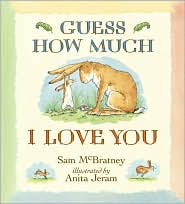
Guess How Much I Love You

Guess How Much I Love You. Sam McBratney. Illustrated by Anita Jeram. 1994. Candlewick Press. 32 pages.
Little Nutbrown Hare, who was going to bed, held on tight to Big Nutbrown Hare's very long ears. He wanted to be sure that Big Nutbrown Hare was listening. "Guess how much I love you," he said. "Oh, I don't think I could guess that," said Big Nutbrown Hare. "This much," said Little Nutbrown Hare, stretching out his arms as wide as they could go. Big Nutbrown Hare had even longer arms. "But I love you this much," he said.

 Are you familiar with Guess How Much I Love You? Are you one of its many fans? I liked this one. I found it sweet and sentimental. If you're looking for a loving, affectionate parent-child relationship--within a picture book--it doesn't get much better than this. The dialogue between Big Nutbrown Hare and Little Nutbrown Hare--while repetitive--is undeniably sweet and loving.

But. While I liked this one. I don't feel that it is the best book ever. Or the most perfect picture book of all time. I liked it. I think it would be a good fit for most home libraries. And it's a sweet, gentle book that would be nice for bedtime. But. It's not one that I would want to again-again forever and ever.

It's available as a picture book and a board book. Don't forget the book-and-toy gift set and the baby book.

© Becky Laney of Young Readers

Monday, August 9, 2010

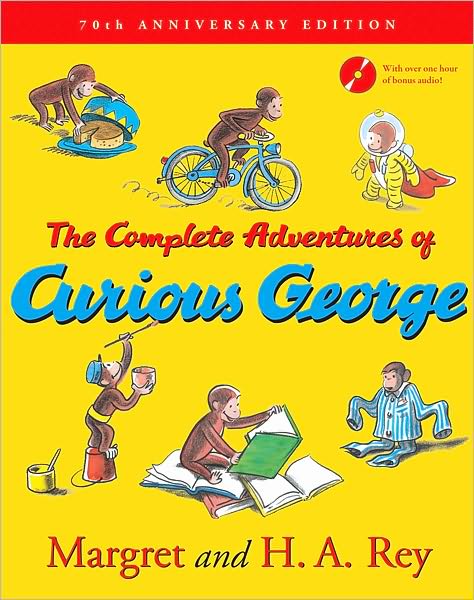
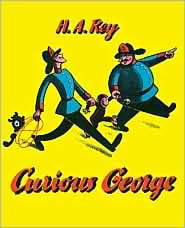
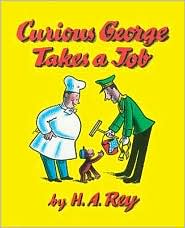
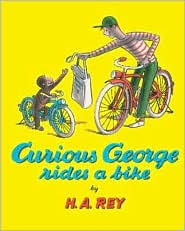
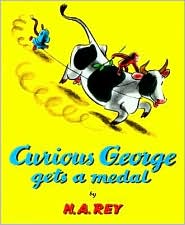
The Complete Adventures of Curious George


Complete Adventures of Curious George: 70th Anniversary Edition. Margret and H.A. Rey. 2010. Houghton Mifflin Harcourt. 432 pages.

This anthology contains these original stories:
  • Curious George, (1941)
  • Curious George Takes a Job, (1947)
  • Curious George Rides a Bike, (1952)
  • Curious George Gets A Medal, (1957)
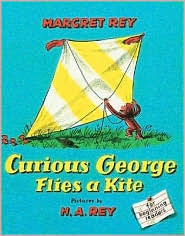
  • Curious George Flies A Kite, (1958)
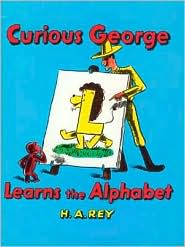
  • Curious George Learns the Alphabet, (1963)
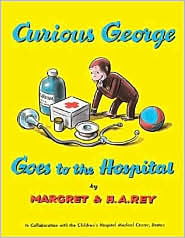
  • Curious George Goes to the Hospital (1966)
It also contains an introduction by Leonard S. Marcus, a publisher's perspective on Curious George, a retrospective essay, and a photographic album of Margret and H.A. Rey.

My thoughts on Curious George (1941):
This is George.
He lived in Africa.
He was a good little monkey
and always very curious.
One day George saw a man.
He had on a large yellow straw hat.
The man saw George too.
"What a nice little monkey," he thought.
"I would like to take him home with me."
The first adventure has George being taken from his happy jungle home by the man in the yellow hat. We're told that George--after the ocean voyage--will live in the zoo. My question is why is the man in the yellow hat so intent on taking George with him if he's just going to be put into the zoo?! Is that the man in the yellow hat's job? To find animals in his travels and place them into zoos? It would make more sense if he wanted George as a pet. George does end up in the zoo. Eventually. But it's a busy couple of days first! He smokes a pipe, phones the fire department, spends time in prison, escapes from prison, and goes on quite an exciting balloon ride.

My thoughts on Curious George Takes A Job (1947)
This is George. He lived in the Zoo. He was a good little monkey and always very curious. He wanted to find out what was going on outside the Zoo. One day, when the keeper was not paying attention, George got hold of the key for the cage. When the keeper discovered what had happened, it was too late--George was gone!
I'm curious how much time has passed (for George) in between books. Has he been in the Zoo long before he makes his escape? (That's something I never thought of as a child!) This second book chronicles George's adventures in the city. Curious George does several "jobs" throughout the book including spending time as a dishwasher in an Italian restaurant, a window washer, a painter (though this one leads him to trouble), and an actor. Poor George also breaks his leg and gets sick from smelling ether. He does reunite with the man in the yellow hat towards the end of the book...

My thoughts on Curious George Rides a Bike (1952)
This is George. He lived with his friend, the man with the yellow hat. He was a good little monkey and always very curious. This morning George was curious the moment he woke up because he knew it was a special day...
What makes that day so special? It's the third anniversary of when George and the man in the yellow hat met. George is given a bike and the promise of a show--an animal show. But first George must have his own adventures. Including "helping" someone out on their paper route. But by the end of the day George ends up being in the show. But that reward didn't come easily. George has to get into and out of several messes first...

My thoughts on Curious George Gets a Medal (1957)
This is George. He lived with his friend, the man with the yellow hat. He was a good little monkey -- and always very curious. George was alone this morning, looking at a picture book, when the doorbell rang. It was the mailman. "Here is a letter for you," he said. "Put it on your friend's desk. He'll read it to you when he comes home." George was curious. It was not often that somebody wrote him.
Most of George's messes are the result of him being left on his own. If the man in the yellow hat really wanted George to behave, to be a good little monkey, then perhaps he'd spend more time with him...or hire a monkey-sitter. Maybe the man in the yellow hat gets satisfaction out of scolding George and forgiving him?! What messes does George get into in Curious George Gets a Medal? Well, he makes a mess of the rug--a watery sudsy mess--and breaks a museum exhibit--a dinosaur. But all is well in the end because there is a professor that wants George to be the first space monkey. He doesn't really go into space--into orbit--he parachutes out of a rocket. But still the public seems thrilled with George's cleverness.

My thoughts on Curious George Flies a Kite (1958)
This is George.
He lives in the house of the man with the yellow hat.
George is a little monkey, and all monkeys are curious.
But no monkey is as curious as George.
That is why his name is Curious George.
I do like Curious George. But this is a very long adventure! In short, Curious George plays with bunnies, goes fishing, flies a kite, and gets a new pet. Of course, he gets into trouble--letting the bunnies out of their home, almost drowning, being flown away by the wind which leads to a dramatic helicopter rescue. Is every day like this for George?! Perhaps he should be Fearless George?!

My thoughts on Curious George learns the Alphabet (1963)
This is George. He lived with his friend, the man with the yellow hat. He was a good little monkey, but he was always curious.
This morning George was looking at some of his friend's books. They were full of little black marks and dots and lines, and George was curious: what could one do with them?
This book is so boring. I'm glad that George wants to learn his letters, wants to learn to read. But this one is not that thrilling to read. It is slightly redeemed by George changing the man in the yellow hat's order for doughnuts. Instead of "one" George writes "ten". So that added some adventure.

My thoughts on Curious George Goes to the Hospital (1966)
This is George. He lived with his friend, the man with the yellow hat. He was a good little monkey, but he was always curious. Today George was curious about the big box on the man's desk. What could be in it? George could not resist. He simply HAD to open it.
This isn't George's first trip to the hospital. He's had a broken leg--from an on-the-job mishap. And we're not exactly told if this is his second trip to the hospital. The monkey has been curious for years now, so perhaps he's a regular?! In this case, George is in the hospital because of a poor decision. He thought it would be a good idea to eat a puzzle piece. It wasn't. (The puzzle they're piecing together--is a picture of George and the man in the yellow hat.) But George does make some new friends--children who are in the hospital. And he is quite an entertaining monkey. And this is when he isn't feeling his best. The book concludes with George being released from the hospital, and they've sent along the puzzle piece--that they've retrieved from George--so they are able to finish the puzzle after all. I think that is strange. I don't know that I'd want the puzzle piece back. How about you?

Do you have a favorite Curious George adventure? Which of these have you read?

© Becky Laney of Young Readers