Showing posts with label classic children's poetry. Show all posts

Tuesday, April 16, 2019

A Child's Garden of Verses

A Child's Garden of Verses. Robert Louis Stevenson. 1885. 67 pages. [Source: Bought]

First sentence:
"Bed In Summer"
In winter I get up at night
And dress by yellow candlelight.
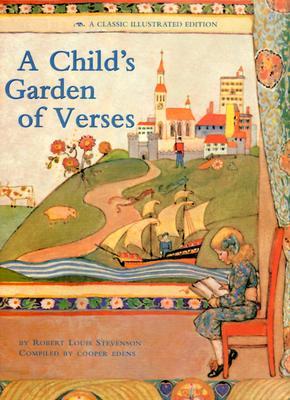
Premise/plot: A Child's Garden of Verses is a collection of children's poems by Robert Louis Stevenson. Some of his best poems are often featured in other collections that have been published through the decades. Even if you've never "read" this one in its entirety, chances are you'll be familiar with a handful of these poems. For example, "My Shadow," and "The Swing."

My thoughts: This is one of my mom's favorites. I recently handed her a copy of Kidnapped to read. She told me that her FAVORITE Stevenson book was A Child's Garden of Verses. She then proceeded to start quoting lines from five or six different poems.

I liked this one. I definitely found myself loving one or two of these poems. Not all of the poems hold up well. (I speak of the poem entitled "Foreign Children.") But plenty of his poems are still worth reading.
Picture Books in Winter
Summer fading, winter comes--
Frosty mornings, tingling thumbs
Window robins, winter rooks,
And the picture story-books.

Water now is turned to stone
Nurse and I can walk upon;
Still we find the flowing brooks
In the picture story-books.

All the pretty things put by,
Wait upon the children's eye,
Sheep and shepherds, trees and crooks,
In the picture story-books.

We may see how all things are,
Seas and cities, near and far,
And the flying fairies' looks,
In the picture story-books.

How am I to sing your praise,
Happy chimney-corner days,
Sitting safe in nursery nooks,
Reading picture-story books?
Block City

What are you able to build with your blocks?
Castles and palaces, temples and docks.
Rain may keep raining, and others go roam,
But I can be happy and building at home.
Let the sofa be mountains, the carpet be sea,
There I'll establish a city for me:
A kirk and a mill and a palace beside,
And a harbor as well where my vessels may ride.
Great is the palace with pillar and wall,
A sort of a tower on top of it all,
And steps coming down in an orderly way
To where my toy vessels lie safe in the bay.
This one is sailing and that one is moored:
Hark to the song of the sailors on board!
And see on the steps of my palace, the kings
Coming and going with presents and things!


© 2019 Becky Laney of Young Readers

Tuesday, January 22, 2019

Now We Are Six

Now We Are Six. A.A. Milne. 1927. 102 pages. [Source: Review copy]

First sentence: When you are reciting poetry, which is a thing we never do, you find sometimes, just as you are beginning, that Uncle John is still telling Aunt Rose that if he can't find his spectacles he won't be able to hear properly, and does she know where they are; and by the time everybody has stopped looking for them, you are at the last verse, and in another minute they will be saying, "Thank you, thank you," without really knowing what it was all about.

Premise/plot: This is A.A. Milne's second volume of poetry written for children. His first was When We Were Very Young.

My thoughts: While I don't absolutely love, love, love Milne's two poetry collections as much as I love his two Pooh novels, I do appreciate them. My favorite poems from Now We Are Six include:

  • Busy
  • Binker
  • Us Two
  • The Engineer
  • The End
From Busy
I think I am a Muffin Man. I haven't got a bell.
I haven't got the muffin things that muffin people sell.
Perhaps I am a Postman. No, I think I am a Tram.
I'm feeling rather funny and I don't know what I am--
BUT
Round about
And round about
And round about I go--
All around the table,
The table in the nursery--
Round about
And round about
And round about I go;
I think I am a Traveller escaping from a Bear;
I think I am an Elephant,
Behind another Elephant
Behind another Elephant who isn't really there...
 From Binker
Binker--what I call him--is a secret of my own,
And Binker is the reason why I never feel alone.
Playing in the nursery, sitting on the stair,
Whatever I am busy at, Binker will be there.
Oh, Daddy is clever, he's a clever sort of man,
And Mummy is the best since the world began,
And Nanny is Nanny, and I call her Nan--
But they can't
See
Binker.
From Us Two
Wherever I am, there's always Pooh,
There's always Pooh and Me.
Whatever I do, he wants to do,
"Where are you going today?" says Pooh:
"Well, that's very odd, 'cos I was too.
Let's go together," says Pooh, says he.
"Let's go together," says Pooh.

Original audience born circa 1920 to 1924.

© 2019 Becky Laney of Young Readers

Saturday, January 19, 2019

When We Were Very Young

When We Were Very Young. A.A. Milne. 1924. 100 pages. [Source: Review copy]

First sentence: At one time (but I have changed my mind now) I thought I was going to write a little Note at the top of each of these poems, in the manner of Mr. William Wordsworth, who liked to tell his readers where he was staying, and which of his friends he was walking with, and what he was thinking about, when the idea of writing his poem came to him.

Premise/plot: When We Were Very Young is a collection of poems dedicated to A.A. Milne's son, Christopher Robin Milne, aka Billy Moon. It was, I believe, Milne's first work for children. It wouldn't be his last.

My thoughts: If I loved poetry more, I think I would appreciate When We Were Very Young more than I do. I found the introduction charming. It does contain plenty of poems that I like, love, or even adore. Poems that are easier perhaps to adore if you were lucky enough to have heard them sung. (Winnie the Pooh: 17 Songs from the Pooh Song Book: Starring Jack Gilford. The album features: "Sing Ho! For the Life of A Bear," "Cottleston Pie," "Lines Written By A Bear of Very Little Brain," "Oh! The Butterflies are Flying," "I Lay On My Chest," "3 Cheers for Pooh," "They All Went Off To Discover the Pole," "Christopher Robin is Going," "Missing," "In the Fashion," "Halfway Down," Buckingham Palace," "Politeness," "The Christening," "Brownie," "Lines and Squares," and "Vespers."). My favorite poems from When We Were Very Young are:
 
Buckingham Palace
Lines and Squares
Politeness
Missing
Halfway Down
Teddy Bear

From Teddy Bear
A bear, however hard he tries,
Grows tubby without exercise.
Our Teddy Bear is short and fat
Which is not to be wondered at;
He gets what exercise he can
By falling off the ottoman,
But generally seems to lack
The energy to clamber back.
From Missing
Has anybody seen my mouse?
I opened his box for half a minute,
Just to make sure he was really in it,
And while I was looking, he jumped outside!
I tried to catch him, I tried, I tried...
I think he's somewhere about the house.
Has anyone seen my mouse?
From Buckingham Palace
They're changing guard at Buckingham Palace--
Christopher Robin went down with Alice.
Alice is marrying one of the guard.
"A soldier's life is terrible hard,"
Says Alice.
Do you have a favorite Milne poem? 

Original audience born circa 1918-1922. 

© 2019 Becky Laney of Young Readers

Thursday, August 2, 2018

Board Book: On the Go with Mother Goose

On the Go with Mother Goose. Iona Opie, editor. Illustrated by Rosemary Wells. 2017. Candlewick Press. 26 pages. [Source: Review copy]

First sentence:
Down at the station,
early in the morning,
See the little puffer-billies
all in a row;
See the engine driver
pull his little lever--
Puff puff, peep peep
off we go!
Premise/plot: This is a themed Mother Goose collection for parents to share with their little ones. The theme is ON THE GO. There are rhymes about going, coming, and arriving. Some of the rhymes may prove familiar to adults, though don't expect every poem to be an old friend. There are SO many Mother Goose rhymes and this collection just shares a few of them that fit this theme.
To market, to market,
to buy a fat pig,
Home again, home again,
jiggety-jig.
To market, to market,
to buy a fat hog,
Home again, home again,
jiggety-jog.
My thoughts: It's probably best not to come to this one with expectations of what should be included. I'm not sure if the 'missing' rhymes are missing because they've been included in other board book collections by Opie and Wells OR if perhaps the nursery rhymes are not Mother Goose but come from another source. Are all nursery rhymes by 'Mother Goose'? For example, I am thinking of "This Little Piggy," "Wee Willie Winkie," "Rub-a-dub-dub."

The book features illustrations by Rosemary Wells.
 

© 2018 Becky Laney of Young Readers
Thursday, September 28, 2017

Three Little Kittens

Three Little Kittens. Illustrated by Lilian Obligado. 1974. Random House. 32 pages. [Source: Bought]

First sentence: Three little kittens,
They lost their mittens,
And they began to cry,
"Oh, mother dear, we sadly fear
Our mittens we have lost."
"What! Lost your mittens, you naughty kittens!
Then you shall have no pie."

Premise/plot: This picture book is the traditional nursery rhyme "Three Little Kittens." The illustrations are by Lilian Obligado.

My thoughts: I have never really thought about "The Three Little Kittens." That is I've never stopped to think if it was a favorite...or not. But when I saw this picture book at my local charity shop, I fell head over heels in love with the illustrations and had to have it. I ended up paying what it would have cost me in 1974--$1.50. I cannot praise the illustrations enough. I ADORED this one.

 Text: 3 out of 5
Illustrations: 5 out of 5
Total: 8 out of 10

© 2017 Becky Laney of Young Readers
Saturday, August 28, 2010

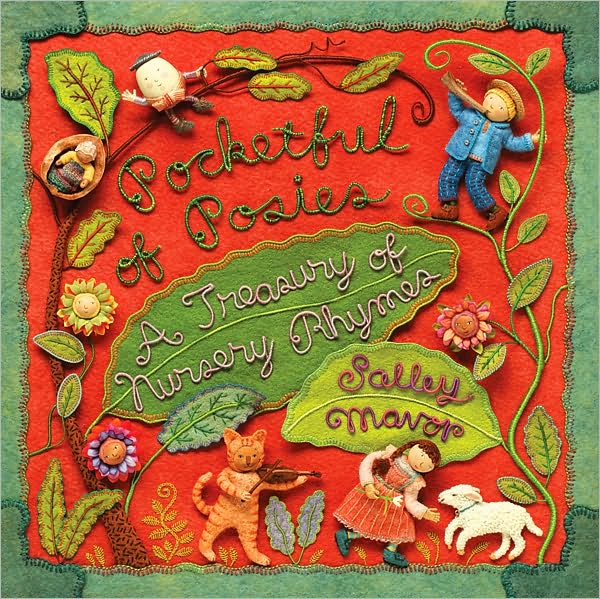
Pocketful of Posies: A Treasury of Nursery Rhymes


Pocketful of Posies: A Treasury of Nursery Rhymes. Salley Mavor. 2010. September 2010. Houghton Mifflin. 72 pages.

I loved this one! I just LOVED, LOVED, LOVED it. Salley Mavor's artwork--her needlework or embroidery--just amazed me. Each and every page of this one wowed me. (You can look inside this book at Amazon.)

The book is a collection of nursery rhymes. You'll find familiar favorites alongside lesser known rhymes. What makes this collection special--really special--is the artwork. It excited me! I just love reading and rereading this one!
I eat my peas with honey.
I've done it all my life.
They do taste kind of funny.
But it keeps them on the knife (47)
Little Miss Muffett
Sat on a tuffet,
Eating her curds and whey;
Along came a great spider,
Who sat down beside her,
And frightened Miss Muffett away. (28)
This would be a great book for parents (and grandparents) to share with the children in their lives!

© Becky Laney of Young Readers
Tuesday, June 2, 2009

Now We Are Six


Milne, A.A. 1927. Now We Are Six. Illustrations by Ernest H. Shepard.

There's something pleasant and charming and wonderfully subdued and just right about A.A. Milne's poetry. True, he's probably best known for his two Pooh books--Winnie the Pooh and House at Pooh Corner, but his two poetry books for children are well worth the read. Personally, it's hard to compare his books. Really, Now We Are Six has the best, best poem in the whole world "Us Two"; yet When We Were Very Young contains a greater number of poems that I love and remember. Of course, you don't have to choose between them. There is plenty of love to go around.

Highlights from Now We Are Six include "Us Two," "The Good Little Girl," and "The End."

Here's how "Us Two" starts off...

Wherever I am, there's always Pooh,
There's always Pooh and Me.
Whatever I do, he wants to do,
"Where are you going today?" says Pooh:
"Well, that's very odd 'cos I was too.
Let's go together," says Pooh, says he.
"Let's go together," says Pooh.


Both books are good books. Partly, this goodness is the result of Milne. But part of me thinks that the 'classic-ness' of the books--the timelessness of it is the result of the incredibly magical oh-so-perfect and somewhat inspirational artwork of Ernest H. Shepard. I mean classic pooh is classic pooh. Granted, I guess some folks may not love classic pooh. But still. I would think classic pooh is the epitome of cuteness and rightness in the world.

Have you read Now We Are Six? Do you have a favorite poem?

© Becky Laney of Young Readers

Monday, June 1, 2009

When We Were Very Young


Milne, A.A. 1924. When We Were Very Young. Illustrated by Ernest H. Shepard.

I love A.A. Milne's Winnie the Pooh and House At Pooh Corner. And while these two poetry books, When We Were Very Young and Now We Are Six, can never even come close to the magic of those other books, the all-Pooh-and-friends books, I enjoy them nonetheless. Why? Because Milne can have a way with words. A way of saying the very ordinary in a memorable, sometimes magical way. There's something sentimental about them without being overly sentimental. If that makes any sense at all. Included in this first poetry book, we see "Buckingham Palace," "Lines and Squares," "Independence," "Politeness," "Missing," "Teddy Bear," and "Halfway Down." These are the highlights...for me...the best of the best.

To me, there's no denying the perfection of pieces like "Teddy Bear" and "Halfway Down."

Here's how Teddy Bear starts off:

A bear, however hard he tries,
Grows tubby without exercise.
Our teddy bear is short and fat
Which is not to be wondered at;
He gets what exercise he can
By falling off the ottoman,
But generally seems to lack
The energy to clamber back.


Here's how Halfway Down starts off:

Halfway down the stairs
Is a stair
Where I sit.
There isn't any
Other stair
Quite like
it.
I'm not at the bottom,
I'm not at the top;
So this is the stair
Where
I always
Stop.


Have you read When We Were Very Young? Have you read it recently? Do you have a favorite poem or two from it? If you haven't read it yet, you should! Of course, the two Pooh books are most important to read if you haven't read any Milne, but still.

© Becky Laney of Young Readers
Friday, April 17, 2009

Snugglebug Friday: Mother Goose


Engelbreit, Mary. HaperFestival: 2005-2008

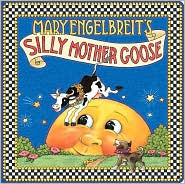
If you love Mary Engelbreit's art and you love classic children's rhymes such as Hey Diddle, Diddle, then you will absolutely love these three books. Engelbreit crafts her classic artistry to illustrate even more classic rhymes. Children love the rhymes about Humpty Dumpty and Jack and Jill, and Engelbreit brings them to life in each of her illustrations.

The rhymes are the same Mothergoose rhymes that most people grew up reading and repeating. Occasionally, a word is slightly different but that is typical of most books repeating the classic rhymes. The rhymes include: Hey Diddle, Diddle; Rub-a-Dub-Dub; Humpty Dumpty; The Old Woman in the Shoe; Mistress Mary; Wee Willie Winkie; Jack and Jill; Pat-a-Cake; Old King Cole; Ring Around the Roses (with different words than the original); Little Bobby Shafto; and Little Boy Blue. These are just a few of the poems in the three books.

A few of them Ladybug had never heard such as:

Three little ghostesses,
Sitting on postesses,
Eating buttered toastesses,
Greasing their fistesses,
Up to their wristesses,
Oh, what beastesses
To make such feastesses!


Every child should know these classic rhymes and what better way to enjoy them than with Mary Engelbreit. Snugglebug and Ladybug enjoyed these three books and hope you do, too!


© Becky Laney of Young Readers

Tuesday, February 3, 2009

My People


Hughes, Langston. 2009. My People. Photographs by Charles R. Smith Jr. Simon & Schuster.

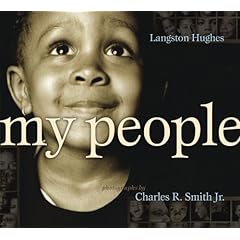
This picture book is incredible. I love the photographs by Charles R. Smith Jr. I do. They're so beautiful, so expressive. They really evoke the mood and tone found in Langston Hughes' classic poem "My People." I really don't see how they could complement each other any better than they already do. You can read the poem in its entirety here. I love what Smith says in his note, "at just thirty-three words total, the poem is a study in simplicity, which is what attracted me to it in the first place." I love simple. And this poem, this book, is further proof that simple can be good, really good. A short and simple poem about beauty paired with masterful photographs.

© Becky Laney of Young Readers

Saturday, October 11, 2008

Aa A was an apple pie


Aa: A Was An Apple Pie. Illustrated by Etienne Delessert.

This picture book is actually an English nursery rhyme from the 1660s. Something used by children to aid in learning the alphabet. It is illustrated by Etienne Delessert.

Aa A was an apple pie
Bb B bit it
Cc C cut it
Dd D dealt it
Ee E ate it.
Ff F fought for it

To read it in its entirely, visit here.

© Becky Laney of Young Readers

Friday, June 27, 2008

Wynken, Blynken, and Nod


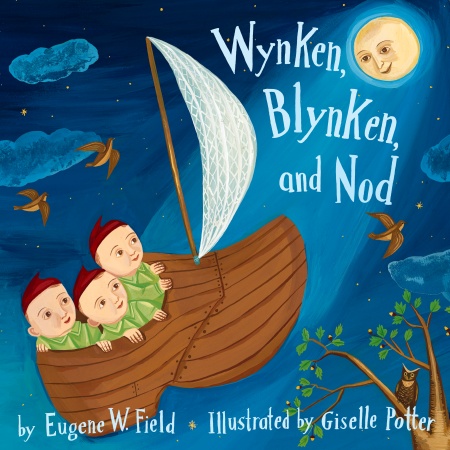
Newly illustrated by Giselle Potter, Wynken, Blynken, and Nod is a classic children's poem by Eugene W. Field. Though I don't specifically recall this one from my own childhood, I showed the book to my mother. She not only knew about Wynken, Blynken, and Nod but she began to list off other poems by Eugene W. Field. And as if that wasn't enough, she then began to sing some of his poems. So it's all a matter of context I suppose.

You can read the poem in its entirety here. Though I thought I'd share the first verse,
Wynken, Blynken, and Nod one night
Sailed off in a wooden shoe---
Sailed on a river of crystal light,
Into a sea of dew.
"Where are you going, and what do you wish?"
The old moon asked the three.
"We have come to fish for the herring fish
That live in this beautiful sea;
Nets of silver and gold have we!"
Said Wynken,
Blynken,
And Nod.

I can't say that I'm a huge fan of the poem. (I don't dislike it. But I don't love it either.) But I can say that I enjoyed the illustrations by Giselle Potter. Some of them were just amazing. They were simply beautiful. And they drew you into the story.

Other reviews (from folks that love the poem and the illustrations both) include: A Well Read Child,
Jen Robinson's Book Page, A Patchwork of Books, Seven Impossible Things Before Breakfast.