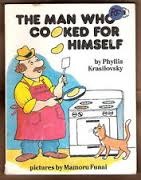
The Man Who Cooked For Himself. Phyllis Krasilovsky. Illustrated by Mamoru Funai. 1981. Parents Magazine Press. 42 pages. [Source: Bought]
First sentence: There once was a man who lived with his cat in a little house on the edge of a wood. He didn't have a wife or children so he always cooked his own supper, cleaned the house by himself, and made his own bed. The man didn't even have a car or a telephone. But he had a friend who visited him every few days bringing him the things he needed.
Premise/plot: What will happen to 'the man' when his friend goes on a summer vacation for three weeks? The friend brings over one last bunch of groceries before he leaves. But will the man's list be thorough enough? long enough?
My thoughts: It's a strange little book. But a strangely charming little book at that. Is it realistic? Yes and no. When the man is hungry and desperate for food, he happens upon a pond where he can fish, wild blueberries, an apple tree, an oak tree, and some watercress. With just a paperclip and some string he catches four fish. As the story went on, the illustrations became hilarious. Readers see the man bent over picking up apples--apples stuffed into his pockets until they're bulging. The man--in the end--learns a valuable lesson about laziness--DON'T--and on how to live off the land.
Text: 3.5 out of 5
Illustrations: 3.5 out of 5
Total: 7 out of 10
© 2018 Becky Laney of Young Readers
Showing posts with label out-of-print. Show all posts
Monday, March 26, 2018
Monday, August 27, 2007
The Gorilla Did It

Today I am highlighting another childhood favorite. The Gorilla Did It by Barbara Shook Hazen. It is illustrated by Ray Cruz. And it was published in 1974. On a personal note, this one was a gift from my great-grandmother. [It is always interesting to me to see which books are inscribed to which sister. My sister and I had one big bookshelf, of course, and shared everything. But it led to some interesting discussions--debates--when it came time to divide out everything. If there are still books with "To Elizabeth" in them, I'm not telling her now.] Books always make the best presents in my opinion. Nothing says love like a book.
The book opens with a young boy asleep in bed. He appears to be sucking his thumb--or at the very least cradling it up close to his mouth. His arms are also wrapped around a teddy bear. Turn the page, and the action begins. What do we see? We see a gorilla gently poking (or touching) the boy's head. Now the boy is WIDE awake. The boy tells the gorilla, "Shhh! Go away. I can't play. I'm sleeping." [Though I've never thought much into this before, the boy doesn't seem shocked to find a gorilla waking him up. He doesn't seem surprised at what he is seeing. So perhaps, just perhaps, this gorilla is a regular visitor.] The gorilla, of course, doesn't say a word. He just begins to play with a yo-yo. So the boy relents, and says, "Okay. But you've got to be quiet, or Mommy'll be mad." But as the two begin to play together in his room, the room gets messier and messier. One picture even shows them riding a tricycle together. But the fun can't last forever. When his mom comes to check on him--to make sure he's sleeping soundly and perhaps because he's been known to make mischief before--she discovers that he has been making quite a mess--a very big mess for just one person to make. So she of course asks the obvious question, "Who made this mess?" His response--which has become a classic at least round these parts--"The gorilla did it." Of course, the mother doesn't see the gorilla. And knows that her son is the one who made the mess. So, of course, there's a scolding. And his anger makes him scold the naughty gorilla who got him to make the mess. But soon the gorilla becomes a repentant gorilla and is ready to make amends by cleaning up the mess he's made. Soon the pair is ready to apologize and ask for cookies. The mother, of course, forgives once she hears the magic words of "I'm sorry."
The book's illustrations are black and white with some occasional color thrown in. For example, the gorilla--the star of the book--is a bluey-black color. Everyone else--everything else--is black and white. [Perhaps, the unnatural blueness of the gorilla is an indication of the fact that he's imaginary.]
As a child, I always thought this book was very funny. For one thing, who doesn't think it's funny to blame someone else for the mess in their room? As a child, I didn't even question the fact that this gorilla was *real.* I just assumed that he, of course, was real. It was funny that the grown-ups just didn't get it. But as a grown-up, I see now that this is imagination at play. It is the story of a boy who let his imagination run away with him--and that wasn't necessarily a bad thing--imagination is good but so is responsibility. This boy learns both. But I think the message is that there is a little gorilla in all of us. A gorilla tempting us to play and be silly when we should be doing something else. A gorilla tempting us to have fun, to enjoy ourselves, to do WHATEVER we want. A gorilla that doesn't necessarily mean to be bad. But a gorilla that sometimes has a hard time listening to the rules and following them.
Sunday, August 26, 2007
The Boy Who Would Not Go To School
Leaf, Munro. 1935. (reprinted 1963) The Boy Who Would Not Go To School: Robert Francis Weatherbee.
Today I am highlighting one of my childhood favorites. (I'm assuming it is the 1963 edition since that was the latest copyright year given. Although it could be early 70s.) The Boy Who Would Not Go To School is Munro Leaf's third picture book. It was published a year before his most-famous book The Story of Ferdinand. Written and illustrated by Leaf, it is a simple story of a boy named Robert Francis Weatherbee who absolutely refused to go to school no matter what his parents said. Here is how Leaf introduces us to our 'hero': This is Robert Francis Weatherbee, who was just like you and me when he was little--only his ears were bigger. His parents liked to imagine him growing up to be a fireman, a policeman, a sailor, or even the president of the United States. But young Robert didn't say a word. When the time came for him to go to school, his father gave him a book, his mother gave him a pencil, and the girl next door gave him an apple. They showed him where to go--the school was right up the road--but Robert Francis Weatherbee would not---WOULD NOT---go to school. And so the reader comes to the first parable:
One day Robert Francis Weatherbee went for a long walk all by himself way down a road that went through the woods. In and out, in and out he walked between the trees, until he was so tired and hungry he was ready to go home. But he learns that if you can't read the road signs, you can't know which way home is. (I liked how the sign posts read: "The Wrong Way" and "Home This Way"). Robert had to wait for his father to come find him. And he missed out on a tasty supper.
So the years pass, Robert grows bigger. (Although his ears are still rather large.) And one day Robert is sitting at home daydreaming about all the things he wants. Most of all he wants a pony with black and white spots. He feels that his uncle, who lives in the west, would send him a pony if he asked for it. But as he goes to get a pen and paper he realizes that it's hopeless. He can't write. He doesn't know how to ask his uncle for that pony after all.
The years really pass now. Robert is all grown up. And I mean ALL grown up. One day, Robert Francis Weatherbee was very hungry, and he asked his mother for a piece of pie. His mother told him to go out and get her ten apples, and she would make a whole pie all for him. So he went out to the orchard, where apples grow on the trees, to pick ten nice big red apples. But when he got there, he didn't get any because he didn't know how many apples are ten--because.....[drumroll please] Robert Francis Weatherbee could not count because he would NOT go to school. So he did not get even a little piece of pie this big.
But this time Robert has learned his lesson. He KNOWS that he made a big mistake all those years ago refusing to go to school. And he's finally ready to enter those classroom doors! So...Robert Francis Weatherbee WENT TO SCHOOL and he learned to read and to write and to count, and he had a good time. The last illustrations show a grown man sitting in a very tiny desk next to two children.
I think there were many things I liked about this book growing up. I liked the drawings. This stick-figure boy and his family. His big ears. The simple parables that were ever-so-obvious yet could cause giggles because we were smarter than Robert. And I liked the charming message that it's never too late to start. That learning is for a lifetime. That learning is for everyone. And I really liked how it was being hungry for an apple pie that made all the difference in the world. I think that is the part that stuck with me through the years.
Many books have been written since The Boy Who Would Not Go To School was published that are very similar. That highlight the benefits and joys of school days. But this one remains a favorite.
http://www.munroleaf.com/
Today I am highlighting one of my childhood favorites. (I'm assuming it is the 1963 edition since that was the latest copyright year given. Although it could be early 70s.) The Boy Who Would Not Go To School is Munro Leaf's third picture book. It was published a year before his most-famous book The Story of Ferdinand. Written and illustrated by Leaf, it is a simple story of a boy named Robert Francis Weatherbee who absolutely refused to go to school no matter what his parents said. Here is how Leaf introduces us to our 'hero': This is Robert Francis Weatherbee, who was just like you and me when he was little--only his ears were bigger. His parents liked to imagine him growing up to be a fireman, a policeman, a sailor, or even the president of the United States. But young Robert didn't say a word. When the time came for him to go to school, his father gave him a book, his mother gave him a pencil, and the girl next door gave him an apple. They showed him where to go--the school was right up the road--but Robert Francis Weatherbee would not---WOULD NOT---go to school. And so the reader comes to the first parable:
One day Robert Francis Weatherbee went for a long walk all by himself way down a road that went through the woods. In and out, in and out he walked between the trees, until he was so tired and hungry he was ready to go home. But he learns that if you can't read the road signs, you can't know which way home is. (I liked how the sign posts read: "The Wrong Way" and "Home This Way"). Robert had to wait for his father to come find him. And he missed out on a tasty supper.
So the years pass, Robert grows bigger. (Although his ears are still rather large.) And one day Robert is sitting at home daydreaming about all the things he wants. Most of all he wants a pony with black and white spots. He feels that his uncle, who lives in the west, would send him a pony if he asked for it. But as he goes to get a pen and paper he realizes that it's hopeless. He can't write. He doesn't know how to ask his uncle for that pony after all.
The years really pass now. Robert is all grown up. And I mean ALL grown up. One day, Robert Francis Weatherbee was very hungry, and he asked his mother for a piece of pie. His mother told him to go out and get her ten apples, and she would make a whole pie all for him. So he went out to the orchard, where apples grow on the trees, to pick ten nice big red apples. But when he got there, he didn't get any because he didn't know how many apples are ten--because.....[drumroll please] Robert Francis Weatherbee could not count because he would NOT go to school. So he did not get even a little piece of pie this big.
But this time Robert has learned his lesson. He KNOWS that he made a big mistake all those years ago refusing to go to school. And he's finally ready to enter those classroom doors! So...Robert Francis Weatherbee WENT TO SCHOOL and he learned to read and to write and to count, and he had a good time. The last illustrations show a grown man sitting in a very tiny desk next to two children.
I think there were many things I liked about this book growing up. I liked the drawings. This stick-figure boy and his family. His big ears. The simple parables that were ever-so-obvious yet could cause giggles because we were smarter than Robert. And I liked the charming message that it's never too late to start. That learning is for a lifetime. That learning is for everyone. And I really liked how it was being hungry for an apple pie that made all the difference in the world. I think that is the part that stuck with me through the years.
Many books have been written since The Boy Who Would Not Go To School was published that are very similar. That highlight the benefits and joys of school days. But this one remains a favorite.
http://www.munroleaf.com/
Subscribe to:
Posts (Atom)
