Friday, May 22, 2026
32. Barbed Wire Between Us
32. Barbed Wire Between Us. Mia Wenjen. Illustrated by Violeta Encarnacion. 2026. 48 pages. [Source: Library] [3 stars, poetry, reverso poetry]
First sentence: IN this land of promise,
we hoped to find a place to belong.
To our surprise, we were unjustly imprisoned.
We came with only what we could carry.
Our family was separated.
Premise/plot: Barbed Wire Between Us uses the poetic format of a reverso poem. It is a picture book for older readers. It tells two stories--same words, different order. One story is set in the 1940s in Japanese internment camps. The other story is set in contemporary times--give or take a couple of years.
My thoughts: This is a picture book that some adults will absolutely love, love, love. Will children be drawn into this story? Perhaps. But I have a hard time imagining it without a lot of pushing from adults (teachers, librarians, etc.).
Is it political? As much as I want to say it is not...it decidedly is. Two different timelines. The Japanese internment was taking Japanese-American families that were living in America--some for multiple generations--and putting them behind barbed wire because they feared they were still loyal to a country that the United States was at war with. There was no proof, no reason beyond fear for this action. The contemporary story is of a family newly entering the United States--illegally--and being put in a immigrant detention center. I will say that the book simplifies or oversimplifies the modern day situation.
I have read fiction and nonfiction for all ages about the Japanese internment. Including a fabulous book about a librarian who sent books to children in these camps.
I like the idea of a reverso poem, but, the modern story just doesn't give enough details to ground it, in my opinion. There are more questions than answers.
© 2026 Becky Laney of Young Readers
Wednesday, March 15, 2023
62. Rescuing Titanic
Rescuing Titanic: A True Story of Quiet Bravery in the North Atlantic. Flora Delargy. 2021. 80 pages. [Source: Library]
First sentence: The year was 1912 and it was the golden age of steam travel. In one of the world's busiest ports, great liners like floating hotels were docked, each hoping to outpace the other across the Atlantic. Before steamships, ocean travel had been fraught with danger and journeys were long and tiresome.
Premise/plot: I'd describe this one as an oversized illustrated nonfiction book for readers of all ages. It is a GREAT fit for elementary age readers. Yet, I could see adult enthusiasts enjoying this one as well.
This one is the story of two ships, two voyages. Carpathia and Titanic. The focus is on the Carpathia--no doubt about it. She was THE SHIP that came to responded to Titanic's distress calls. She was THE SHIP that changed course, risked its own danger from the icebergs, and came to rescue Titanic's survivors. They expected to find a Titanic in distress. What they found, I'm sure was haunting. They rescued those that they could. It is the story of that night/morning.
My thoughts: I loved, loved, loved, loved, LOVED, LOVED, LOVED, LOVED the illustrations. They are so absolutely fantastic. I loved the story as well. It breaks down the chronology of that night. It provides perspectives from both ships. Each spread features a CLOCK. I found this effective.
This book is SO WONDERFUL at what it does. Tell the story in a way that readers of all ages--but especially elementary grade readers--can grasp. It's a compelling read. Super happy to recommend this one.
© 2023 Becky Laney of Young Readers
Tuesday, September 7, 2021
140. The Longest Storm
The Longest Storm. Dan Yaccarino. 2021. 40 pages. [Source: Library]
First sentence: A storm came to our town. It was unlike any storm we'd ever seen. No one knew how long it would last. We were going to have to stay inside, maybe for a long while.
Premise/plot: A father and his children struggle with all the many, many uncertainties of being house-bound for a long, long, long, LONG, long, long, long time. The illustrations and text tell the story of their emotional roller-coaster-like journey. It isn't so much what is going on outside the house in the midst of the storm as what is going on mentally and emotionally within the house.
My thoughts: The Longest Storm could definitely be a picture book for those aged 9 to 99. It is an abstract picture book in some ways. You could easily say it was about mental health or the importance of having coping strategies in place OR you could focus more on the relationships. You can love someone without *liking* them all that much. And relationships can have very tense moments that build and build. Life happens. There are BIG emotions. But the book also shows the importance of being kind and intentional. After all having BIG emotions doesn't make you a villain.
For those wondering...it does have a happily ever after ending tacked on at the end. This makes sense in some ways. Who wants to end a book in the middle of the storm when everything is still so unknown and uncertain? Even though in real life, the transitions from beginning, middle, and end aren't so precise and exact. When you're going through the big storms in life, it would be nice if you could just turn a page and suddenly everything be all brand new and ready to go...but life isn't like that.
© 2021 Becky Laney of Young Readers
Thursday, August 5, 2021
103. A Life Electric
A Life Electric: The Story of Nikola Tesla. Azadeh Westergaard. 2021. 40 pages. [Source: Library]
First sentence:
At the stroke of midnight on July 10, 1856, thunder clapped.
Lightning flashed.
And a baby was born.
"He'll be a child of the storm," his nurse said.
"No," his mother replied, "A child of light."
She did not know that her son, Nikola, would grow up to be both:
one of the most important electrical inventors in the world--
then and now.
Premise/plot: A Life Electric is a picture book biography of Nikola Tesla written in verse.
My thoughts: I really liked this picture book biography. I thought the verse was good. The author pulled in lots of interesting--fascinating--facts and tidbits. For example, while I knew some of his work with electricity, I did not know he was a pigeon lover. I knew that he had plenty of struggles throughout his life--but I didn't realize the depths of his struggles.
I found the illustrations to be unique, old-fashioned, dare I say charming? There's something very old-school vintage about them. If you are drawn to that, then these illustrations may draw you further into the text. Even if you're not--if that artistic style isn't your cup of tea--the text is compelling.
© 2021 Becky Laney of Young Readers
Tuesday, February 9, 2021
15. We Are Still Here! Native American Truths Everyone Should Know
We Are Still Here! Native American Truths Everyone Should Know. Traci Sorell. Illustrated by Frane Lessac. 2021. [April] 40 pages. [Source: Review copy]
First sentence: Our Native Nations have always been here. We are Indigenous to the continent now called North America. Our leaders are sovereign and have power to make rules. Our ways of life changed when white people arrived from Europe.
We Are Still Here! is a nonfiction picture book for older readers. The framework of the story is that a classroom is celebrating Indigenous Peoples' Day and presenting twelve projects. (But despite this framework the book itself is clearly nonfiction.) The twelve projects/topics are: Assimilation, Allotment, Indian New Deal, Termination, Relocation, Tribal Activisim, Self-Determination, Indian Child Welfare and Education, Religious Freedom, Economic Development, Language Revival, and Sovereign Resurgence.
The projects almost have a power-point feel to them. (Not in a bad way, the framework clearly has this being a school research project/presentation). And there's nothing wrong with bullet points after all! The illustrations hint at historical context for the given topic. But not always or exclusively. For those that are curious about the illustrations--exactly what, when, where--there is more information to be found in the back of the book.
The refrain of the book is WE ARE STILL HERE. This is repeated after every single presentation as an affirmation.
There is back matter. A LOT of back matter which is wonderful thing to see in nonfiction.
I found this to be an informative, fascinating, well-researched read. (Not that I am an expert by any stretch of the imagination. But the amount of back matter leads me to believe it is well-researched.)
© 2021 Becky Laney of Young Readers
Friday, February 5, 2021
13. Flip! How the Frisbee Took Flight
Flip! How The Frisbee Took Flight. Margaret Muirhead. Illustrated by Adam Gustavson. 2021. [April] 32 pages. [Source: Review copy]
First sentence: For centuries, folks have been flipping for flying discs. Did cave kids reel round rocks? Maybe. Did the most macho of the Ancient Greeks flick discs? Certainly. But who really invented the thrilling, top-selling toy that came to be called the Frisbee?
Premise/plot: Flip! How the Frisbee Took Flight is a nonfiction book for children about the invention of the Frisbee. The book offers two behind-the-scenes glimpses of how this craze--this toy--took off. First highlighting Joseph P. Frisbie and his pie pans in New England starting in the 1920s, and then highlighting Fred Morrison and his eventual-wife Lu who began playing around with popcorn tins, pie pans, cake pans, etc. in the 1930s in California. It was Morrison's passionate obsession--lasting decades--that led to the plastic product...but it was the name FRISBEE that stuck! (Frisbee sounds so much better than PLUTO PLATTER, don't you think?!
My thoughts: I enjoyed this nonfiction book! I didn't know that the Frisbee was manufactured/distributed by the same toy company that had great success with the Hula Hoop. Of course that wasn't the only I Didn't Know moment the book offers.
You can watch a short video aired originally on Decades about the Pluto Platter/Frisbee.
© 2021 Becky Laney of Young Readers
Monday, November 18, 2019
Birth of the Cool: How Jazz Great Miles Davis Found His Sound
First sentence: Mornings in East St.Louis, Miles Davis sits as close as he can get to the radio.
Premise/plot: The Birth of the Cool is a picture book biography of jazz musician, Miles Davis. It is written in verse. I should add beautifully written in verse with compelling illustrations. It is the story not only of how he became a musician but how he became his own musician with a new, unique style.
My thoughts: I enjoy jazz. I do. I love that there are many picture book biographies of many different jazz artists and musicians both male and female. I am glad to see this one published on Miles Davis. Reading this one inspired me to listen to the album Birth of the Cool. I would recommend that as an extension activity for all ages.
© 2019 Becky Laney of Young Readers
Thursday, June 20, 2019
Walt's Imagination
First sentence: Walt wandered the family farm and saw rabbits, foxes, raccoons, bobwhites, crows, and cardinals. He bottle-fed his favorite pig, Skinny, and rode hogs into their muddy pigpens.
Premise/plot: This is a picture book biography of Walt Disney. Though Disney movies might appeal to young toddlers and preschoolers, this picture book biography is best shared with elementary-aged readers with a good-sized attention span. It is TEXT-HEAVY.
My thoughts: I really enjoyed this one. I loved, loved, loved, LOVED, LOVED, LOVED the illustrations. There is a lot of text--as I mentioned above--but it is for the most part interesting. I also love the inclusion of quotes. The first quote is shared on the opening end pages, "I do not make films primarily for children. I make them for the child in all of us, whether we be six or sixty." I think children's authors often have the same philosophy.
They sure didn't publish biographies like this when I was a 'young reader.'
Text: 3 out of 5
Illustrations: 5 out of 5
Total: 9 out of 10
© 2019 Becky Laney of Young Readers
Monday, June 10, 2019
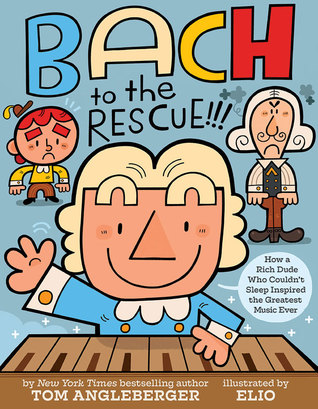
Bach to the Rescue
First sentence: Hey, it's me! Bach, the greatest composer ever! Have I ever told you the story about Goldberg and the Rich Dude Who Couldn't Sleep? It happened about 225 years ago, but I think it's better to start a story like this with Once Upon A Time...
Premise/plot: Is Bach to the Rescue a picture book biography? Probably not technically. The focus is not on Bach's life, or any other person's life, not really. It is a behind-the-scenes story of how Bach composed the Goldberg Variations. Is it a true story? Maybe, maybe not. But it is 'loosely' based on a legend first recorded by Albert Schweitzer. IT may not be a picture book biography, BUT it is without a doubt a lesson on the IMPORTANCE OF SLEEP.
So, because "Rich Dude" couldn't sleep....no one could sleep....trying to get this guy to sleep each night was a full-time job for many, many, many people. EVERYONE was super-super-super-cranky because they were all sleep-deprived. Can Bach save the day?
My thoughts: I will always be thankful that I read this one. I looked up the Goldberg Variations and I've enjoyed listening to them. I honestly can't imagine trying to fall asleep to many of them. Has this picture book convinced me that Bach is the greatest composer ever....probably not. (I'm Team Mozart.) But it was an entertaining read. IF a reading of this one is paired with the music itself, I could see it being a hit.
Text: 4 out of 5
Illustrations: 3 out of 5
Total: 7 out of 10
© 2019 Becky Laney of Young Readers
Friday, May 17, 2019
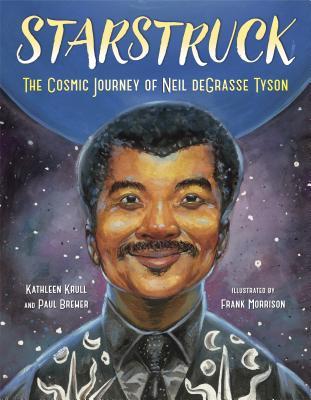
Starstruck: The Cosmic Journey of Neil Degrasse Tyson
First sentence: Our universe began its dance with what scientists call the Big Bang.
Premise/plot: This is a picture book biography of Neil DeGrasse Tyson.
My thoughts: I like this one. I don't love, love, love it. Perhaps because of all the big bang theory stuff at the very beginning. But his biography is interesting. I don't love the illustrations. I thought they were semi-realistic--somewhere between cartoonish and realistic. I would say the humans were drawn fun-house mirror style. This bothered me more than it should have.
Text: 3 out of 5
Illustrations: 3 out of 5
Total: 6 out of 10
© 2019 Becky Laney of Young Readers
Wednesday, May 8, 2019
Midnight Teacher
First sentence: From a young age, Lilly Ann Eliza Cox believed the path to freedom was through education. Born into slavery around 1821 in Petersburg, Virginia, Lilly Ann was the youngest of four sisters. When she was around four years old, her mother died, and Lilly Ann was sold to a family in Kentucky.
Premise/plot: Lilly Ann learned to read and write as a child in Kentucky even though she was a slave, even though educating slaves wasn't the norm. (In some slave states it was actually illegal; in other slave states there wasn't a law against it, but it was probably more the exception than the rule.) She wanted to share her knowledge with other slaves. She began holding secret schools on Sundays. After her master's death, Lilly Ann was sold; her new masters were in Mississippi. It was illegal for slaves to learn to read and write there. Would that stop Lilly Ann from teaching those who wanted to be taught?! NO! It did mean that she'd have to hold school at night and in secret--hence the title of this picture book biography, MIDNIGHT TEACHER. The story of her life is worth your attention.
My thoughts: I really LOVED this one. It is a picture book for older readers, in my opinion, because it has a lot of text. (It could also be a great read aloud for elementary students.) Education is something that we often take for granted; it is something that we don't take time to fully appreciate. This picture book is an engaging read that got me thinking. It celebrates the legacy of a strong woman.
Text: 5 out of 5
Illustrations: 4 out of 5
Total: 9 out of 10
© 2019 Becky Laney of Young Readers
Monday, April 15, 2019
Carter Reads the Newspaper
First sentence: Each February we celebrate Black History Month. It's a time to honor heroes like Harriet Tubman, Rosa Parks, and Martin Luther King, Jr. But there's one hero we sometimes forget. Carter G. Woodson didn't help people escape from slavery, start a bus strike, or lead a movement of millions. Yet without him, we might not have Black History Month. This is his story.
Premise/plot: Carter Reads the Newspaper is a biographical picture book of Carter G. Woodson. Carter grew up hearing stories from his mom and dad about slavery--both of his parents were slaves. He worked hard; he valued education. But nothing came easy for him. That high school education he longed for was only possibly after several years of working in a coal mine. While working as a miner, he was encouraged and inspired by a fellow miner even though he couldn't read or write. Since he knew how to read, he helped others stay informed and continue to learn. He went on to get his education--even a doctorate in history. Once he was challenged by a professor that that was no such thing as black history--Carter knew he was wrong. He was determined to "prove" his people had a history worth knowing, worth studying, worth celebrating.
My thoughts: I'd not heard of Carter G. Woodson before. This was an absolutely LOVELY way to meet him. What a legacy he left behind! I enjoyed this one so much.
Text: 5 out of 5
Illustrations: 5 out of 5
Total: 10 out of 10
© 2019 Becky Laney of Young Readers
Friday, March 8, 2019
Marguerite Makes a Book
First sentence: In a small house in Paris, nearly six hundred years ago, lived a man who made beautiful books. His name was Jacques the Painter, but he was affectionately known as Papa Jacques because he was the oldest and most famous book painter in all of Paris.
Premise/plot: Marguerite Makes a Book is a picture book for older readers. It is set in the Middle Ages in France. The heroine is a young girl, Marguerite, the daughter of a book painter--or illustrator. When her father becomes unable to finish his work, she steps up to completes his order. She knows just what to do and how to do it. In fact her own embellishments make it even more beautiful.
My thoughts: This one is text-HEAVY. It is definitely for older readers. The text is packed with details and information--fascinating stuff for the most part. Not every reader will be interested in book making or this time period in general. But for those that are--it's an excellent read.
Text: 4 out of 5
Illustrations: 4 out of 5
Total: 7 out of 10
© 2019 Becky Laney of Young Readers
Wednesday, March 6, 2019
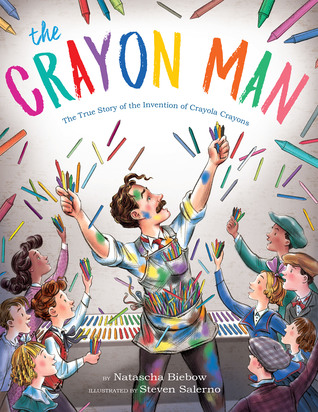
The Crayon Man
First sentence: Once there was a man who saw color everywhere.
Premise/plot: The Crayon Man is a picture book biography of Edward Binney the creator of crayons.
My thoughts: I loved, loved, loved this one. The narrative is well written. It's packed with information--which I loved. Plenty of information is included within the sidebars. But at its heart it remains an entertaining story.
Edwin invented a new kind of inexpensive slate pencil that wrote very smoothly--it was gray. Children loved it! He invented a kind of chalk that wasn't dusty and didn't crumble--it was white. Teachers loved it! He invented a wax crayon that would write on wood and paper packaging. It was really, really black. People loved it.Edwin's wife was a former school teacher. She told him that children needed better, cheaper crayons. So he set about inventing something that would work.
In a large tub at the mill, Edwin's team measured out the ingredients: melted wax, clay to thicken, something for texture, colored powders, each in just the right amount every time to make...a top secret formula. Slowly, carefully, stirring by hand, they poured the special formula into thin, crayon-shaped molds, smaller than any other inventors' just the right size for children's hands. The mixture cooled and hardened. Edwin watched, and Edwin waited.The illustrations are fabulous.
Text: 5 out of 5
Illustrations: 5 out of 5
Total: 10 out of 10
© 2019 Becky Laney of Young Readers
Monday, February 18, 2019
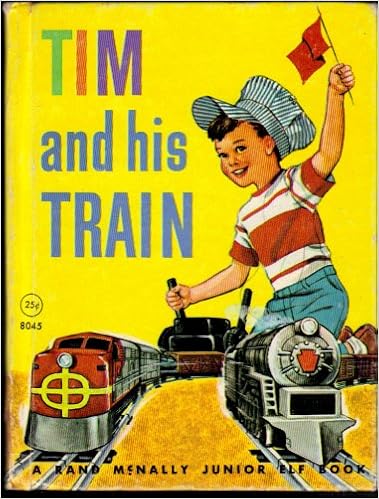
Tim and His Train
First sentence: Tim loved trains. He and his Dad had just returned from a visit to the railroad yards. Tim's head was full of thoughts of streamliners, turntables, switching engines, signal towers, and all of the other interesting sights he had seen.
Premise/plot: Tim receives an electric train for his birthday. Does he love, love, love it? YES, yes he does.
My thoughts: This has a LOT of text. Dad has a LOT of information to pass along to his son before the real play can begin. At times this felt a bit like an advertisement for a toy train with a few instructions rolled in. But not necessarily in a bad way.
I am not particularly a train enthusiast myself. But I do know plenty of people in my life who are--of all ages.
I do LOVE vintage children's books. That is one reason I bought Tim and His Train. This one was originally published in 1949. I've seen it listed as 1959, but I can read Roman numerals. And I can't see how MCMXLIX could be anything other than 1949.
© 2019 Becky Laney of Young Readers
Friday, February 15, 2019
Lights! Camera! Alice!
First sentence: Once there was a little girl named Alice, and she lived on stories. Her grand-mere fed her folktales as she stirred the cherry soup. Her nursemaid spun colorful yarns as she helped button up her boots.
Premise/plot: Lights! Camera! Alice! is a picture book of Alice Guy-Blaché. If you've never heard of her then you're in good company. But all shall be remedied with a quick read of this picture book for older readers. The story opens in France...
My thoughts: I found this an interesting read! I would definitely recommend it to anyone who loves true stories and biographies. I thought the narrative was compelling. Nonfiction books don't "have" to be boring or dull. Facts can come alive on the page in the hands of a good writer. The illustrations are also wonderful.
"The Cabbage Fairy" (1896)
"The Birth, the Life, and the Death of Christ" (1906)
"The Glue" (1907)
"Madam's Fancies" (1907)
"The Cleaning Man" (1907)
"The Cruel Mother" (1908)
"Falling Leaves" (1912)
"Officer Henderson" (1913)
Text: 5 out of 5
Illustrations: 5 out of 5
Total: 10 out of 10
© 2019 Becky Laney of Young Readers
Tuesday, February 12, 2019
So Tall Within
First sentence: In Slavery Time, when Hope was a seed waiting to be planted, Isabella lived in a cellar where the windows never let the sun in and the floorboards never kept the water out. She had ten or twelve brothers and sisters--she couldn't be sure, since almost all of them were sold as slaves before she was old enough to remember.
Premise/plot: So Tall Within is a picture book biography of Sojourner Truth.
My thoughts: One word: COMPELLING. I thought the text--the narrative--was fabulously written. I didn't love, love, love every single illustration, but overall I thought the illustrations complemented the text well. This one would be for older readers since it is so text-heavy. But older readers need picture books. There is nothing wrong in using the picture book format to craft a compelling nonfiction narrative. Words and illustrations can work together in powerful, creative way.
Text: 5 out of 5
Illustrations: 3 out of 5
Total: 8 out of 10
© 2019 Becky Laney of Young Readers
Monday, February 4, 2019
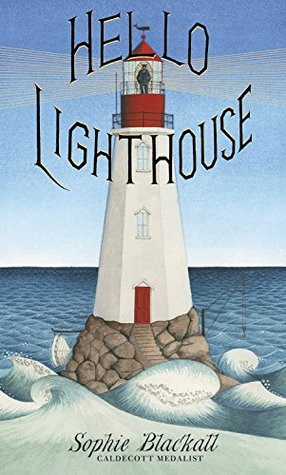
Hello Lighthouse
First sentence: On the highest rock of a tiny island at the edge of the world stands a lighthouse. It is built to last forever. Sending its light out to sea, guiding the ships on their way. From dusk to dawn, the lighthouse beams. Hello!... Hello! Hello, Lighthouse!
Premise/plot: Hello Lighthouse imagines what it might have been to be light keeper and live in a lighthouse. The picture book opens with the 'new' keeper arriving and closes with his retirement--he has been replaced by a machine. In between times there is a lot of living--ups, downs, highs, lows.
My thoughts: Hello Lighthouse won the Caldecott Medal in 2019. I checked it out because it won. I'm not sure I would have sought out a picture book specifically about lighthouses if it hadn't won. But I am glad I did. What did I think of the text? the story? What did I think of the illustrations?
I'm honestly not sure what I think of the story. I think it was realistic in depicting the hardships. The more you think about it the more emotionally complex the story becomes--what it says, what it doesn't say. How did he feel about being replaced by a machine? Was he sad to go? Was he happy to go? Was he going to miss the lifestyle? How did his wife and daughter feel? Are readers supposed to be sad with the ending? Is it supposed to feel oh-so-bittersweet?
Is this a picture book for young readers or older readers? What is the right age for this book? It is on the text heavy side and as I mentioned before it offers some complexity to it. I am leaning towards thinking this one is for older readers.
As for the text itself, at times it felt poetic.
I do know what I think of the illustrations. I loved them. I thought they were beautiful.
One more thing. I read a library copy and was SAD, SAD, SUPER SAD to see that so much of the author's note--"about lighthouses" was hidden and covered up. This could have been avoided if only the author's note was not printed on the end pages itself.
Text: 4 out of 5
Illustrations: 5 out of 5
Total: 9 out of 10
© 2019 Becky Laney of Young Readers
Tuesday, January 15, 2019
Finding Winnie
First sentence: "Could you tell me a story?" asked Cole.
Premise/plot: Cole, the author's young son, asks for a story--a TRUE story; he wants a true story about a BEAR. What the author shares with her son--in the story--and with readers--in the book--is indeed a true story. The story of how a young soldier on his way to war--the author's great-great grandfather finds a bear at a train station, buys it, and takes it with him. The bear's name is WINNIE. And when Harry Colebourn goes to the front, he leaves Winnie in the London Zoo. Many people loved going to see Winnie, but, the best known perhaps is A.A. Milne's young son.
My thoughts: I love several things about this one. I love the personal connection. The author is sharing her own family history with readers. Older readers may enjoy looking at the album at the back of the book. Many photos and captions are included. This grounds the book very well as being a TRUE story. It brings the story to life.
But I also enjoy the framework of this one. It is a book that celebrates storytelling and families. I believe it is a bedtime story he's asking for. I love the idea of parents sharing their own stories with children, and true stories at that! Throughout the story, readers hear the mother and son chatting. It works.
I also just genuinely love the writing of this one!
ETA: I read this first in 2016. I reread it again in January 2019. I love it just as much this second time reading it. I may even love it more. The author has now written a new book for young readers a fantasy novel from the bear's point of view.
Text: 5 out of 5
Illustrations: 5 out of 5
Total: 10 out of 10
© 2019 Becky Laney of Young Readers
Friday, October 19, 2018
Little Brown
First sentence: Little Brown was cranky. Probably because no one ever played with him. Or maybe no one ever played with him because he was cranky. At this point, it was hard to know.
Premise/plot: Little Brown is the star of this picture book. When the book opens he is cranky and lonely. When the book closes he is cranky and lonely. In between Little Brown and the other dogs--whose names we learn on the end pages--wonder about life's complexities.
Why doesn't Little Brown have friends? Does his crankiness keep the other dogs from liking him, playing with him, being his friends? Or is it his loneliness--his lack of friends and playmates--making him cranky? If the other dogs were his friends--if they took the first step--would he stop being cranky? What if he took the first step--would they reject him? Wouldn't that make him even crankier to be rejected?
Here is a line that got to me, "But Little Brown did nothing and did it alone."
My thoughts: The first time I read this book I was frustrated. I didn't want to think about the complexities of friendship--of life--and the golden rule (do unto others as you would have them do unto you). I wanted a lesson tied up with a bow. I wanted Little Brown to return what he'd stolen. I wanted Little Brown to have been forgiven by the other dogs. I wanted Little Brown to have been accepted by the other dogs. I wanted him to make a friend. Or else I wanted another dog to step forward and make the first step of friendship. In short I wanted a happy ending--to be assured that even cranky, lonely
The second time I read this one I liked it better. I identified with it more. Who hasn't been Little Brown at some point? (Is Little Brown the dog version of Alexander and the Terrible, Horrible, No Good Very Bad Day?!) Who hasn't experienced cranky days? Who hasn't experienced loneliness? The truth is that it is almost always scary to take that first step. I don't know that kindness is ever super-super easy. But. It is true that it easier to be a kind to someone who is "nice" and "friendly" and "cheerful." It is more difficult to be kind to someone who is "cranky" or "mean" or "sad" or "angry" or "lonely" or "bitter." The people who need our kindness the most can be the most difficult to reach out to.
"First of all," he said, "if you can learn a simple trick, Scout, you'll get along a lot better with all kinds of folks. You never really understand a person until you consider things from his point of view--"If there is a lesson in Little Brown, perhaps it's an interactive lesson in perception and empathy. When Little Brown is cranky what other emotions could he be feeling?
"Sir?"
"--until you climb into his skin and walk around in it." (Harper Lee, To Kill A Mockingbird, 30)
Text: 3 out of 5
Illustrations: 4 out of 5
Total: 7 out of 10
© 2018 Becky Laney of Young Readers