Showing posts with label space. Show all posts

Wednesday, July 12, 2023

170. Spacebusters Race to the Moon


DK Super Readers (Level 3) Spacebusters Race to the Moon. Philip Wilkinson (according to Goodreads) 2023. [April] 48 pages. [Source: Library] [Nonfiction, early chapter book]

First sentence: Three, two, one--blastoff! With a great roar, the Apollo 11 rocket lifted off the ground. Flames and smoke poured from its base as it started its dangerous journey to the Moon. President John F. Kennedy had promised an American would reach the Moon before the end of the 1960s. The astronauts could make history! 

Premise/plot: This is a nonfiction book for young, independent readers. It focuses on one mission of the space race in the 1960s--the flight of Apollo 11. The last chapter--the fourth chapter--gives a brief summary of later missions. 

My thoughts: Is this the most compelling, engaging book for young readers about the space race, about Apollo 11? No. Not really. It's good; solid; basic. But I've read other books--including some picture books--that do a better job of telling this specific story. This one blends photographs AND illustrations. 


© 2023 Becky Laney of Young Readers

Sunday, February 12, 2023

40. Space Cat


Space Cat. Ruthven Todd. Illustrated by Paul Galdone. 1952. 80 pages. [Source: Library]

First sentence: The little gray kitten had always been the most adventurous member of his family. He had been the first to explore the roof of the apartment building where he lived with his brothers and sisters. There he had sat for hours admiring the face of the Cat in the Moon until his mother had dragged him in by the scruff of his neck. The next day he had managed to maroon himself on top of the flagpole on the roof and the Fire Department had had to be called to take him down.

Premise/plot: When a [cute, adorable, super-curious] gray kitten befriends Captain Fred Stone, he gets a new name, "Flyball," a new home, and new adventures. Flyball accompanies his human to the moon and back. Their adventure on the moon isn't without some peril--good thing Flyball is there to save the day. 

My thoughts: This charming little book was written in 1952. It is always interesting/intriguing to see how the public [writers, readers] imagined space exploration to be like. This one was written, published, and enjoyed long before NASA sent anyone to the moon--or even into orbit. This qualifies both as science fiction and fantasy. It is told through the perspective of the cat. There are plenty of men [military men] talking rockets, rockets, and more rockets. 

I enjoyed this one. The illustrations are wonderful.


© 2023 Becky Laney of Young Readers
Thursday, April 4, 2019

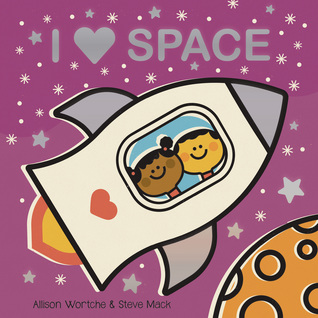
Board book: I Love Space

I Love Space. Allison Wortche. Illustrated by Steve Mack. 2019. Houghton Mifflin Harcourt. 14 pages. [Source: Review copy]

First sentence: CALLING ALL ASTRONAUTS! Ready to zoom into space? Hop into your shuttle. 3-2-1...Blast off!

Premise/plot: This board book introduces SPACE to little ones. It is an interactive board book. There are pages that fold out, flaps that lift, and wheels that turn.

My thoughts: I thought this one was cute. It has simple, basic facts about our solar system. It is also super-colorful. I've never thought about space being PURPLE, but why not?!

Text: 4 out of 5
Illustrations: 4 out of 5
Total: 8 out of 10

© 2019 Becky Laney of Young Readers

Tuesday, February 23, 2010

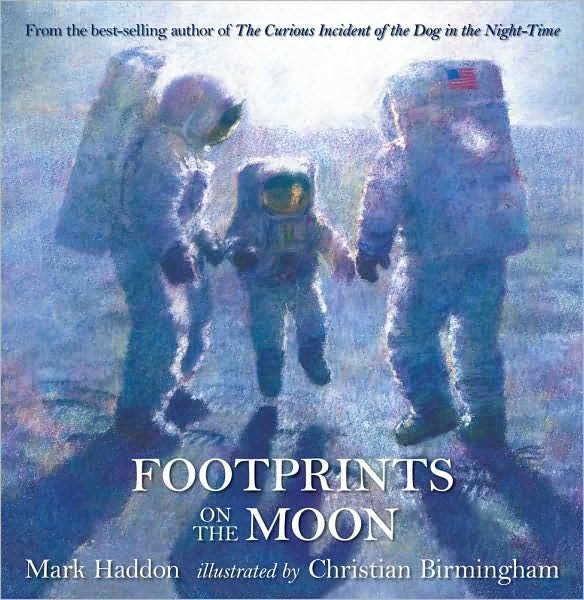
Footprints On the Moon


Footprints On the Moon by Mark Haddon. Illustrated by Christian Birmingham. 2009. [March 2009] Candlewick Press. 32 pages.

Years ago there was a little boy who had the solar system on his wall.

A little boy imagines (or dreams) that he is part of the historic moon landing in 1969. That's a quick little summary of this picture book by Mark Haddon. That 'little boy' is the author. And the book is based on his recollections of what it was like--really like--to be growing up during this time. What it was like to watch the moon landing. What it was like to see men walk on the moon. What it was like to dream big dreams. Here's a bit of text to give you an idea of the writing style:

He borrowed library books and read about how astronauts had orbited the earth and walked in space and how they'd flown around the moon itself. And every night he hoped and hoped that one day they would find a way to land and walk across the tiny world where he had dreamed of walking.

And eventually, one cloudless night, they did.
This one was originally published in 1996 in the UK. It was reprinted in the US by Candlewick in 2009.

The illustrations were probably my favorite part of this one. (I thought that the text was a little heavy in some places.)

© Becky Laney of Young Readers