Showing posts with label mg fantasy. Show all posts

Sunday, July 23, 2023

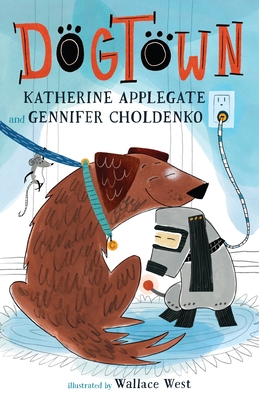
196. Dogtown


Dogtown (A Dogtown Book #1) Katherine Applegate and Gennifer Choldenko. 2023. [September] 352 pages. [Source: Review copy] [Animal fantasy; J Fiction; MG Fiction]

First sentence: I know what you're thinking: That poor dog only has three legs. But don't go there. It's not that bad, okay? So, I'm not American Kennel Club material. Big deal. My eyes are sharp, my nose is wet, my coat puppy soft, and the white patch over my eye? It's a charmer, I don't mind saying. My name is Chance. I'm pleased to meet you.

Premise/plot: Dogtown is an animal shelter (dog shelter). It features dog-dogs and robot-dogs. (Presumably, this animal fantasy is futuristic animal fantasy). It stars Chance, our LOVABLE, adorable, super-kind hero. He's long been a resident at Dogtown. This is the story of his friendships at Dogtown. In particular, how he made [close] friendships with two unlikely residents: a mouse (named Mouse) and a robot dog, Metal Head. The book contains their adventures/misadventures.  

My thoughts: Does this one feature a dog in peril? Yes and no. No, in that it isn't just one dog in peril. It is DOGS (plural) in peril. Though this one doesn't feature direct-direct sads, it features plenty of potential peril. Does it have heart and substance? A thousand times yes. I loved, loved, loved, loved this one so much. I LOVE the emotional journey of this one. Very feel-good. Very warm-and-cozy. Yet not instant. Do I see myself rereading it? YES. I already want to reread it. I could reread it a million times and still be moved by how awesome it is.

I loved the story. I loved the characters. I loved EVERYTHING. 

My favorite, favorite, favorite element of this one is the inclusion of the BOOK BUDDY program. Pairing school-age children with shelter-dogs for reading time. These scenes were HEART-MELTING. 

© 2023 Becky Laney of Young Readers

Tuesday, January 17, 2023

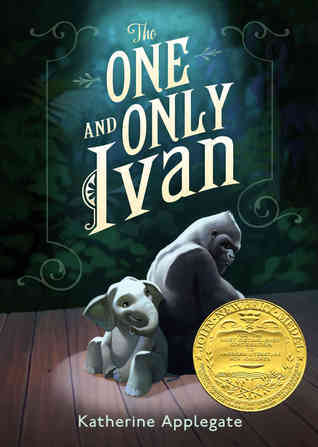
13. The One and Only Ivan


 The One and Only Ivan. Katherine Applegate. Illustrated by Patricia Castelao. 2012. 307 pages. [Source: Library]

First sentence: I am Ivan. I am a gorilla. It's not as easy as it looks. 

ETA: I read this one initially in 2012 (see below review). I reread it in January 2023. I don't know that I could improve upon my initial review. Everything I said in the review below, I stand by. My love for this novel hasn't faded with time. 

Want to read one of the best, best books of the year? May I suggest Katherine Applegate's verse novel, The One and Only Ivan. I can't promise that every reader will come to LOVE Ivan, Ruby, Stella, Bob, Julia, and George, but you might end up loving them just as much as I did. (Ivan is a gorilla; Ruby and Stella are elephants; Bob is a dog; George and Julia are two of the most sympathetic human characters in the novel.)

So what is it about? It's about a small group of animals on display at Exit 8 Big Top Mall and Video Arcade. Ivan, the gorilla, is an artist whose works sell in the gift shop. He's been captive almost thirty years. Stella is one of his dearest friends, she's an elephant who knows quite a few tricks. She's a great storyteller, but, many of her stories are bittersweet. She's had a hard life to have such a great memory. Bob, the stray dog, is Ivan's other best friend, he's not really on display--not wild enough, not talented enough--but to Ivan, well, he's the best dog in the world. One day, Mack, the owner, brings someone new: a baby elephant named Ruby. Her arrival changes EVERYTHING for Ivan. For at long last, he has someone to protect. 

Within pages, I was hooked. Here is the second poem:

names


People call me the Freeway Gorilla. The Ape at Exit 8. The One and Only Ivan, Mighty Silverback.


The names are mine, but they're not me. I am Ivan, just Ivan, only Ivan.


Humans waste words. They toss them like banana peels and leave them to rot.


Everyone knows the peels are the best part.


I suppose you think gorillas can't understand you. Of course, you also probably think we can't walk upright.


Try knuckle walking for an hour. You tell me: Which way is more fun?

The narrative voice is so strong, so rich, so observant, so right. Here are just a few examples:

Humans speak too much. They chatter like chimps, crowding the world with their noise even when they have nothing to say. (3)
Anger is precious. A silverback uses anger to maintain order and warn his troop of danger. When my father beat his chest, it was to say, Beware, listen, I am in charge. I am angry to protect you, because that is what I was born to do. Here in my domain, there is no one to protect. (10)
It was Julia who gave me my first crayon, a stubby blue one, slipped through the broken spot in my glass along with a folded piece of paper. I knew what to do with it. I'd watched Julia draw. When I dragged the crayon across the paper, it left a trail in its wake like a slithering blue snake. (16)
Humans don't always seem to recognize what I've drawn. They squint, cock their heads, murmur. I'll draw a banana, a perfectly lovely banana, and they'll say, "It's a yellow airplane!" or "It's a duck without wings!" That's all right. I'm not drawing for them. I'm drawing for me. (17)
My visitors are often surprised when they see the TV Mack put in my domain. They seem to find it odd, the sight of a gorilla staring at tiny humans in a box. Sometimes I wonder, though: Isn't the way they stare at me, sitting in my tiny box, just as strange? (23)
Bob's tail makes me dizzy and confused. It has meanings within meanings, like human words. "I am sad," it says. "I am happy." It says, "Beware! I may be tiny, but my teeth are sharp." Gorillas don't have any use for tails. Our feelings are uncomplicated. Our rumps are unadorned. (35)
Homework, I have discovered, involves a sharp pencil and thick books and long sighs. (44)
But hunger, like food, comes in many shapes and colors. At night, lying alone in my Pooh pajamas, I felt hungry for the skilled touch of a grooming friend, for the cheerful grunts of a play fight, for the easy safety of my nearby troop, foraging through shadows. (133)
It's an odd story to remember, I have to admit. My story has a strange shape: a stunted beginning, an endless middle. (144)
The One and Only Ivan is definitely an EMOTIONAL read. It's a book about how humans treat or mistreat animals. It tells the story of several animals: Stella, Ivan, Ruby, etc. In some cases relating how they got to their current "domain" (cage, or prison). For the most sensitive reader, it may prove a little too much in a few poems. Overall, I think it's a great read. Powerful, compelling, beautifully written.

Read The One and Only Ivan
  • If you love E.B. White's Charlotte's Web
  • If you love Kathi Appelt's The Underneath
  • If you love animal stories
  • If you love gorillas, elephants, dogs
  • If you love GREAT writing


© 2023 Becky Laney of Young Readers

Wednesday, October 5, 2022

157. Violet and Jobie


Violet and Jobie In the Wild. Lynne Rae Perkins. 2022. [September] 240 pages. [Source: Library]

First sentence: The SNAP! of the cheese game was frightening if you weren’t expecting it. Or even if you were. Violet and Jobie stuffed tissue into their ears. Together they lifted the snapping pole, then moved into their assigned places: Jobie crouching in front, Violet reaching up behind him.

Premise/plot: After Violet and Jobie are caught, these brother-sister mouse siblings are released in the wild. Before, nature was something that they watched on the television screen, not something that they actually experienced. But now that they are in the wild, they have to find a way to survive. Not just against the elements, but against predators as well. These two find a great friend in Zolian (I believe I have the name right; I didn't write it down in my notes). With a little help from an older--much older--and wiser--much wiser mouse, these two may be able to live out their lives. But being a mouse is always risky.

My thoughts: My favorite thing about Violet and Jobie was the narrative. I loved the writing. I enjoyed the characterization. It is--in my opinion--a bittersweet novel. But if you enjoy animal fantasy OR coming of age novels OR novels with a Kate DiCamillo touch, then this one should be one you consider. I absolutely loved, loved, loved parts of this one.

Quotes:

Let’s go toward the sun,” she said. “At least we’ll be going in a straight line.”
And so, they did.
They couldn’t always see the sun, but they could see the shadows, and then guess where the sun was. For quite a long time, they made their way silently. Sometimes they clambered over a boulder or skirted a puddle. After each obstacle, they checked to see where the light was, and where there was shadow. And then they continued on, as lost in their own thoughts as they were in this world. Violet’s thoughts bounced all around. She thought about cheese, and where and whether it could be found in this strange place. She thought about their mother and father and brothers and sisters and aunts and uncles and cousins, who would be wondering where they were. 
 
“It’s not going to be a human house,” he said. “There are no human houses here.”
“I know that,” she said. “But—”
“But what?” asked Jobie.
The truth was, Violet didn’t know But what. She was going through a process. She was getting used to an idea. The idea that life was going to be different now.
The first hollow they looked at (that didn’t smell of fox) seemed unbearably primitive. Horrible. And they were all much the same after that. But she began to notice slight differences: how this one felt sort of cozy. How this other one had a good view. How the next one had an alcove, almost an extra room. She knew she was going to have to settle for something soon. They stopped to rest and get a drink of water at the edge of a pond. As she wiped her mouth with her paw, which was now muddy so of course she had to then rinse it off and wipe her face again, Violet surveyed the scene. Trees, trees, trees. And rocks. Mud and dirt. She glared at the trees. And the rocks, the mud, and the dirt.
 
And then he couldn’t remember what he was trying to remember. Oh, yes—the familiar flavor. But he couldn’t even taste it anymore. It had blended in with the rest of his mouth.
“Let it go,” he told himself as he drowsed off once more. “You’ll figure it out tomorrow.”
Which, in a way, was an answer to the question what does it taste like? Because if there was going to be a tomorrow, what it tasted like was hope.

And then another mouse, Bear (Because he was big and burly. For a mouse.), explained an even more complicated game where a mouse pretended to be another animal that was pretending to be even another animal, and they had to guess both. To demonstrate, Bear pretended to be a bee pretending to be a snake. It was almost impossible to act out, and even harder to guess, but they all laughed so hard they couldn’t see straight. Tears of laughter streamed down their cheeks.
 
“Jobie is right,” she murmured as she hurried down the tree and into the connecting burrow. “I will be fine. I will be fine. I will be fine.
“I will be alone and miserable, but fine.” She laughed. And when you hear yourself laugh, that’s when you know that you really will be fine. Eventually. Maybe even sooner.
Violet hummed a little as she searched the tunnels and chambers of Zolian’s abode. He didn’t seem to be in any of the usual spots, but with Zolian, this was not unusual. She called out his name and was impressed by the cheeriness of her own voice.
“Good job, Violet,” she said. She called out again and listened for a response, but heard nothing. She began to worry. Until she remembered that the day before, Zolian had told her about the migration of the sandhill cranes.
“It’s really something to see,” he had said. “I came upon it in my rambling days, and I still like to make the pilgrimage. They are very large birds, and thousands of them lift up and fly all at once. Really heart-stopping.

Her courage flagged. She had been quite brave, she thought.
“How many times do I have to be brave?” she asked. She knew the answer: At least one more time. Always one more time.
“I don’t want to,” she said.
It’s scary when you don’t know what to do. But if you can think of one or two things that you do know how to do, and then do them, that can help.

© 2022 Becky Laney of Young Readers

Sunday, September 18, 2022

143. The Sisters Grim: The Fairy-tale Detectives


The Sisters Grimm: The Fairy-Tale Detectives. Michael Buckley. Illustrated by Peter Ferguson. 2005. 284 pages. [Source: Library]

First sentence (of the prologue): The dense forest branches scratched at their faces and arms, but Sabrina and Daphne couldn't stop running, though they had long since passed the point of exhaustion. Fear was fueling each step now. Another thunderous bellow rang in the distance, followed by the terrible sound of falling trees and shrieking animals.
"We have to find a way to stop it," Daphne cried between gasps. Sabrina knew her little sister was right. But how? They were two children versus a vicious monster.
"I'll think of something," Sabrina said, dragging her sister behind an enormous oak tree for a much-needed rest. Sabrina squeezed her sister's hand to reassure her, while she forced oxygen into her burning lungs. Her words were empty. She didn't have a plan. The only thing going on in her head was the thumping of blood roaring through her eardrums. But it made no difference. It had found them. Splintering wood and damp soil rained from the sky as the tree they stood next to was violently uprooted. The two girls looked up into the horrible face above them and felt hot breath blow through their skin. What's happened to our lives? Sabrina wondered. When had their world become unrecognizable? And what had happened to her, the eleven-year-old girl who only two days ago had been just an orphan on a train?
 

 Premise/plot: Sabrina and Daphne are young sisters with a legacy or heritage about to catch up with them. When their parents disappeared over a year ago, the two had been placed into foster care or social services. Bounced from home to home, now the girls are on their final journey to a new home. A mysterious relative has stepped up to claim them. Now Ms. Smirt, their social worker, has only to deliver them to Ferryport Landing and her work will be done.

Smirt had made a mistake when she chose a career with children, Sabrina thought, especially since she didn't seem to like them. Ms. Smirt complained whenever she had to touch their sticky hands or wipe their runny noses, and reading bedtime stories was completely out of the question. She seemed to especially dislike the Grimm sisters and had labeled them rude, uncooperative, and a couple of know-it-alls. So, Sabrina was sure it was Ms. Smirt's personal mission to get the girls out of the orphanage and into a foster home. So far it had failed miserably. She'd sent them to live with people who were usually mean and occasionally crazy, and who had used them as maids, house sitters, or just plain ignored them. But this time she had gone too far. This time Ms. Smirt was sending them to live with a dead woman. (2-3)

This 'dead woman' is their grandmother Grimm. Eccentric, yes. And the environment is odd at best. And their are certain rules the girls will have to adjust to...but it soon becomes clear...at least to the reader that this will be a loving, adventure-filled home.

Here is a description of the house beginning with the living room: (can you guess why I like it???)
It was enormous, a much larger room than seemed possible in a cottage so small. Each wall was lined with bookshelves, stuffed with more books than Sabrina had ever seen. Stacks of them also sat on the floor, the tables, and every other surface. A teapot perched precariously on a stack that looked as if it would fall over at any moment. Books were under the couch cushions, under the carpet. Several giant stacks stood in front of an old television, blocking any chance that someone could watch cartoons. On the spines Sabrina read the strangest titles: BIRDS OF OZ, THE AUTOBIOGRAPHY OF AN EVIL QUEEN, and SHOES, TOYS, AND COOKIES: THE ELVISH HANDCRAFT TRADITION. Mrs. Grimm led them through another door where a dining room table sat littered with books, open and waiting to be read. Sabrina picked one up and rolled her eyes when she read the title: 365 WAYS TO COOK DRAGON. (15)

And it doesn't take long for the adventures to begin....but I won't spoil them here!!! This is one you'll have to read for yourself.

My thoughts: I have always meant to reread this series. I have. I remember absolutely loving it. I enjoyed rereading it. It was just a delight. And it's definitely been long enough--fifteen plus year--that it's like reading the book for the very first time. 


© 2022 Becky Laney of Young Readers

Thursday, November 11, 2021

163. The Bookshop of Dust and Dreams


The Bookshop of Dust and Dreams. Mindy Thompson. 2021. [October 26] 272 pages. [Source: Library]

First sentence: The bookshop is feeling blue today. I sense it the moment my brother James and I arrive home from school. The lights are low, the ever-shifting wallpaper is a cheerless dark gray, with somber books on display--Wuthering Heights, Old Yellow, A Little Princess. The gloom sinks into my bones.

Premise/plot: The Bookshop of Dust and Dreams has an intriguing premise. It is set during the Second World War--1944 to be precise. But its main setting is a bookshop. Rhyme and Reason is one of a handful of magical bookshops. "Our shop isn't a normal bookshop, it belongs to the world of magic ones. Just like the others, Rhyme and Reason finds people from outside of our time and brings them to our door. It searches a hundred years into the future and the past to find customers who need the light and hope it can offer through books and community. Papa says bookshops are good for broken souls and wounded hearts." Poppy, our heroine, is quite a bookworm. She loves, loves, loves, loves her family's bookshop. She loves meeting all the customers--all ages of customers--from all time periods. But the shop has been acting weird, strange, out of sorts, unpredictable, moody. And Poppy feels called--in more ways than one--to try to mend the shop and set things right again. But that process is complicated. How does one *know* what the right thing to do is? There can be a subtle difference between something feeling right and being right. And sometimes doing what is right breaks your heart--shatters it. Still the fate of the bookshop may be in her hands--as incapable and unsure as she feels. 

My thoughts: This book had the potential to be super-fluffy and just pure delight OR the potential to be a weighty complex read. It was certainly heavier than I imagined it might be. The premise is pure delight: a MAGICAL bookshop. Customers coming into the shop from ALL time periods. Being able to read books from other time periods. Books finding the right reader at the right time. Books connecting people together. A true sense of community between readers--no divisions or divides. Pure delight. But it goes beyond that and ventures into more familiar territory perhaps--the battle between good and evil, light and dark. The magic that makes the bookshop possible is more complex than you might think. Magic comes with a price--in the words of Rumpelstiltskin from ONCE Upon A Time. There is a showdown between light and dark in The Bookshop of Dust and Dreams. And the book has more layers than you might expect. I found myself accurately predicting a few things, but it held some twists and turns that I did not guess, would never have guessed.

© 2021 Becky Laney of Young Readers

Thursday, October 7, 2021

154. Scary Stories for Young Foxes

Scary Stories for Young Foxes. Christian McKay Heidicker. Illustrated by Junyi Wu. 2019. 320 pages. [Source: Library] [Newbery Honor; J Fantasy; MG Fantasy; J Fiction; J Fantasy; Animal Fantasy]

First sentence: The haunted season had arrived in the Antler Wood.

Premise/plot: Seven kits sneak off for story time in Heidicker’s new animal fantasy. The stories aren’t for the timid, these are SCARY stories (for foxes). The storyteller, an old fox, tells a series of stories—seven or eight. The stories star other fox kits...and as the book progresses, readers realize the stories are related to each other and tell one big story.

Mia and Uly are the two stars of the stories...

My thoughts: Scary Stories for Young Foxes was named a Newbery Honor book in 2020. It is definitely an action-packed, character-driven fantasy novel that is intense. I loved the perspective; for whatever reason I had never seen Beatrix Potter as a super scary villain. This is just one example.

Overall it was a satisfying read. That being said it is as grim and gruesome as watching a nature special. If the thought of some kits (and some foxes and vixens) not making it disturbs you, this might not be the best choice for you.

I originally read this one in February 2020. I reread it in October 2021. It was just as delightful the second time around.


© 2021 Becky Laney of Young Readers

Thursday, September 16, 2021

144. The Gilded Girl


The Gilded Girl. Alyssa Colman. 2021. 352 pages. [Source: Library]

First sentence: Izzy watched through a crack in the door as the young ladies in the parlor burst into flame.

Premise/plot: The Gilded Girl is a retelling of The Little Princess set in New York City in 1906/1907. Emma Harris, one of our heroines, plays the role of the 'spoiled' little rich girl. (She's not spoiled. Emma Harris even before the fall that everyone knows is coming has a heart of pure gold.) Izzy, our other heroine, is a servant at the school. 

The school is where the book perhaps takes the most liberties. For this isn't just any elite boarding school, it is Miss Posterity's Academy for Practical Magic. She teaches wealthy young girls how to do magic, how to prepare for the Kindling Ceremony and the Kindling Winds that blow every December. Those whose magic is kindled can become licensed magicians. Magic is only for the wealthiest, most prestigious classes of society. Otherwise one's magic is snuffed out at age 12. 

Izzy has magic--though a servant--and she does not want it snuffed out. Emma is forced into servitude. She also doesn't want to lose her magic. These two work together as servants and secret students to see if they can hold onto their magic despite their poverty.

My thoughts: I enjoyed this one very much. The intended audience for this one were born probably between 2008 and 2012. Today's generation may or may not be familiar with the story of The Little Princess. Most probably wouldn't have read the original. Some may have seen it adapted for film. It is not labeled by the back copy (jacket copy) as being a retelling of The Little Princess. I am curious if this was intentional. Because it is glaringly apparent if you're an adult that this is without a doubt The Little Princess newly adorned.

I think my favorite part of The Gilded Girl was the "house dragon" (aka the black cat pictured on the cover) named FIGGY PUDDING.


© 2021 Becky Laney of Young Readers

Friday, August 27, 2021

131. The Hedgehog of Oz


The Hedgehog of Oz. Cory Leonardo. 2021. [February] 400 pages. [Source: Library]

First sentence: Tucked between a brick apartment building and a busy corner deli, on a storybook tree-lined street, sits a theater. A run-down but beautiful theater.

Premise/plot: Marcel (our Oz-loving hedgehog) lives at The Emerald City Theater with Auntie Hen and Uncle Henrietta (two chickens). He misses *his* Dorothy--the little girl who gave him a happy, happy home. But that was BEFORE and sometimes it's too painful to think about before. But before readers get properly settled into a routine with Marcel and company, the theater is closed and the animals are rounded up and dumped. Marcel finds himself separated from his chicken friends...and in the woods. Here he'll have to start completely over making new friends...friends that may eventually feel like family...but it's exhausting work being LOST and LONELY and SAD. Where does he go from here? Does he try to get back to the theater in the city? Does he try to find *his* Dorothy (that's not her real name)? Does he make peace with his new circumstances?

My thoughts: I wanted to love, love, love this one. I did. I absolutely love the cover. If I was giving out stars based on the cover alone, I'd give it a five easily. I do typically love animal fantasy. So my hopes were very high.

I didn't quite love, love, love this one. I loved elements of this one. I particularly loved the wisdom of Oona the moth. She has without a doubt some of the best lines of the whole book.

"Oona?" he tried. "Have you come to help me now--help me get back to the theater?"
The moth gave him a sad sort of smile. Her voice was quiet. "No, Marcel. Not in the way you'd like, I'm afraid. What you're asking isn't that easy."
"Oh." At her words, something inside Marcel deflated.
He'd been thinking about something for a little while now. Since he'd lived in the theater, he'd seen an awful lot of movies, and a movie journey was usually pretty easy at first. But somewhere around the middle and all the way to the end, things always got hard if you were one of the characters.
"The rest of the way," he asked Oona. "Do you think it will be dangerous?"
"I don't know, Marcel." Oona's eyes were soft. She thought for a moment. "But maybe we're not meant to. To know, that is. If we knew every turn of the journey before we set out..." she smiled. "Well, I wonder if we'd ever want to take that first step. Or that first flight, if you were me."


and later

"I think you have lost something, Marcel, my hedgehog friend."
He had. He'd lost Dorothy. Lost her forever.
"But I wonder if one of the things you've lost isn't the most important thing you need to find--something you need more than all the rest. Not someone, not somewhere. It's not what you think."
"It's not? But what else is there?" he asked, as Oona stretched out her wings.
"I think you'll find it," she said simply. "Sometimes you can't know what you've lost until it's sitting right there in front of you."


and much, much later

"Marcel, don't you know?"
He shook his head. What else was there to know?
Oona gave him a small smile. "We're all a little lost before we're found."
Marcel stopped crying. He sniffled. "We are?" he asked shakily.
"Oh yes. I think so. But I'm sorry you're lost. I'll help you if I can."
Marcel shook his head. "You can't. But thank you. Just being here is enough."
The moth's face changed then, and she looked at him intently. "Marcel, do you believe?"
"Believe what?" he asked.
"Marcel," she repeated. "Do you believe?"
Marcel knew what she was asking. Did he believe he could be found.

Marcel meets a handful of other animals (a mouse, a raccoon, a squirrel) who join him on his journey-quest. And the quest is DANGEROUS. There's even an "evil witch"....not really...but they embrace the concept of the OWLS being evil witches.

One of my favorite quotes from the book: Loss always breaks you. But love--even love that spans miles and time--finds a way to mend the broken places.

So what didn't work for me? I had a hard time suspending my disbelief 100%. It stretches your belief to extremes to get to that super-super happy ending. I don't know if this would have bothered me if I was a kid.

BUT that's a whole other issue. I've mentioned before--and even just recently--that I was a super super sensitive reader as a kid. And if a book even looked remotely that it had a death in it, I would have avoided it completely. This book LOOKS like it would be safe. But it ISN'T. It really isn't. NOT all the animals you meet survive the journey. In other words, you get attached to characters that may DIE all so that Marcel can get a chance at a happy ending.

And then there's the whole issue of OWLS.

© 2021 Becky Laney of Young Readers

Monday, July 5, 2021

73. The Monster Missions


The Monster Missions. Laura Martin. 2021 [June] 320 pages. [Source: Review copy]

First sentence: The morning before I left the Atlas forever started the same as every other.

Premise/plot: The Monster Missions is an action-packed premise-driven middle grade adventure novel. Set in a world where ALL the continents are under water, Berkley and Garth are young scavengers on board the Atlas. But when their deep dive goes horribly, tragically wrong, well, their futures look dim. Facing separation from their families, they are given two options: going to a work ship to pay off their so-called debt OR joining the crew on the submarine Britannica. They choose the submarine. But did they make the right choice?

The Britannica has a special mission--a crucial mission--though it is kept hush, hush. The oceans are full of SEA MONSTERS. And it is Britannica's job to research, track, and rescue. Berkley and Garth will receive quite the education...to prepare them for exciting adventurous dangers and thrills ahead. But they may not have to wait long for the thrills.

My thoughts: This one has it all: action, adventure, thrills, dangers. The world building was solid, in my opinion. I'm not sure I suspended my disbelief completely, but, it was so well-paced that I always wanted to keep turning pages.

The genre lends itself to the "boy book" category. Sea Monsters. Pirates. Danger. Thrills. Action. But the narrator, Berkley, is a girl. I think there's plenty for both boys and girls to enjoy.

This one could easily be read by mid-to-upper elementary students. Sensitive readers (who are usually self-aware of their comfort zones) may not appreciate the intensity of the danger and thrills. But for those always looking for a new adventure and are all about action, this one may prove quite satisfying.

As an adult, my favorite line was "I lay in bed a second longer, wondering why beds were always the most comfortable right when you had to get out of them..."

© 2021 Becky Laney of Young Readers

Tuesday, June 15, 2021

63. Pencilvania


Pencilvania. Stephanie Watson. 2021. [August] 384 pages. [Source: Review copy]

First sentence: Ever since she first learned to hold a crayon, Zora loved to draw.

Premise/plot: Pencilvania is Stephanie Watson's newest middle grade (fantasy) novel. Zora, our heroine, loves, loves, loves to draw--always has. But does that mean she always will? Her mom has a special word, VOOM, for describing when her daughter is in the zone and FEELING the art. Her mom appreciates her daughter's talent--some of Zora's drawings have become part of her mom's permanent collection. Frankie, her younger sister, also loves Zora's art. Especially when Zora draws horses for her. (Frankie loves, loves, loves horses).

But after her mom dies--of leukemia--Zora loses her voom. Every time she tries to draw, she ends up having a panic attack. On her sister's birthday, Zora tries one more time--for her sister--to draw. But that leads to a burst of anger leading to...well...the start of the adventure.

Pencilvania is the fantasy land our characters find themselves in. It is a land created--quite unintentionally in many, many ways--by Zora. EVERY drawing Zora has ever done--EVER, EVER--comes alive and lives in Pencilvania. From the earliest scribbles--the eeks--to the latest (a traced horse done the day of her sister's birthday) all are there. But all is not well in Pencilvania. TROUBLE is afoot.

Can Zora find a way to save the day?

My thoughts: While it isn't all that unusual for middle grade novels to handle grief in one way or another, I found the fantasy world of Pencilvania to be entirely unique. (Well, mostly). I love the premise! It's cute, adorable, relatable. I also thought it was clever. I loved the world-building! I loved that there was a SEVEN LEGGED HORSE, and that this horse is one of the central characters. I also loved, loved, loved the eeks--the earliest drawings, her stick figures, if you will. I loved the HAMSTERS IN PAJAMAS. There were plenty of little details that come together to create such a perfect fantasy world. (Like the thousands of baby lakes. Or how EVERY sun that she ever drew exists in this world so everything is always sunny!)

I liked the conflict as well. Everything just seems OH SO RIGHT about this novel. 

I personally loved, loved, loved it. I did. I loved everything about it. I loved the relationship between Frankie and Zora. I loved the emotional journey--highs and lows. I loved how imaginative and creative it was. It balances a super fun premise with authentic feelings of grief. This book has plenty of heart. But it isn't a heavy, heavy novel.

Quotes:

  • “We gather here today,” said the hamster, “like every day, to celebrate our creator. To offer our gratitude for the magnificent world she has made!” All of the hamsters raised their balloon strings high, like torches. 
  • “Well,” Airrol said, “as you looked at us, we looked back at you. Yours was the first face any of us ever saw. Everyone knows you created them, and they adore you for it.” In her mind’s eye, Zora saw the angry protesters by the Zoracle. “Not everybody adores me.” “True,” Airrol said. “But most of us do. And why wouldn’t we? You drew the whole of Pencilvania. Every creature, every blade of grass…” He looked up at the uneven puffs of white drifting overhead. “You drew the clouds, probably when you were just figuring out how make circles. 
  • “Everything you draw gets to decide what it’s going to be and do in Pencilvania. When a drawing arrives, first they pick a name. To make it official, they tell the Zoracle. Then they get on with the business of being themselves.” “Wait, you named yourself?” Zora asked. “Naturally,” Airrol said. “It’s my name. I have to answer to it. Shouldn’t I pick it?”

© 2021 Becky Laney of Young Readers

Friday, February 19, 2021

17. Mission Multiverse


Mission Multiverse. Rebecca Caprara. 2021. [May] 400 pages. [Source: Review copy]

First sentence: Dev Khatri's rules for surviving middle school were pretty simple: Don't speak up. Don't act out. Don't get your butt kicked.

Premise/plot: Mission Multiverse is a middle grade science fiction novel. There are a handful of young heroes and heroines--classmates, band mates--who, for better or worse--find themselves separated from their classmates during a tour of NASA on a school field trip. They stumble into a frightening, out-of-this-world experience and they might just be the key to saving earth (or Dimension 14 as its called). 

Dev, Lewis, Tessa, Maeve, and Isaiah--these are our main (human) characters.

My thoughts: Mission Multiverse is a premise-driven middle grade novel. The premise being multiverses, parallel universes, multi-dimensions, aliens, etc. For those readers that enjoy science fiction and action, this one offers plenty. It feels very much like a first in the series book as opposed to a stand alone novel. If this is all we ever get, then there is no resolution. (Surely it's the start of a new series.) 

Earth is in great danger--just thirty days away from THE END. Can these five representatives save Earth? Can they uncover the plots and schemes of the VILLAIN who's out to destroy Earth?

There is some world-building. We're not given a clear date--but I'm assuming that if Earth is THIS Earth, it's far in the future. If it's an alternate universe Earth--one of the author's imagination--then the dating doesn't truly matter. But things work differently on this Earth--for better or worse.

This does have a problem-novel feel to it as well. I think one of the agendas is climate change and the environment.

© 2021 Becky Laney of Young Readers

Monday, January 4, 2021

2. Pinocchio


Pinocchio. Carlo Collodi. 1883. 160 pages. [Source: Bought]

First sentence: Centuries ago there lived-- "A king!" my little readers will say immediately. No, children, you are mistaken. Once upon a time there was a piece of wood. It was not an expensive piece of wood.

Premise/plot: Pinocchio, as a character, is rotten from the start: selfish, pleasure-loving, foolish, rebellious, ungrateful, disrespectful, slow to learn, slow to listen, slow to change. Living by the motto of if I want to do it, it must be right! Who are you to tell me it's wrong or it's a mistake or I'm hurting someone else!

But Pinocchio doesn't know best, he doesn't "know" much of anything of the world and its many dangers. He knows nothing about consequences natural or supernatural. (There are so many fantasy elements in Pinocchio.)

The Disney movie gives viewers essentially three misadventures (the puppet show ("I've Got No Strings), his running away to toy land (becoming a donkey), and searching for his father and getting swallowed up. The book gives readers about three or four dozen misadventures. 

My thoughts: This is the third time I've read Pinocchio. I wanted to read it after recently watching the Disney movie for the first time in forever--probably twenty or twenty-five years. 

The movie left me with the impression that I am GLAD that God is not like the blue fairy. That while the movie is very moralistic and lesson-driven, it's teaching works-righteousness. In other words, bad behavior is punished and good behavior is rewarded. If you want to become a real boy--you'll have to earn it by works of righteousness. You reap what you sow. 

The movie also gives the impression that temptations come from without. Pinocchio was innocent and naive while in the home. It wasn't until he left his home--to go to school--that he faced temptation and wasn't strong enough to say no. If he'd been homeschooled and never left the safety of his home, would he have ever been naughty? Disney doesn't answer that, of course. But it made me wonder just how short a movie it could have been.

In the book, temptations don't only come from without. In fact, they come from within. (In other words, we sin because we're sinners.) We see this in his creation:

After choosing the name for his Marionette, Geppetto set seriously to work to make the hair, the forehead, the eyes. Fancy his surprise when he noticed that these eyes moved and then stared fixedly at him. Geppetto, seeing this, felt insulted and said in a grieved tone: "Ugly wooden eyes, why do you stare so?"
After the eyes, Geppetto made the nose, which began to stretch as soon as finished. It stretched and stretched and stretched till it became so long, it seemed endless. Poor Geppetto kept cutting it and cutting it, but the more he cut, the longer grew that impertinent nose. In despair he let it alone. Next he made the mouth. "Stop laughing!" said Geppetto angrily; but he might as well have spoken to the wall. "Stop laughing, I say!" he roared in a voice of thunder. The mouth stopped laughing, but it stuck out a long tongue.  "Pinocchio, you wicked boy!" he cried out. "You are not yet finished, and you start out by being impudent to your poor old father. Very bad, my son, very bad!" And he wiped away a tear. The legs and feet still had to be made.
As soon as they were done, Geppetto felt a sharp kick on the tip of his nose. "I deserve it!" he said to himself.
When his legs were limbered up, Pinocchio started walking by himself and ran all around the room. He came to the open door, and with one leap he was out into the street. Away he flew!

Pinocchio wasn't corrupted by bad companions and poor decisions. He was "born" naughty.

Gepetto regretted carving Pinocchio almost from the start! 

While there is a friendly cricket offering advice, Pinocchio KILLS HIM fairly soon after his introduction in the text. He doesn't even survive one page!

"Tell me, Cricket, who are you?" "I am the Talking Cricket and I have been living in this room for more than one hundred years." "Today, however, this room is mine," said the Marionette, "and if you wish to do me a favor, get out now, and don't turn around even once." "Woe to boys who refuse to obey their parents and run away from home! They will never be happy in this world, and when they are older they will be very sorry for it." "Sing on, Cricket mine, as you please. What I know is, that tomorrow, at dawn, I leave this place forever. If I stay here the same thing will happen to me which happens to all other boys and girls. They are sent to school, and whether they want to or not, they must study. As for me, let me tell you, I hate to study! It's much more fun, I think, to chase after butterflies, climb trees, and steal birds' nests."
"Poor little silly! Don't you know that if you go on like that, you will grow into a perfect donkey and that you'll be the laughingstock of everyone?" "Keep still, you ugly Cricket!" cried Pinocchio. But the Cricket, who was a wise old philosopher, instead of being offended at Pinocchio's impudence, continued in the same tone: "If you do not like going to school, why don't you at least learn a trade, so that you can earn an honest living?"
"That of eating, drinking, sleeping, playing, and wandering around from morning till night."
"Let me tell you, for your own good, Pinocchio," said the Talking Cricket in his calm voice, "that those who follow that trade always end up in the hospital or in prison." "Careful, ugly Cricket! If you make me angry, you'll be sorry!" "Poor Pinocchio, I am sorry for you." "Why?" "Because you are a Marionette and, what is much worse, you have a wooden head." Perhaps he did not think he would strike it. But, sad to relate, my dear children, he did hit the Cricket, straight on its head. With a last weak "cri-cri-cri" the poor Cricket fell from the wall, dead!

Pinocchio's greatest gift--if you don't count disobedience or willfulness as gifts--is making excuses and justifying his behavior and beliefs. And also, of course, LYING.


"Boys always promise that when they want something," said Geppetto. "I promise to go to school every day, to study, and to succeed--" "Boys always sing that song when they want their own will." "But I am not like other boys! I am better than all of them and I always tell the truth. I promise you, Father, that I'll learn a trade, and I'll be the comfort and staff of your old age."

VeggieTales offers a better adaptation called Pistachio: The Little Boy that Woodn't. It isn't 100% faithful to the book, mind you. But it is definitely more faithful to the book than the Disney movie. It also does a better job of putting the morals and lessons into context. It is complemented by the PARABLE OF THE PRODIGAL SON and highlights unconditional love. It also has some great lines in it! 


Quotes:

  • "Do you want to double your gold pieces?" "What do you mean?" "Do you want one hundred, a thousand, two thousand gold pieces for your miserable five?" "Yes, but how?" "The way is very easy. Instead of returning home, come with us."
  • As he walked, Pinocchio noticed a tiny insect glimmering on the trunk of a tree, a small being that glowed with a pale, soft light. "Who are you?" he asked. "I am the ghost of the Talking Cricket," answered the little being in a faint voice that sounded as if it came from a far-away world. "What do you want?" asked the Marionette. "I want to give you a few words of good advice. Return home and give the four gold pieces you have left to your poor old father who is weeping because he has not seen you for many a day." "Tomorrow my father will be a rich man, for these four gold pieces will become two thousand." "Don't listen to those who promise you wealth overnight, my boy. As a rule they are either fools or swindlers! Listen to me and go home." "But I want to go on!" "The hour is late!" "I want to go on." "The night is very dark." "I want to go on." "The road is dangerous." "I want to go on." "Remember that boys who insist on having their own way, sooner or later come to grief." "The same nonsense. Good-by, Cricket." "Good night, Pinocchio, and may Heaven preserve you from the Assassins." There was silence for a minute and the light of the Talking Cricket disappeared suddenly, just as if someone had snuffed it out. Once again the road was plunged in darkness.
  • To speak sensibly, I think assassins have been invented by fathers and mothers to frighten children who want to run away at night. And then, even if I were to meet them on the road, what matter? I'll just run up to them, and say, 'Well, signori, what do you want? Remember that you can't fool with me! Run along and mind your business.'
  • "Drink this, and in a few days you'll be up and well." Pinocchio looked at the glass, made a wry face, and asked in a whining voice: "Is it sweet or bitter?" "It is bitter, but it is good for you." "If it is bitter, I don't want it." "Drink it!" "I don't like anything bitter." "Drink it and I'll give you a lump of sugar to take the bitter taste from your mouth." "Where's the sugar?" "Here it is," said the Fairy, taking a lump from a golden sugar bowl. "I want the sugar first, then I'll drink the bitter water." "Do you promise?" "Yes." The Fairy gave him the sugar and Pinocchio, after chewing and swallowing it in a twinkling, said, smacking his lips: "If only sugar were medicine! I should take it every day." "Now keep your promise and drink these few drops of water. They'll be good for you." Pinocchio took the glass in both hands and stuck his nose into it. He lifted it to his mouth and once more stuck his nose into it. "It is too bitter, much too bitter! I can't drink it." "How do you know, when you haven't even tasted it?" "I can imagine it. I smell it. I want another lump of sugar, then I'll drink it."
  • The Fairy sat looking at him and laughing. "Why do you laugh?" the Marionette asked her, worried now at the sight of his growing nose. "I am laughing at your lies." "How do you know I am lying?" "Lies, my boy, are known in a moment. There are two kinds of lies, lies with short legs and lies with long noses. Yours, just now, happen to have long noses." Pinocchio, not knowing where to hide his shame, tried to escape from the room, but his nose had become so long that he could not get it out of the door.
  • I have never obeyed anyone and I have always done as I pleased.
  • "I never should have thought that chick-peas could be so good!" "You must remember, my boy," answered the Pigeon, "that hunger is the best sauce!"
  • "Oh, I'm tired of always being a Marionette!" cried Pinocchio disgustedly. "It's about time for me to grow into a man as everyone else does." "And you will if you deserve it--" "Really? What can I do to deserve it?" "It's a very simple matter. Try to act like a well-behaved child." "Don't you think I do?" "Far from it! Good boys are obedient, and you, on the contrary--" "And I never obey." "Good boys love study and work, but you--" "And I, on the contrary, am a lazy fellow and a tramp all year round." "Good boys always tell the truth." "And I always tell lies." "Good boys go gladly to school." "And I get sick if I go to school. From now on I'll be different." "Do you promise?" "I promise. I want to become a good boy and be a comfort to my father.
  • Where shall I hide? Oh, how much better it would have been, a thousand times better, if only I had gone to school! Why did I listen to those boys? They always were a bad influence! And to think that the teacher had told me--and my mother, too!--'Beware of bad company!' That's what she said. But I'm stubborn and proud. I listen, but always I do as I wish. And then I pay. I've never had a moment's peace since I've been born! Oh, dear! What will become of me? What will become of me?"
  • The boy's real name was Romeo, but everyone called him Lamp-Wick, for he was long and thin and had a woebegone look about him. Lamp-Wick was the laziest boy in the school and the biggest mischief-maker, but Pinocchio loved him dearly.
  • "And where are you going?" "To a real country--the best in the world--a wonderful place!" "What is it called?" "It is called the Land of Toys. Why don't you come, too?" "I? Oh, no!" "You are making a big mistake, Pinocchio. Believe me, if you don't come, you'll be sorry. Where can you find a place that will agree better with you and me? No schools, no teachers, no books! In that blessed place there is no such thing as study. Here, it is only on Saturdays that we have no school. In the Land of Toys, every day, except Sunday, is a Saturday. Vacation begins on the first of January and ends on the last day of December. That is the place for me! All countries should be like it! How happy we should all be!"
  • "But I don't want to be digested," shouted Pinocchio, starting to sob. "Neither do I," said the Tunny, "but I am wise enough to think that if one is born a fish, it is more dignified to die under the water than in the frying pan." "What nonsense!" cried Pinocchio. "Mine is an opinion," replied the Tunny, "and opinions should be respected."
  • "Bravo, Pinocchio! In reward for your kind heart, I forgive you for all your old mischief. Boys who love and take good care of their parents when they are old and sick, deserve praise even though they may not be held up as models of obedience and good behavior. Keep on doing so well, and you will be happy."           

© 2021 Becky Laney of Young Readers

Monday, March 9, 2020

36. Exile (Keeper of the Lost Cities #2)

Exile. (Keeper of the Lost Cities #2) Shannon Messenger. 2013. 576 pages. [Source: Library][j fantasy; mg fantasy; j fiction; mg fiction; elves; magic]

First sentence: Sophie‘s hands shook as she lifted the tiny green bottle.

Premise/plot: Exile is the second novel in this fantasy series for young readers. Sophie, the heroine elf, has quite a lot going on in her life. Every day brings to light something new: a new gift or talent, a new clue to her past, a new clue to present threats and dangers, a new crisis or disaster. The novel opens with Sophie “discovering” an alicorn. Sophie being Sophie, the two form an unbreakable bond. If anyone can train or tame this magnificent creature, it will be Sophie. Much depends, so readers are told, on this alicorn coming to their Sanctuary. Sophie though new seems to be the one, the key to solving many, many problems that have been damaging or divisive to the community. But can Sophie really be the answer?!

My thoughts: I am pleasantly surprised by how much better this one is to the first book. Don’t get me wrong, you have to suspend your disbelief to read this one. Not just because there are elves, goblins, imps, and feathery dinosaurs—and of course the alicorn. But because of the description of how magic works and feels as you use it or experience it. It can come across as silly or goofy if you take it too seriously. But if you accept it as a purely for entertainment escape from the real world, it’s quite a ride.

I like the characters and relationships. I think my favorite sidekick is Keefe. Followed by Dex. Those two would be my favorites. Fitz wouldn’t be. But at least at this point, it’s just friendships. No crushes admitted aloud, no crushing on awkwardness, no worrying about if so-and-so like-likes me. No obsessing. Just good, solid, foundation building. But if I were to pick a team, at this early stage, it would be Keefe.


© 2020 Becky Laney of Young Readers

Tuesday, March 3, 2020

33. 100 Cupboards

100 Cupboards. N.D. Wilson. 2007. 289 pages. [Source: Library] [j fiction, mg fiction, j fantasy, mg fantasy]

First sentence: Henry, Kansas, is a hot town.

Premise/plot: Henry York’s parents are missing—he doesn’t seem overly concerned since they are absent much of the time—and so he has gone to live with his Uncle Frank, Aunt Dotty, and cousins Anastasia, Penny, and Henrietta. His bedroom is in the attic. All the adventures, well, except for the baseball sort, stem from the attic and the cupboards within. For the cupboards are ways or gateways to other places, lands, universes, realities. Henry may not intend to travel to “fantasy lands” and have showdowns with evil—an evil witch to be precise. But the whole family may be in great danger once these cupboards are active.

My thoughts: I really loved this one the first time I read it. Though I never did read the rest of the trilogy. In my defense, I read this one before it was even released let alone the other two books. By the time they released I had forgotten the first book and didn’t work up the energy to reread the first book and properly read the series as a whole.

I didn’t love it quite as much the second time though I still loved the actual writing and narrative. I was confused by having read the prequel. So there were dozens of questions in my mind that probably shouldn’t have been there.

I am going to try to read the other books this year. Maybe my questions will be answered. 


© 2020 Becky Laney of Young Readers

Monday, March 2, 2020

32. The Door Before

The Door Before. N.D. Wilson. 2017. 240 pages. [Source: Library] [j fiction; j fantasy]

First sentence: Every storm will spill a final drop. Every mortal will draw a final breath. Every road will carry a final traveler.

Premise/plot: The Door Before is a prequel to The Hundred Cupboards. I read that one ages ago and don’t remember much. This one stars Hyacinth Smith, a girl who is not a witch, not a spell-caster, but someone who finds herself able to travel between worlds, make ways/doors, bring dead things back to life, etc. Her family notices how special and unique she is. Though they don’t know about traveling between worlds. They feel the need to keep her hidden and out of sight from the Order. But their plans to keep her safe...fail. There is a battle between good and evil coming, and Hyacinth will be right there, front and center.

My thoughts: I read this in one sitting. It was a compelling fantasy to read, and it is full of all the traditional fantasy elements. The book seems to embrace all the elements of well beloved fantasy classics. This one isn’t about being new, edgy, shocking. I did really like this one. Overall it made me want to reread The 100 Cupboards.


© 2020 Becky Laney of Young Readers

Friday, February 14, 2020

23. Scary Stories for Young Foxes

Scary Stories for Young Foxes. Christian McKay Heidicker. Illustrated by Junyi Wu. 2019. 320 pages. [Source: Library] [Newbery Honor; J Fantasy; MG Fantasy; J Fiction; J Fantasy; Animal Fantasy]

First sentence: The haunted season had arrived in the Antler Wood.

Premise/plot: Seven kits sneak off for story time in Heidicker’s new animal fantasy. The stories aren’t for the timid, these are SCARY stories (for foxes). The storyteller, an old fox, tells a series of stories—seven or eight. The stories star other fox kits...and as the book progresses, readers realize the stories are related to each other and tell one big story.

Mia and Uly are the two stars of the stories...

My thoughts: Scary Stories for Young Foxes was named a Newbery Honor book in 2020. It is definitely an action-packed, character-driven fantasy novel that is intense. I loved the perspective; for whatever reason I had never seen Beatrix Potter as a super scary villain. This is just one example.

Overall it was a satisfying read. That being said it is as grim and gruesome as watching a nature special. If the thought of some kits (and some foxes and vixens) not making it disturbs you, this might not be the best choice for you.

I am definitely glad that I read it in one sitting. 


© 2020 Becky Laney of Young Readers

Wednesday, February 12, 2020

21. Remarkables

Remarkables. Margaret Peterson Haddix. 2019. 304 pages. [Source: Library] [Speculative Fiction; Realistic Fiction; J Fiction; MG Fiction]

First sentence: Marin stared at the towering wall of cardboard boxes that ran down the middle of her family’s new living room.

Premise/plot: Marin, our heroine, is nervous about making new friends in her new school in her new town in her new state. She left her old town, old school far behind her...and her old friends, well, she’s not sure they’re even friends now. Friendship is super complicated at this age—she is eleven. Owen, her brand new brother, is awesome. Her parents are incredibly awesome. No conflicts in the home—as far as she’s concerned. All she really needs for life to be perfectly perfect are friends her own age.

Something strange is going on in her neighborhood, near her yard, there are teens that appear and disappear. She watches them come and go on a fairly regular basis. The only other one who sees these Remarkables is her next door neighbor, Charley. Charley, unlike Marin, has a less than perfect life. He can’t decide if Marin is a bad intrusion or a good one. Charley shares with her his theory that these teens are time travelers from the past.

My thoughts: I liked this one. I thought it was weird and thought-provoking. Weird because of the teens that appear and disappear and are only visible to Charley and Marin. If you’re looking for this whatever it is to actually be explained in a satisfying way to an adult, you’ll be disappointed. If you’ve read a description that makes it sound like a time travel adventure, you’ll really be disappointed. It is a coming of age novel that touches briefly on serious topics like bullying and drug addiction.

S
P
O
I
L
E
R

*
*
*

A
L
E
R
T

Thought-provoking because this novel asks the question...would it help to be able to see yourself happy and well seven years in the future. Would that take away the stress and anxiety of your current worries?! 


© 2020 Becky Laney of Young Readers

Wednesday, July 18, 2018

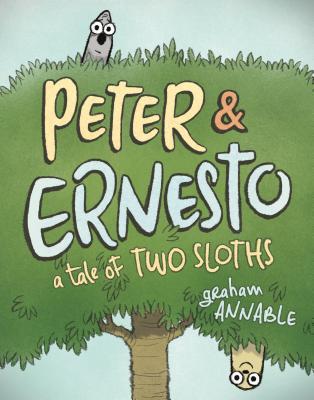
Peter & Ernesto

Peter & Ernesto: A Tale of Two Sloths. Graham Annable. 2018. First Second. 128 pages. [Source: Review copy]

First sentence: Rabbit. Good one. Oh! Bear! Oooo! Scary! You finish the hibiscus, Ernesto! Thanks, Peter!

Premise/plot: Peter and Ernesto star in this graphic novel for young readers. Peter and Ernesto may both be sloths but the similarities end there. Ernesto is ADVENTUROUS, BRAVE, CURIOUS, DARING. Peter is, well, perfectly content to stay in his one tree and watch the same piece of sky every day. He doesn't want adventure. He fears nearly everything that unfamiliar to him. One day Ernesto decided to leave Peter and go on a BIG adventure. The story follows both Ernesto and Peter.

Peter can't escape adventure after Ernesto leaves the tree. There is something that Peter fears worse than leaving the comfort of his own home, and that is the idea that something terrible could happen to Ernesto. Peter MUST save Ernesto and bring him back home. The idea of SAVING ERNESTO gives Peter courage to explore the world around him, meet new animals, make a few friends. Ernesto is busy making friends too. Everywhere he goes, Ernesto makes friends. His quest is quite extraordinary.

My thoughts:  I liked this one. I did. Peter is my kind of sloth. It was a fun story just right for little readers beginning to pick up graphic novels.

© 2018 Becky Laney of Young Readers