Monday, August 31, 2009

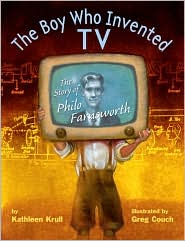
The Boy Who Invented TV


Krull, Kathleen. 2009. The Boy Who Invented TV. Illustrated by Greg Couch. Random House.

Who is Philo Farnsworth? Why, he's the one who invented TV, and in Kathleen Krull's The Boy Who Invented TV, you'll learn all about him. From the antique TV endpapers--fabulous, in my opinion--to the author's note, this one had me hooked. (And it's not because I'm a science geek.) Here's how it starts off:
"No sooner did Philo Farnsworth learn to talk than he asked a question. Then another, and another. His parents answered as best they could."
Krull presents a biography of this little known and under-appreciated genius. At first glance, he may seem like just an ordinary kid, a farm kid at that, but his curiosity and fascination with learning--especially learning how things work on the technical/mechanical side made him stand out. I love the fact that it was while he was doing his farm work that inspiration struck.

One bright, sunny day, fourteen-year-old Philo plowed the potato fields. It was the best chore for thinking--out in the open country by himself. Back and forth, back and forth...the plow created rows of overturned earth. He looked behind him at the lines he was carving--perfectly parallel. Then he almost fell off the plow seat. All his thoughts fused together. Instead of seeing rows of dirt, he saw a way to create television: breaking down images into parallel lines of light, capturing them and transmitting them as electrons, then reassembling them for a viewer. If it was done quickly enough, people's eyes could be tricked into seeing a complete picture instead of lines.
What did I like about this one? I think it has appeal to those that love the human side of science as well as appealing to those that like science science. I fall into the first category. Show me a documentary on scientists and inventors, and I'm there, I'm hooked. I like the human side of science, the people behind the ideas. I did try this one out on my dad who's closer to falling into the second category. He enjoyed this one as well.


© Becky Laney of Young Readers

Monday, August 24, 2009

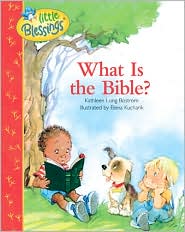
What is the Bible?


Bostrom, Kathleen Long. 2009. What is the Bible? (Part of the Little Blessings series by Tyndale). Illustrated by Elena Kuchank. Tyndale.

This August, Tyndale is releasing two more stories in the Little Blessings series by Kathleen Long Bostrom. (I reviewed a four-in-one collection back in January.) These two new titles are What is the Bible? and Who Made the World?

I've heard people talk
of the Bible in church.
It seems extra special,
so I'm on a search.

Who wrote the Bible?
One person? A few?
What does it say?
Can you give me a clue?

Is it a book
I will need as I grow?
Does it tell stories
of people I know?

This one is about the Bible. Or perhaps I should say the B-I-B-L-E. (I don't know why that song popped into my head just now, but it seems a little fitting, doesn't it?)

This book is divided into three parts. The first part is a question-poem written from a child's perspective. These are simple questions, questions that may be a bit familiar to parents with curious kids with a heart for God. The second part is an answer-poem written from an adult's perspective. The third part is for Bible references. What I love about this last section is that it goes through line-by-line of the answer-poem, and it provides a verse or two to back up the rhyme.

The illustrations by Elena Kuchank are traditional and cutesy. The types of illustrations that you might find on greeting cards. One plus to the illustrations is that her illustrations are multicultural.

Are you a Christian parent? Have you read any books in this series? What do you think?

© Becky Laney of Young Readers

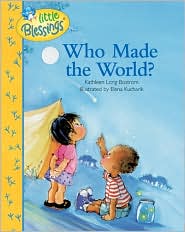
Who Made the World


Bostrom, Kathleen Long. 2009. Who Made The World. (Part of the Little Blessings series by Tyndale). Illustrated by Elena Kuchank.

Earlier in the year--way, way back in January--I reviewed Questions from Little Hearts, a four-in-one collection of stories by Kathleen Long Bostrom. (The book contains: What is God Like? What is Prayer? What About Heaven? and Are Angels Real?) This latest book is in a similar format.

1) a question-poem written from a child's perspective.
2) a small transition-type poem written from an adult perspective--something that points the child towards God
3) An answer-poem written from God's perspective
4) Bible references for parents and older children.

As you could easily guess, this one is all about creation. Here's how it starts off...

The world is so pretty!
There's so much to see.
A rainbow! A river!
A flower! A tree!

So who made the world?
God, I think it was you.
Did you have a helper?
If so, tell me who!

What was the first thing
you made, and the last?
Did you snap your fingers
to make it go fast?


Of course, that's only the beginning...

I really enjoy this series. And this one is no exception. While I don't love, love, love the illustrations--they're not bad by any means but they're not incredibly amazing either--I do love the text. I'm so happy to have discovered these books because I think they are great for Christian families.

© Becky Laney of Young Readers

Saturday, August 22, 2009

Nathaniel Fludd: Flight of the Phoenix


LaFevers, R.L. 2009. Nathaniel Fludd: Beastologist: Book One: Flight of the Phoenix. Houghton Mifflin. 136 pages. September 2009.

It was one of the most important moments in Nathaniel Fludd's young life, and he was stuck sitting in the corner.

I love that first line. (What say you? Does it make you want to know more?) Nathaniel Fludd, our hero, is about to learn that his parents have died--they're presumed dead at least. They left him several years earlier--in the care of his governess, Miss Lumpton--and went off adventuring. Promising him that they'd write. That they'd send for him when he was old enough to have gotten an adventurous spirit (and heart.)

"You need a little more time to grow up," his father had said. "When you're old enough to travel well and your sense of adventure has developed, we'll send for you then."
Time had passed. On his eighth birthday, Nate had been excited, but nervous, too. He wasn't sure his love of adventure had shown up yet. But his parents' letter asking him to join them never showed up, either. "Just as well," Miss Lumpton had sniffed. "Their job is much too important to have a youngster tagging along, getting in the way."
On his ninth birthday Nate had been hopeful. Miss Lumpton told him not to be silly. His parents' work was much too dangerous for a young boy. Especially a young boy like himself, one who liked quiet walks, reading, and drawing. Clearly he wasn't suited to a life of adventure. Nate was a little disappointed--he thought he had felt the smallest beginning of an adventurous spark.
By his tenth birthday, Nate had buried the memory of his parents and never took it out anymore. Much like a toy he'd outgrown, he told himself. But the truth was, thinking of them hurt too much. (3-4)
After Miss Lumpton is given a tidy sum, Nate is sent to live with his father's cousin, Phil A. Fludd. Phil, surprise, surprise, is a woman. But that doesn't mean she can't live up to the Fludd name and be a great adventurer. She's a bit shocked that Nate hasn't been taught the trade, he knows nothing about being an adventurer, about living an exciting and dangerous life. But she's determined to train him up right!

Thus the adventure begins...

I liked this one. It features black and white illustrations by Kelly Murphy. It's a nice blend of mystery, adventure, and humor.


© Becky Laney of Young Readers

Friday, August 21, 2009

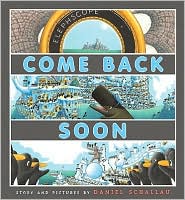
Come Back Soon


Schallau, Daniel. 2009. Come Back Soon. Houghton Mifflin. September 2009.

Every day from Icetown, hundreds of fish letters are delivered far and wide around the world. Postwhales deliver most of the long-distance letters, and penguins do the rest.


I didn't really get this picture book. It stars a somewhat-clumsy Elephant and an ever-forgiving group of penguins. Elephant, the star of the book, receives a letter from a friend inviting him to visit. He's excited to receive the letter--the envelope was most tasty--and he immediately begins making plans for his trip. Most of the book concerns the visit itself. The things these two do together. The trouble Elephant gets into while he's there.

I don't think I'm the ideal audience for this one. I suppose some readers might enjoy it.

© Becky Laney of Young Readers