Showing posts with label 1987. Show all posts

Thursday, April 25, 2024

63. Henry's School Days


Henry's School Days. (Too Many School Days) Robert Quackenbush. 1987/2023. 40 pages. [Source: Library] [Picture book]

First sentence: When Henry the Duck was growing up, he got into a lot of trouble at school--like the time he went to hang up his coat on an overcrowded rack. Before his teacher could stop him and help him find a place for his coat...all the coats came tumbling down!

I feel seen. Henry the Duck has quite a time leading his teachers to say that Henry has too many school days. Will Henry the Duck ever have a good day at school? 

When I was growing up I loved some of Quackenbush's books. I've loved becoming reacquainted with his books as an adult. I absolutely LOVE the story, the characters, and the illustrations.

I am definitely going to see what other "new" books they have by Quackenbush.


© 2024 Becky Laney of Young Readers

Wednesday, June 6, 2018

Just A Mess

Just A Mess. Mercer Mayer. 1987. 24 pages. [Source: Bought]

First sentence: Today I couldn't find my baseball mitt. I looked in my tree house. I looked under the back steps. I asked Mom if she had seen it. She said I should try my room. I never thought to look there. What a mess!

Premise/plot: Little Critter has a messy room. (Anyone caught by surprise there?!) Since he can't get anyone to help him clean his room, he decides to do it for himself...in a way that only Little Critter can. (Well, I take that back. Little Critter's technique isn't all that original.) Will he find his baseball mitt?

My thoughts: Perhaps with the exception of Ramona Quimby (did she have a messy room too?) the character I most identified with as a child was LITTLE CRITTER. I love, love, love, love, crazy love Mercer Mayer's Little Critter.
The rest of the mess could fit under my bed. So I put it there. Then I made the bed. Won't Mom be pleased. 
 Text: 5 out of 5
Illustrations: 4 out of 5
Total: 9 out of 10

© 2018 Becky Laney of Young Readers

Thursday, February 1, 2018

Henry and Mudge

Henry and Mudge The First Book. Cynthia Rylant. Illustrated by Sucie Stevenson. 1987. 40 pages. [Source: Library]

First sentence: Henry had no brothers and no sisters. "I want a brother," he told his parents. "Sorry," they said. Henry had no friends on his street. "I want to live on a different street," he told his parents. "Sorry," they said. Henry had no pets at home. "I want to have a dog," he told his parents. "Sorry," they almost said. But first they looked at their house with no brothers and sisters. Then they looked at their street with no children. Then they looked at Henry's face. Then they looked at each other.

Premise/plot: Henry and his dog Mudge star in Cynthia Rylant's early chapter book series. This is the first book in the series. It is about when Henry gets Mudge, or, perhaps when Mudge gets Henry. It is about what they mean to each other. Later chapters in this book explore this devotion. Mudge learns a lesson about staying close to home.

My thoughts: I really adore Cynthia Rylant's work. What do I love? I love her writing, her narrative style, her pacing. There's something delightful about her phrasing. "Every day when Henry woke up, he saw Mudge's big head. And every day when Mudge woke up, he saw Henry's small face."

I don't know that it would be fair to compare Henry and Mudge with the Mr. Putter and Tabby series. I'm glad both exist.

© 2018 Becky Laney of Young Readers

Tuesday, October 31, 2017

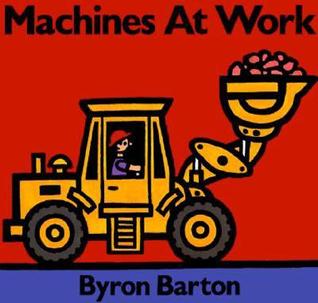
Machines at Work

Machines at Work. Byron Barton. 1987. 32 pages. [Source: Library]

First sentence: Hey, you guys! Let's get to work. Knock down that building. Bulldoze that tree. Dig up that road.

Premise/plot: It's not just machines at work in Byron Barton's Machines at Work. Little ones also see construction workers working hard all day.

My thoughts: It doesn't take a lot of words to tell a good story. Though though are just a few words per page, Barton's Machines at Work tells an enjoyable story. The illustrations are also super-simple. In a few illustrations, the construction workers reminded me of duplo people. Speaking of which, this would be a fun story to act out with duplos!

Text: 5 out of 5
Illustrations: 3 out of 5
Total: 8 out of 10
© 2017 Becky Laney of Young Readers

Tuesday, September 27, 2011

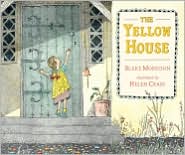
The Yellow House

The Yellow House. Blake Morrison. Illustrated by Helen Craig. 1987/2011. Candlewick Press. 32 pages.

Every day we passed the yellow house on our way to the park, Mom and me and my little sister, Jenny. The house was on its own. It looked old, sad, and rather scary. 

I'll try to keep this one short. After all, why waste time with a book I'm not eager to recommend?! This picture book was just odd to me. I haven't decided if the intent is just to be odd, or if the intent is to be odd and CREEPY. Is it a seemingly simple book about a young girl with an active imagination? Or is the "little boy that beckons to her" meant to be creepy? I found him VERY creepy. But that could just be me.

So. There's this abandoned house that the heroine passes often. She feels a little sad--if sad is the right word?--that no one lives there. That the house doesn't have a family, a family with little children. One day the little girl passes the house and stops. She "notices" a little boy in the yard. He wants her to play with him. And they have an over-the-top, completely unbelievable adventure together. But. Of course she never sees him again because no one lives there, the place is abandoned and will likely always be abandoned.

Anyway, the book is weird. I suppose it could just be unusual or quirky or peculiar. I didn't like it. But you may like it more than I did. Are you a fan of this one? If you like it--love it--I'd love to hear why. I would appreciate seeing it through someone else's eyes!

Text: 2 out of 5
Illustrations: 2 out of 5
Total: 4 out of 10

© 2011 Becky Laney of Young Readers

Wednesday, September 9, 2009

Helen Oxenbury

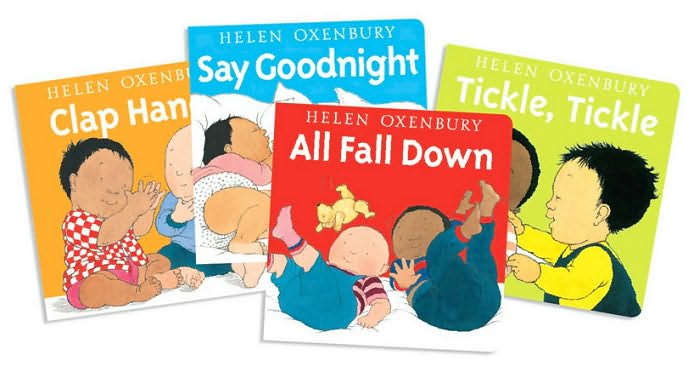
Helen Oxenbury's All Fall Down.
Helen Oxenbury's Clap Hands.
Helen Oxenbury's Say Goodnight.
Helen Oxenbury's Tickle, Tickle.

Simon & Schuster is reprinting these four classic books written and illustrated by Helen Oxenbury. (They were originally published in 1987). I believe they are available individually and as a collection. (Barnes & Noble, for example, has the gift set--due to be released this December--for $7.99)

What makes these books special? Well, they're short, sweet, and simple. How short is short? Four spreads (two pages = 1 spread) apiece. How sweet is sweet? The books features babies of all colors happily doing baby things. A book about babies for babies. In other words, adorable babies all. How simple is simple? Each book is just one sentence long. Yes, just one sentence. But that one sentence is a poetic little verse full of rhythm.

I'll just choose one to highlight...

Clap hands, dance and spin,
open wide and pop it in,
blow a trumpet, bang a drum,
wave to Daddy, wave to Mom.

My favorite is probably All Fall Down. But all of these are sweet in their own way.

© Becky Laney of Young Readers