Showing posts with label wordless picture books. Show all posts

Monday, October 7, 2024

134. La La La

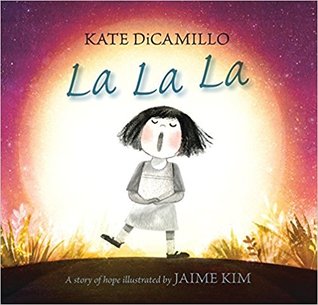
La La La: A Story of Hope. Kate DiCamillo. Illustrated by Jaime Kim. 2017. Candlewick. 72 pages. [Source: Library] [3 stars] [picture book, wordless picture book]

First sentence: La  

ETA: I never meant to reread this one. In all truth I had forgotten about it. Hence why I accidentally reread it. This one is newly available in digital format. It was listed as a "new" book at my library. I don't dislike this one. I just don't grasp this one. The illustrations are BEAUTIFUL. The story, well, some might "get it" and really connect with it.


Premise/plot: La La La: A Story of Hope is a nearly wordless picture book by Kate DiCamillo. Readers meet a young girl who appears to be lonely AND imaginative. She speaks to the world in la la la's. This one is subtitled "a story of hope." Will the girl's voice finally be heard? Will she find someone to sing back a response?

My thoughts: Without the notes from Kate DiCamillo and Jaime Kim would I have understood the message of La La La? I'd like to say yes--that the illustrations and the simple refrain powerfully, unmistakably told an incredibly beautiful and haunting story that most everyone can relate to easily. But. Just as the girl struggled with loneliness, I struggled to fully get the story. (Emphasis on fully).

It appears that the girl was at her loneliness when the pages were blank--devoid of color. But sometimes her singing led her out into the world--into nature--and the colorful scenes of this one were majestic. There would be pages of the little girl--though still alone--being happy, almost joyful. But this never seemed to last. She'd return to the blankness of her life.

The main plot point--the highlight--seems to be when she sees the moon and wants to reach out to it. Like the moon represents everything missing in her life. But it's too far away--too out of reach. She tries...and fails. But the story doesn't end there. The story ends with the moon coming down to her--echoing back her song.

What does it all mean? Is there one big, obvious meaning? Who--or what--is the moon? What does it symbolize? And how does the symbolism relate back to the real world? How can this story about a girl and the moon singing beautiful harmony together help an actual little girl with her loneliness? Is it about being at one-ness with the universe? Is it about the splendor of nature--the healing effects of nature? Could it be a spiritual thing--a symbol of God being there, being enough? If I struggle as an adult with what the story is about, would a child struggle more or less with interpreting the story?

Text: 2.5 out of 5
Illustrations: 4.5 out of 5
Total: 7 out of 10 


© 2024 Becky Laney of Young Readers

Monday, November 22, 2021

167. Little Red and the Cat Who Loved Cake


Little Red and the Cat Who Loved Cake. Barbara Lehman. 2021. [November] 64 pages. [Source: Library]

Little Red and the Cat Who Loved Cake is a wordless picture book. Mostly. There are technically words in this narrative free picture book, but the words are on signs, shirts, etc. It appears to be set in a fractured fairy tale world where all fairy tale characters mix and mingle. Little Red is delivering a cake to Grandma. But Little Red's CAT comes along--secretly or not so secretly. The cat is fairly insistent to be included in any eating of cake.

If I had known BEFORE borrowing from the library that it was a wordless picture book, I would have not checked it out. To be honest, I need words in my stories. It isn't that it is impossible for stories to be told without words, but all the best of the best stories have words. Even if the text is super-simple and just a few words per page--think of Max's communication skills in Max and Ruby--I need words.

But I was drawn to this one because of the word CAT in the title.

I thought the super-playful and "sneaky" cat was cute. Is the cat trying to steal cake enough of a gimmick to make me love a wordless picture book???? Probably not.


© 2021 Becky Laney of Young Readers.

Tuesday, May 8, 2018

Red

Red by Jed Alexander. 2018. Cameron Kids. 32 pages. [Source: Review copy]

Premise/plot: A little girl in a red hood and cape is walking in the woods. Could she be on the way to her Grandma's house? Perhaps. She is going somewhere that is for sure--basket in hand. She is not alone in the woods.

Red is a wordless picture book. The story is revealed solely through the black, white, and red illustrations.

My thoughts: I rarely love, love, love wordless picture books. I need words. I hate to admit it, but I do. It is a lot harder for me to "read" illustrations than to read words. Perhaps it should be the opposite in a logical world.

The illustrations. I didn't love them. I like the idea of loving vintage-inspired illustrations. I like the idea of loving the simplicity and boldness of the black, white, and red. I think I liked the backgrounds better than the illustrations of the people and the animals.

In this picture book, a little girl is on her way to her own surprise birthday party. The wolf in the woods is not an enemy, but a DISTRACTION. His goal seems to be to keep the girl from noticing all the other animals on the way to the party. The animals are carrying presents, party decorations, balloons, a CAKE. Will she be SURPRISED?

Text: 0 of 0
Illustrations: 3 out of 5
Total: 3 out of 5

© 2018 Becky Laney of Young Readers

Monday, December 4, 2017

The Little Red Cat Who Ran Away and Learned His ABC's

The Little Red Cat Who Ran Away and Learned His ABC's (the Hard Way). Patrick McDonnell. 2017. Little, Brown. 48 pages. [Source: Library]

First sentence: Aa Bb Cc Dd Ee

Premise/plot: Using nothing but the alphabet, McDonnell tells the story of a little red cat who has a mighty, big adventure before returning home once more.  It stars a cat, an alligator, a bear, a dragon, a chicken, and an egg....

My thoughts: Technically, I'm not sure if this one would count as wordless or not. The only text within the book is the alphabet. The story is communicated nevertheless. This one has plenty of adventure and some guesswork. The only letter I had trouble translating back into a word to further the story was Ww. (Which was 'wave.') The other letters I was able to 'read' correctly in the context of the story. (Mostly). If I'm being 100% honest, I interpreted Nnnnnnnnnnnnn Ooooooooooo! as NO and not "no over." But either way the story made complete sense.

Text: 0 out of 0
Illustrations: 4 out of 5
Total: 4 out of 5

© 2017 Becky Laney of Young Readers

Friday, October 6, 2017

Wolf in the Snow

Wolf in the Snow. Matthew Cordell. 2017. 48 pages. [Source: Library]

 First sentence: Bark! bark! bark!

Premise/plot: Wolf in the Snow is nearly wordless. Technically, it's not wordless. It features words like "bark," "huff," "whine," "growl," and "howl." The story isn't hard to follow--which is nice. A young girl, on her way home from school, gets lost in a snow storm or blizzard. A young wolf cub gets lost--separated from the pack--as well. These two find each other. But will they find their way to where they belong?

My thoughts: It was okay. I did appreciate that the story was easy to follow. I have read some wordless or nearly wordless books that made little sense--at least on first reading.

There are several scenes before the title page. After the title page, the first scene shows a LOT of children leaving school all bundled up. We follow one little girl, wearing a RED COAT. She meets a WOLF. I do hope the other children made it home safely. The school appeared to be a one-room schoolhouse. It definitely has an old school feel about it. (The home she lives at appears to be a log cabin type home.) I do like how the wolf pack help the girl and help her get rescued. That was nice.

Is the story meant to be historical? If it was. WHY do the two men searching for the girl carry flashlights?! And if the story isn't historical, where is it set that a one room school house makes sense?! I'm not sure a child would ask these types of questions. (Though maybe they would.) But I had questions that were not answered. I was left puzzled by this one.

Text: 2 out of 5
Illustrations: 3 out of 5
Total: 5 out of 10


© 2017 Becky Laney of Young Readers

Sunday, September 24, 2017

La La La: A Story of Hope

La La La: A Story of Hope. Kate DiCamillo. Illustrated by Jaime Kim. 2017. Candlewick. 72 pages. [Source: Review copy]

First sentence: La

Premise/plot: La La La: A Story of Hope is a nearly wordless picture book by Kate DiCamillo. Readers meet a young girl who appears to be lonely AND imaginative. She speaks to the world in la la la's. This one is subtitled "a story of hope." Will the girl's voice finally be heard? Will she find someone to sing back a response?

My thoughts: Without the notes from Kate DiCamillo and Jaime Kim would I have understood the message of La La La? I'd like to say yes--that the illustrations and the simple refrain powerfully, unmistakably told an incredibly beautiful and haunting story that most everyone can relate to easily. But. Just as the girl struggled with loneliness, I struggled to fully get the story. (Emphasis on fully).

It appears that the girl was at her loneliness when the pages were blank--devoid of color. But sometimes her singing led her out into the world--into nature--and the colorful scenes of this one were majestic. There would be pages of the little girl--though still alone--being happy, almost joyful. But this never seemed to last. She'd return to the blankness of her life.

The main plot point--the highlight--seems to be when she sees the moon and wants to reach out to it. Like the moon represents everything missing in her life. But it's too far away--too out of reach. She tries...and fails. But the story doesn't end there. The story ends with the moon coming down to her--echoing back her song.

What does it all mean? Is there one big, obvious meaning? Who--or what--is the moon? What does it symbolize? And how does the symbolism relate back to the real world? How can this story about a girl and the moon singing beautiful harmony together help an actual little girl with her loneliness? Is it about being at one-ness with the universe? Is it about the splendor of nature--the healing effects of nature? Could it be a spiritual thing--a symbol of God being there, being enough? If I struggle as an adult with what the story is about, would a child struggle more or less with interpreting the story?

Text: 2.5 out of 5
Illustrations: 4.5 out of 5
Total: 7 out of 10

© 2017 Becky Laney of Young Readers

Saturday, May 14, 2011

A Ball for Daisy

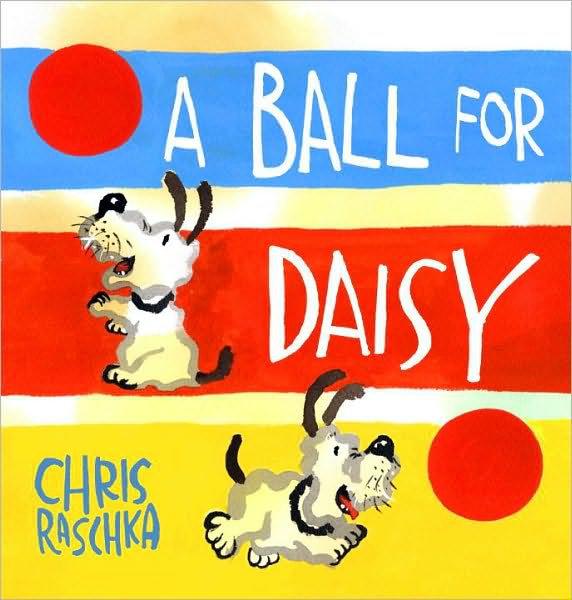
A Ball for Daisy. Chris Raschka. 2011. Random House. 32 pages.

What do you need to know about A Ball for Daisy? Well, it's a wordless picture book. I'll be honest, I find wordless picture books difficult--at best--to review. It's not that I dislike them all. There are good wordless picture books--and I feel A Ball for Daisy is a good wordless picture book--but still I'm at a loss for words. What is this wordless picture book about? It's about a dog, of course. A dog that LOVES her red ball. Readers see in frame after frame, page after page, all the ways this dog LOVES her ball. But. One day something HORRIBLE happens. The dog--presumably named Daisy--loses her ball when another dog--a brown dog--plays too rough with it. We see Daisy go from exuberant to sad because of this loss. But there is hope--for Daisy finds a couple of friends and gets a new ball--a blue ball. That being said, I'm not sure I can make a story for every illustration, that I can trace the story through every single picture. I feel I got the basics, but I'm not sure I got everything that there was.

I liked this one. I didn't quite love it. But it was good.

Illustrations: 3 out of 5


© 2011 Becky Laney of Young Readers

Wednesday, July 14, 2010

Beaver is Lost


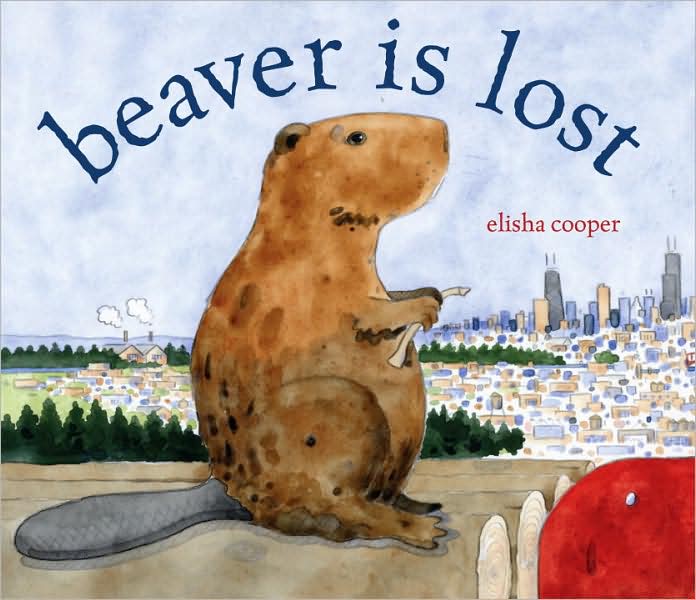
Beaver is Lost. Elisha Cooper. 2010. June 2010. Random House. 40 pages.

I read Beaver is Lost a few weeks ago. And I'm just as puzzled now as I was then as to what to say about it. Why? Well, it's a wordless picture book. Mostly. Four little words tell the whole story. Three you might guess--since they're also in the title: Beaver is Lost. It's a story of a beaver who has lost his way. A beaver who has wandered into the city, into a strange environment. And the book illustrates his journey, his quest, to find his way back home.

© Becky Laney of Young Readers

Monday, February 4, 2008

Yellow Umbrella


Yellow Umbrella by Jae Soo Liu. This book isn't exactly new--the first American edition being published in 2002--and it isn't exactly unknown since it got some high praise when it first released including being named one of the New York Times Best Illustrated books of the year (2002). But it is new-to-me. Or relatively new-to-me.

I first read Yellow Umbrella last fall. I loved it. I really really loved it. But since it is a wordless picture book, I felt somewhat at a loss of what to say. But I've decided to be brave and venture forth into new territory. If my review doesn't do it justice, you'll just have to trust me that it is worth it. Worth finding and reading yourself.

The book Yellow Umbrella comes with a CD. For the full experience, readers are urged to listen to the CD while 'reading' or 'sharing' the book. An interesting concept in my opinion. A wordless picture book whose story is told by music--by melody--and by illustrations. It's a completely different experience than you might expect. It's all about mood and tone. I'm not sure everyone will love it. But I urge you to read and see for yourself. You might just find it as delightful as I did.


The CD is 27 minutes. The track needed for reading the story is a little over 7 minutes long. The rest of the CD are "extra" bits that make it just that much more fun of an experience.

Thoroughly appropriate for use as "art appreciation" or "music appreciation" or the more complex aspects of storytelling. It also makes for a great shared experience on a rainy day.


The publisher is Kane/Miller. It was originally published in South Korea.