Running Out of Time. Margaret Peterson Haddix. 1995. 184 pages. [Source: Library] [action, adventure, speculative fiction]
First sentence: The light woke Jessie, though it was just a glimmer downstairs.
Premise/plot:
Running Out of Time is a premise-driven, action-packed middle grade
coming of age novel. Jessie, our heroine, is thirteen and about to be
sent on a mission by her mother with life and death implications.
Jessie’s
family is one of the families living in Clifton. To Jessie, it’s home,
just home. To the world, however, it’s a tourist attraction, a field
trip destination. In 1984, give or take, a group of adults decided to
move to this new town, Clifton, and live like it’s the 1800s. (The
starting year was in the mid to late 1820s. The year now is 1840.)
Jessie’s parents were part of this group. Jessie’s mom is now having
major regrets. Their lives are in danger, Jessie must escape and get
help.
How will Jessie cope with the real world? Can she find help? Will any adult believe her? Who can she trust?
My
thoughts: I was shocked that I only gave this one three stars the first
time I read it. Why? Because it’s been almost ten years and I haven’t
forgotten the story and characters. The premise intrigued me. The idea
of a community living “in the past” and their children and potential
grandchildren being clueless that they were being watched as education
or entertainment. Something very Truman Show about it (though this was
published in 1995). It has a dystopian thriller tone to it.
Technically
it may be weak in that it is premise driven. It has a few info dumps
that aren’t all that subtle. But I found it compelling all the same. I
found Jessie brave and resilient.
© 2020 Becky Laney of Young Readers
Showing posts with label 1995. Show all posts
Tuesday, February 4, 2020
Tuesday, November 21, 2017
I'm Sorry
I'm Sorry. Gina Mayer and Mercer Mayer. 1995. 24 pages. [Source: Bought]
First sentence: Whenever I do something wrong, I just say "I'm sorry."
Premise/plot: Little Critter is always careful to say, "I'm sorry." But he is definitely not always careful in the first place.
My thoughts: I liked this one. I didn't love, love, love it like I have other Little Critter titles. But it was definitely an enjoyable read. Little Critter can make a BIG, BIG, BIG mess. In this one, he learns--perhaps temporarily--that you have to be careful and considerate in the first place. Saying "I'm sorry" and then not changing your behavior shows you're not really that sorry.
This one reminded me of a Daniel Tiger song. Saying I'm sorry is the FIRST step, not the only step.
Text: 3 out of 5
Illustrations: 3 out of 5
Total: 6 out of 10
© 2017 Becky Laney of Young Readers
First sentence: Whenever I do something wrong, I just say "I'm sorry."
Premise/plot: Little Critter is always careful to say, "I'm sorry." But he is definitely not always careful in the first place.
My thoughts: I liked this one. I didn't love, love, love it like I have other Little Critter titles. But it was definitely an enjoyable read. Little Critter can make a BIG, BIG, BIG mess. In this one, he learns--perhaps temporarily--that you have to be careful and considerate in the first place. Saying "I'm sorry" and then not changing your behavior shows you're not really that sorry.
This one reminded me of a Daniel Tiger song. Saying I'm sorry is the FIRST step, not the only step.
Text: 3 out of 5
Illustrations: 3 out of 5
Total: 6 out of 10
© 2017 Becky Laney of Young Readers
Wednesday, January 5, 2011
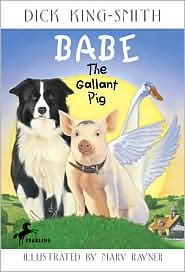
Babe: The Gallant Pig
Babe: The Gallant Pig by Dick King-Smith. Illustrated by Mary Rayner. 1995 (Reprint). Random House. 128 pages.
© 2011 Becky Laney of Young Readers
"What's that noise?" said Mrs. Hogget, sticking her comfortable round red face out of the kitchen window. "Listen, there 'tis again, did you hear it, what a racket, what a row, anybody'd think someone was being murdered, oh dearie me, whatever is it, just listen to it, will you?"I love the movie. It's become so much a part of me, that I really can't remember a time when I didn't love it. It is just so good. So quotable. So true. So perfect. It's one of those meaning-of-life, beauty-in-simplicity movies. Anyway, I could gush for hours. How does the book compare? Well, the movie will always be better in my opinion. (Rare I know.) But the book was good. The plot is less complex. There are fewer characters, fewer conflicts. There is no "Rex" just Fly. There is no Ferdinand the duck to lead Babe into trouble. There are definitely no singing mice. It's good; it's enjoyable. But you really can't get better than the movie.
Farmer Hogget listened. From the usually quiet valley below the farm came a medley of sounds: the oompah oompah sounds of a brass band, the shouts of children, the rattle and thump of a skittle alley, and every now and then a very high, very loud, very angry-sounding squealing lasting about ten seconds.
Farmer Hogget pulled out an old pocket watch as big around as a saucer and looked at it. "Fair starts at two," he said. "It's started."
© 2011 Becky Laney of Young Readers
Labels:
1995,
animals,
chapter books,
J Fiction,
library book,
pigs,
Random House
Subscribe to:
Posts (Atom)