Tuesday, September 16, 2008

Please Don't Tease Tootsie


Chamberlain, Margaret. 2008. Please Don't Tease Tootsie.

This one is "a cautionary tale about looking after your furry friends." Here's how the jacket flap reads, "Tootsie cat and Poochie are furry friends. They don't like to be teased or poked. No... Our pets like to be doted on, stroked! Furry or slimy, scaly or silly, the playmates we love come in every size, shape, and hue. So please make the effort, everyone... be kind to our four-legged friends."

While Margaret Chamberlain has illustrated many books for children, this is her first to write and illustrate. Good message, a teeny tiny bit didactic, but a good message to impart nonetheless. The illustrations are interesting. The writing is straight forward.

Please don't tease
Tootsie,
or provoke
Poochie.
Don't madden
Mutley,
or disturb Dixie.

You get the idea. After a long list of things to don't do...the reader then gets a list of things to do with their pets. And it ends on a happy note,

We will stroke you,
never poke you.
We love you Tootsie Cat!

How do I feel on this one? Well. I realize the message was that all pets--cats, dogs, lizards, birds, etc--deserve to be treated well by their young owners...there wasn't much story. I initially picked up Please Don't Tease Tootsie because Tootsie looked like an interesting character, a cat with personality, a cat with attitude. So I was slightly disappointed that this wasn't the story of one pet and her family. But I know it's not fair to judge a book based on what it's not. So there you have it. I liked it well enough. It won't be making my top ten list of books to avoid by any means. But I didn't love, love, love it either. It probably won't be making my top ten list for best books either. So it's safely in the middle.

It was originally published with the title, Please Don't Torment Tootsie.

© Becky Laney of Young Readers

Monday, September 15, 2008

Be Gentle With The Dog, Dear!


Matthew J. 2008. Be Gentle With The Dog, Dear! (Penguin)

I loved this one. I just loved it. I loved Tag. I loved Elisa. I loved the illustrations and story. It just worked for me pure and simple. It had me from hello. Look at the end papers. Look at the title page.
Elisa is a baby--a toddler really--and she's precious most of the time....well, some of the time anyway. The dog, Tag, thinks she's cute and adorable when she's asleep. But when she's awake, she's a terror...at least to him. She loves to chase him. She loves to squeeze him. She loves to sit on him. She loves to pull his tail. She loves to "play" with him. But Tag's the kind of dog that is good and patient and enduring...most of the time. But some things can't be endured.


This is a fun book with an important message. The text just works for me. It is simple and to the point, but it is fun and true to life as well. My favorite line is without a doubt..."There she is...and here she comes." The illustrations are just perfect.

I love EVERYTHING about this book. And it's highly recommended.


© Becky Laney of Young Readers

Friday, September 12, 2008

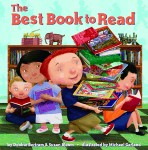
The Best Book To Read


Bertram, Debbie & Susan Bloom. 2008. The Best Book To Read. Illustrated by Michael Garland.

This book is the follow up to two previous books: The Best Place to Read and The Best Time to Read. I haven't read those books. However, I did enjoy this one. While it flirts with the idea of being didactic, I think it works to a certain extent. In other words, it's a message book that everyone can generally agree is a message book, yet it has a few charming qualities about it that make you okay with the fact that it's all about the message. If that makes any sense.

The writing. I was on the fence with this one to be honest. At least in the very beginning. There are places where it seems to have rhythm, to really flow, and then there are a few places where it doesn't quite make it. Still, there are no awkward places.

Hooray! It's a trip to the library today.
We line up as we get off the bus.
We've been specially invited. Our class is excited!
The librarian is welcoming us.

See, maybe it's not the *best* poetry out there (Adam Rex comes to mind), but it's far from awkward.

"Hello, boys and girls," the librarian says.
"I see faces I've seen here before.
Finding books can be fun!
You may choose more than one.
And my job is to help you explore--

This is the kind of text that had to grow on me. I had to read it (in my head) several times, but then it clicked and I found the beat. (Which is just one of *many* reasons, adults should practice before they read aloud--well, if it's part of their job--teacher, librarian, etc.)

Picture books, chapter books, books that pop up,
nonfiction, and fairy tales, too.
You may look by yourselves.
Take some books from the shelves.
Then check out the best book for you."

The librarian character then proceeds to highlight certain books--certain types of books really--from her collection to show kids that there are many different books for many different kinds of readers.

It's a message that is close to my heart. I do believe that every book has the potential to be *the book* (a.k.a. the best book ever) for some reader out there. One person's "best book" is another person's worst. And librarians do have the joy of potentially matching readers with their "best book ever" and changing a life or two along the way. Sometimes all it takes is one magic book to turn a non-reader or a struggling reader or a reluctant reader into someone who loves reading.

That being said, the message is clearly good. The only question is will readers (adults and children alike) feel that they're being preached at? Is the message hitting you over the head with a hammer, in other words? That's something every person will have to decide for themselves. I liked this one. I don't know that I loved it as much as say The Boy Who Was Raised by Librarians. But it is infinitely better than Born to Read.


I love how perfectly the illustrations match the text. On one side of the spread, the librarian is holding up a book and describing it. And the other half of the spread, is an action spread. For example, when the librarian talks about bug books--entomology--then the next page, the second half of the spread, shows kids actually out gathering and collecting bugs. When the librarian is talking about dog books--dog training books to be exact, the next page shows a little boy trying to control his dog from jumping on the bed. So some of the pages illustrate the fact that reading is practical, is useful, is applicable to daily life. That you can read to learn. But at the same time, there are examples the librarian gives of people (children) reading for pleasure, to escape. So both types of reading are applauded. And I really loved that aspect of it. I'm sure it was intentional on the author's part, yet I'm not sure it is as obvious to readers--at least not the first time round.

If you ask a roomful of people--kids, preteens, teens, adults--to name what they think "the best book to read" is you'll hear many different answers, responses, books. Everyone has their own personal idea of what "the best book to read" is. And this book reflects that in a way that is clear and concise and fun.

© Becky Laney of Young Readers

Thursday, September 11, 2008

Big Little Monkey


Schaefer, Carole Lexa. 2008. Big Little Monkey. Illustrated by Pierre Pratt. Candlewick.

I loved this one. I just loved it. This is what the jacket flap says,
"Early one morning, Little Monkey wakes up and looks around. His whole family is still asleep. Is Little Monkey brave enough and big enough to go find someone else to play with? He thinks so! And he swings away, bim-ba-lah, bim-ba-lah, hand over hand--until he finds just the right playmates in just the right place.
Carole Lexa Schaefer and Pierre Pratt have crafted a sweet and funny story about our first attempts to be independent--and about how we still need home and family most of all."
The text is wonderful. It's rhythmic. It's fun. It's just a great story. The author captures what it's like to be small and full of energy and impatient. I could immediately identify with Little Monkey.

Definitely recommended.

© Becky Laney of Young Readers

Sara Dobie speaks on publicity...

Don’t Be a Couch Potato….

Publicity for Your New Release

Guess what? You’re a published author. Sitting on your couch, it’s hard to believe. Publishing is what happens to other people—people who wear black, smoke cigarettes and talk about Kerouac. It doesn’t happen to people like YOU, who have day jobs, families, and car loans. Obviously, you’re excited. You can already see yourself on the cover of People magazine, Pulitzer in hand. You pat yourself on the back—job well done. You can finally relax and wait to become a millionaire. Right?

Wrong.

Your work has just begun, and it’s the work of “publicity.”

If there is no publicity, no one knows your name. If no one knows your name, no one knows your book. If no one knows your book, it doesn’t sell, and it dies on the shelves faster than you can say “backlist.” So as an author, what can you do to beat the competition? And no, you should not start harassing managers at Barnes and Noble.

1) The Review

Getting your book reviewed is mainly in the hands of your publisher. However, there are plenty of things that you, as an author, can do to assist in the process and make it more effective. Publishers know about the big dogs. They know Publishers Weekly, the New York Times, the LA Times, etc. However, they don’t know the specialists in your field. If your book is about birds, your publisher isn’t going to know the most famous ornithologist who just has to endorse your book. So think—what contacts do you have? Which of these contacts could be used to the advantage of your book? Pass this on to your publisher, and they will thank you for it! If you are willing to help your publisher, it will pay off. They will be much more willing to focus on you, because you’ve done your research. You have the names and organizations; all your publisher has to do is send the emails. Think alumni associations, your local media contacts, state reading associations and national topic-specific magazines that would want to know about your book. The opportunities are endless, and it will keep you ahead of the pack.

2) What’s your pitch?

In other words, what are you selling? Is your book about a new diet that promises Michael Phelps abs? What about a children’s book that can teach kids about ADD? Can you explain the entire theme/mission/importance of your book in five words or less? You need to, because that’s about as much time you’ll have to impress the random Oprah intern who just happens to give you a call. The real question is, can you sell yourself?

Let’s face it—in the media and in stores, no one is booking your novel. They are booking you. If you are lacking in passion for your product, they’ll know, and your book will suffer. You have to be willing to go out there and get those interviews. Get those events. I suggest selling yourself as a package. Any author can just sit there and sign a book. What about an author who can use her book to teach kids about bullies? What about a different author who can show math teachers a better way to interest students in fractions? You have to make bookstores believe you have something to offer. Make them believe you are the one doing the favor, as opposed to vice versa. You are the main attraction. People will come to see you because you are worthy of seeing. If you don’t think so, who will?

3) The Launch

I cannot emphasize how important your book launch is. I have said it over and over and over to authors all over the country. Some believe me, and some don’t. Who do you suppose has the better book sales? If you said the ones who don’t believe me, I’m glad I’m not your publicist.

Okay, in the publishing world, there is a “publication date.” This is when your book is available for purchase to the public. Your launch date should be scheduled around this time. A specific scheduled event should be referred to as your “launch date,” in fact, because a definite date makes it tangible to the media, meaning more likely to be covered. The media likes tangible events, as opposed to vague announcements, as in “People can buy my book now! Cool, huh?” No. They don’t care. They care, however, when you have a cluster of events coming up where people can actually meet you.

What does a cluster entail? I’m talking fifteen to twenty scheduled events, clustered around a two-week period, with your launch right at the beginning. I realize you probably don’t have fifteen to twenty individual bookstores in your hometown. It helps to travel, making it more of an official Author Tour. If your funds require you to stay close to home, no problem! Start with bookstores. Now, what about gift shops and specialty stores whose clientele would relate to your book? What about libraries? If your book is about astronomy, what about planetariums or museums? If it’s about salt marshes, what about national parks? The opportunities are endless. You just have to be ready to work. Events sell books. Yes, authors are artists, and your books do mean a lot to you. However, a book—no matter how good it is—dies without sales. Get out there and schedule events. It’s the way to turn your book into your career.

Don’t mean to be pushy….

The publishing industry is cutthroat. If you’re not careful, your book is old news before you’ve even unwrapped your complimentary copies. You have to retain the passion you had while writing your book through the entire process. Do not let yourself think that once your book is on the shelf, you’re done. You cannot sit back and collect royalty checks. Work with your publisher. Give your input, and use your contacts to encourage word of mouth. Believe in yourself, and bookstores will believe in you, too. Finally, always keep those events coming. Stay in the public eye, and your book will, as well. It feels good to be recognized for your work, but it won’t happen until you get off the couch and show ‘em what you got.

Sara Dobie is the Public Relations Coordinator for Sylvan Dell Publishing in South Carolina. Learn more about Sara and Sylvan Dell Publishing at http://www.sylvandellpublishing.com/.


© Becky Laney of Young Readers