Showing posts with label historical fiction. Show all posts

Friday, March 3, 2023

56. Rosetown


Rosetown. Cynthia Rylant. 2018. 149 pages. [Source: Library]

First sentence: Wings and a Chair Used Books was where Flora Smallwood's mother worked three afternoons a week. Inside, it had a purple velveteen chair by the window for anyone who wanted to stay awhile, and Flora, who sometimes felt quite acutely the stress of being nine years old, and sensitive, loved this chair. Mondays, Wednesdays, and Fridays were her favorite day because of it.

ETA: I first read Rosetown in August 2021. I loved it then. I loved it now. I may have even loved it more the second time around. I definitely noticed more details the second time around. Still highly recommend this one!


Premise/plot: Flora Smallwood (9) lives in Rosetown, Indiana--the year, 1972. She loves vintage books and reading, and she loves hanging out with her new friend, Yury. What she doesn't love is change--at least not too much change, too quickly.

My thoughts: Rosetown is a character-driven book. Flora, our protagonist, is adjusting to being a fourth grader AND to her parents separating AND to life without her dog (Laurence). The book takes place over a school year. The focus is on family and friends.

I loved, loved, loved the WRITING. Rylant (one of my favorite authors) just has a way with words. I believed in Flora's voice from the first page. By the end of the second chapter I knew were were kindred spirits. I knew that Flora was going to end up being a good, good friend.

Here's a quote from chapter two:

What Flora noticed at once on the first day of fourth grade had been the sudden confidence all the former third graders seemed to have found, and she wondered where they had found it. Nearly all of her classmates appeared to be taller, louder, stronger, and possessed of a sureness of opinion that had been entirely absent the year before. The stumblers, the wanderers, and the floaters of third grade had suddenly, mysteriously, found their feet. They weren't afraid of school anymore. Or maybe of anything. All of this made Flora a little shy. She missed the uncertainty. Fortunately, a new and uncertain person had arrived in room 22, and with him Flora was beginning to build that precious thing called friendship. His name was Yury, which set him apart right away. His Eastern European name, combined with the burden of being the new boy, made Yury a very uncertain fourth-grade person indeed. He wore large round glasses, which made him look rather owl-like. And he was very smart, like an owl, beneath all of the new-boy uncertainty. Flora knew this right away because he was clever....but he shared his cleverness with only one person in fourth grade: Flora. He sat behind her in class, so it was easy for him to whisper to the back of her head. Yury whispered, Flora smiled, and the seeds of friendship were planted.


I highly recommend Rosetown. I loved everything about it!


© 2023 Becky Laney of Young Readers

Wednesday, February 8, 2023

32. The Secret Sisters


The Secret Sisters. Avi. 2023. [August] 256 pages. [Source: Review copy]

First sentence: As far as Ida Bidson was concerned, it was the most exciting day in her fourteen years of life: she was about to leave for high school. It was September 13, 1925, a bright and chilly Sunday morning, when she stepped out of her log cabin home, high among Colorado's Elkhead Mountains.

Premise/plot: The Secret Sisters is the sequel to Avi's Secret School. Ida Bidson, our fourteen year old protagonist, is taking her first steps to fulfilling her lifelong dreams. She's leaving home to attend high school. She'll be boarding with Miss Trudy Sedgewick who will be acting as her guardian for the school year. 

The novel chronicles one semester--the fall semester--at high school. Ida will be meeting teachers, classmates, and...the school principal. Some will be kindred spirits...others not so much. She'll be taking many subjects--most of them new to her. She'll also be experiencing a more 'modern' world. Indoor plumbing. Electricity. Movie theaters with motion pictures. Popular music. 

It is titled Secret Sisters. This is the club that she forms with other freshman girls. Each week they take turns being 'president' of the club and choose a new activity to do. 

My thoughts: I LOVED, LOVED, LOVED this one so much. I loved meeting Ida and all of her new friends. They were a hoot! I love that this one is so grounded in the 1920s. Ida is learning a new way to talk, and a new way to "experience" the world around her. In addition to the vocabulary, there's plenty of cultural references to songs, dances, movies, actors, artists, hairstyles and fashion, etc. Even 'new' recipes for 'modern' households. I love that Trudy is so determined to be 'modern' that she is cooking all these recipes from magazines. Readers are learning alongside Ida about this 'modern' world. So it never feels like an info-dump as Ida processes the world around her. 

I loved the characters and characterization. I loved the story. I wouldn't mind a book for each semester of her high school year.

Quotes:

She searched for the country called Latin but couldn't find it. As she flipped through the book, she felt as if the world were getting bigger.
Learning is wonderful. But at the same time--hard. Why is something good hard? Because, she told herself, the more you learn, the more things change. It's not the learning that's hard--it's the changing.


© 2023 Becky Laney of Young Readers

Friday, July 22, 2022

105. The Titanic (Survival Tails #1)


Survival Tails #1: The Titanic. Katrina Charman. Illustrated by Owen Richardson. 2018. 224 pages. [Source: Library]

First sentence: The rain fell softly, swirling around the small garden to land on Mutt's wiry, dull brown fur. It was the kind of rain that seemed barely there at all when you looked out from the dry comfort of indoors--little more than a mist on the wind. But when you had no choice but to be out in it, it was almost as wet as a full-pelt downpour.

Premise/plot: Animal fantasy set during the voyage of the Titanic in April 1912. That is the premise--short and sweet. This novel is narrated by two animals: Mutt (the dog) and Clara (the cat). Plenty of other animals star in this historical animal fantasy as well. (Three kittens and a rat). Mutt is distraught that Alice (his girl) and Master (Alice's father) are leaving for America and sailing on the Titanic. Distraught that he's being left behind. It doesn't seem fair--not to Alice and not to Mutt. So he decides to stowaway on the ship. But it isn't easy to sneak aboard, and this requires help from a brand new friend, a rat, King Leon. Clara, meanwhile, belongs to the Captain. (Or perhaps the Captain belongs to her.) She discovers three kittens on board. They are wanting/needing/mewing for their mother--who is nowhere to be found. Clara is not a mama cat--never has been, never will be--but she takes an interest in these three. Not forever, but just for a few days. Clara and Mutt (and King Leon and the three kittens, Violet, Jack, Cosmo) do meet eventually. But the Titanic, well, it isn't smooth sailing to say the least...will ANY of these animals survive????

My thoughts: Sensitive readers should go with their instincts. This one doesn't just feature one dog on the cover--whose life could be in peril--but a cat, three kittens, and a rat. Definitely animal fantasy. These animal characters know a LOT. Not just animal-y things that you could easily imagine but a wide spectrum of knowledge that will conveniently come in useful when the Titanic runs into big trouble. 

I definitely liked this one. I would have absolutely hated it as kid. But that would have been all pre-judgement on my part. I would have never picked this one up ever, ever, ever. I would have avoided it at all costs. 

The story flows well. The pace is great. Plenty of will-they-or-won't-they suspense--will these animals (whom you've come to love) survive?????  

I do think sensitive readers may be upset with how this one ends. But it isn't 100% happy or 100% tragic. It is a bittersweet ending that probably is about the best you can expect.


© 2022 Becky Laney of Young Readers
Wednesday, April 1, 2020

46. Prairie Lotus

Prairie Lotus. Linda Sue Park. 2020. 272 pages. [Source: Library] [historical fiction; j fiction]

First sentence: “Should be our last day,” Papa said when they stopped to make camp.

Premise/plot: Hanna and her father are newly moved to Dakota territory; the year is 1880. Her dad will be opening up a dress goods shop once the building is completed. Hanna, meanwhile, hopes to graduate with her diploma and fulfill her mom’s dream. But it won’t be easy because Hanna is half-Chinese. There is some question whether she’ll be allowed to attend school. She doesn’t need the diploma, but she wants it. Her dream is to be a dress maker, a seamstress.

My thoughts: I loved this one so much. As I was reading this one I kept asking myself, are these characters inspired by Little House?! In particular the social scenes with the other kids. I was so pleased to read the author’s note and learn that yes she was inspired to write her own twist to Wilder’s books. Growing up, Park wanted to be Laura’s best friend. As she continued to grow and mature she realized that Laura probably would not have been allowed to be her friend. That Ma would have probably looked down upon her, that her prairie experience would have been completely different—even more challenging. What would it be like to be an Asian pioneer?! Plenty has been written about Chinese settlers in California, but this may be the first—probably is the first for young children—about settling further East.

I found the book to be well written, and the characters well drawn. I loved that Hanna was able to make friends with Bess! 


© 2020 Becky Laney of Young Readers

Tuesday, April 17, 2018

John Philip Duck

John Philip Duck. Patricia Polacco. 2004. 48 pages. [Source: Library]

First sentence: Edward was a sweet boy who lived with his family on a small farm just outside Memphis in the foothills of Tennessee. Times were hard. there was a depression on and money was hard to come by. Even though Edward was just a lad, he and his father worked at the same hotel in Memphis. During the work week they stayed at the hotel, but on the weekends they both went home.

Premise/plot: Edward finds an abandoned little duckling; he decides to raise it as his very own. He takes the duck to work with him--at first with the intent to keep him completely out of sight. He teaches the duck tricks--trains him. The boss isn't happy to discover the duck in his hotel, but, he's happy enough when he sees the duck perform. Can Edward train other ducks too?! He's given a month. Will it be enough time?!

My thoughts: I enjoyed this one very much. Parents should definitely introduce their children to the music of John Philip Sousa before or after reading this one. (Sousa in Stereo). Edward LOVES, LOVES, LOVES Sousa's marches, and he trains his ducks to "march" to Sousa.

The goal becomes to train the ducks to march through the lobby and into the lobby's fountain, and to stay in the fountain and swim all day. At the end of the day, they will march out again. That is if all goes according to plan.

This one is loosely based on a true story. There are ducks at the Peabody hotel that were/are trained to do just that. Edward and his father are fictional representatives of that first duckmaster.

Text: 4 out of 5
Illustrations: 4 out of 5
Total: 8 out of 10

© 2018 Becky Laney of Young Readers

Monday, April 16, 2018

Knit Your Bit

Knit Your Bit: A World War I Story. Deborah Hopkinson. Illustrated by Steven Guarnaccia. 2013. 32 pages. [Source: Library]

First sentence: When Pop left to be a soldier, I wanted to go with him. "I'm brave," I told Pop. "I know, Mikey," he said, patting my shoulder. "And you'll need to be, 'cause it takes just as much courage to stay behind."

Premise/plot: Mikey says he wants to do something BIG to help the war effort. While his sister, Ellie, learns to knit so she can knit her bit, Mikey resists such a simple, little thing. Besides knitting is for girls. BUT when a knitting bee--to be held at Central Park--is announced, Mikey finds himself entering with two of his friends. Perhaps he enters because he's dared to enter. But once he begins knitting lessons, he realizes that it's not so simple and anything but a 'little' contribution to the war effort.

My thoughts: I enjoyed this historical picture book. It was inspired by real events.
The New York Times reported that the event raised $4,000. Mrs. Ethel Rizzo of East 67th Street, who completed an entire sweater in around six hours, won the prize for fastest knitter. Over the course of three days, volunteers knitted 50 sweaters, 48 mufflers, and 224 pairs of socks. Prize winners included four blind women, two men, an eighty-three year old woman, and four children under the age of eleven. 
I would definitely recommend this one! I found it a compelling story with a fascinating author's note.

Text: 5 out of 5
Illustrations: 3 out of 5
Total: 8 out of 10

© 2018 Becky Laney of Young Readers

Friday, April 13, 2018

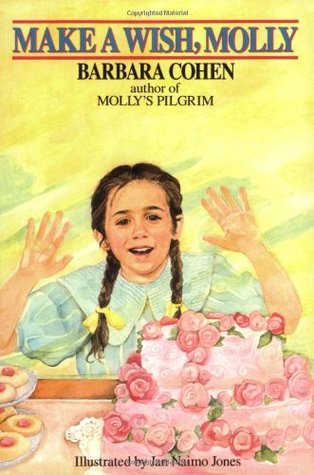
Make A Wish, Molly

Make A Wish, Molly. Barbara Cohen. 1994. 48 pages. [Source: Bought]

First sentence: I didn't know about birthdays. In Russia we hadn't celebrated birthdays. But I learned once we came to Winter Hill. I had started school in the fall, and I'd hated it. But by spring I didn't hate it anymore. That's because I had a friend. Her name was Emma. Her desk was next to mine.

Premise/plot: Molly gets the chance to learn about birthdays--and birthday parties--in this early chapter book by Barbara Cohen. But perhaps more importantly she gets the chance to learn something about herself.

Molly sees a BEAUTIFUL decorated cake in a shop window. Her friend says she'll have a cake like that and her birthday party in a few weeks. Molly might get a chance to taste such a delectable cake for herself--it seems almost too good to be true.

Unfortunately, the birthday party takes place during Passover week. Molly does NOT want to take her own food to snack on--not while her friends are enjoying that incredible cake. Could she--should she--eat the cake anyway?

My thoughts: What a lovely little story! It's historical fiction--presumably early to mid-twentieth century. The family of our wonderful little heroine is Jewish--recently arrived from Russia. Their traditions are not the same as everyone else. Part of Molly longs to fit in no matter what. Coming-of-age novels address the question who am I? This does just that. I loved Molly's confidence by the end of the novel!

© 2018 Becky Laney of Young Readers

Friday, March 23, 2018

A Gift for Mama

A Gift for Mama. Esther Hautzig. 1981/1997. Penguin. 64 pages. [Source: Bought]

First sentence: Sara was sick and tired of making presents. And Mother's Day was coming. For birthdays and for Hanukkah, for anniversaries and for Mother's Day, Sara always had to make a gift. Mama said that the best presents were handmade presents.

Premise/plot: Sara, our heroine, has determined that she will BUY her mother a present this year. This won't be easy. She doesn't have an allowance. She doesn't have money saved up. She has nothing but her determination--her grit--to find a way to make it happen. She knows exactly what she wants to buy her mother--a pair of slippers that her mother has admired from a store's window display. She knows exactly how much they cost--nine zlotys. How resourceful can one girl be?

My thoughts: The setting of this one is very understated. I believe it is set in Poland in the 1930s. It stars a Jewish family in a Jewish community. The focus isn't on HISTORY or DANGER or THREATS. The focus is on family--immediate and extended. The focus is on relationships. I love seeing how close Sara is to her aunt, Margola. I LOVED, LOVED, LOVED seeing their bond. And Sara also has a close relationship with her grandmother. This is without a doubt a character-driven story. And it packs a lot of emotion and intensity into its pages.

For better or worse, the Mama of the family--whom Sara LOVES--seems to have some big issues, unresolved issues from her past. And she's far from perfect. But just because she's far from perfect--in our eyes--doesn't make her any less loved by Sara or any of the rest of her family.

I could relate to Sara--her stubbornness, her sensitivity, her wearing her heart on her sleeve, her feeling emotions so deeply and intensely. Sara is the exact opposite of her mother in so many ways. But love connects them even if communicating by words--even actions--doesn't. I think that you could say they speak different love languages.

I'm not sure what I would have thought about this one as a child, but I could relate to it as an adult. 

© 2018 Becky Laney of Young Readers

Monday, November 15, 2010

The Hallelujah Flight

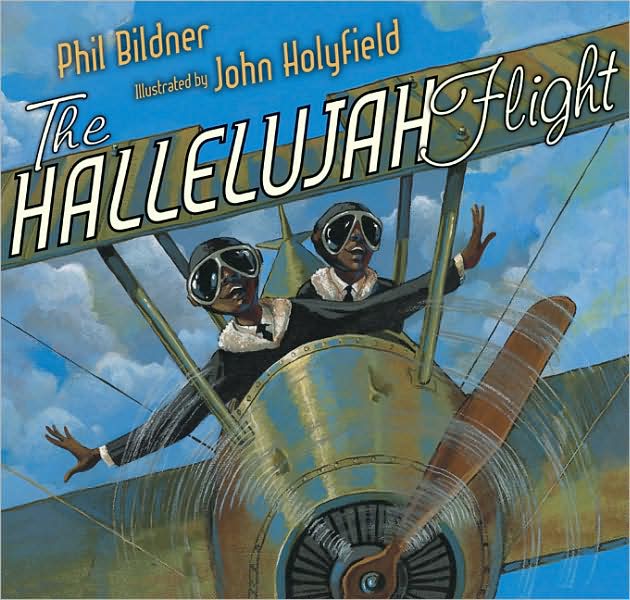
The Hallelujah Flight. Phil Bidner. Illustrated by John Holyfield. 2010. Penguin. 32 pages. 

The day I first met James Banning, he said, "Mr. Allen, my dream is to fly a plane from sea to shining sea, and this here 0XX6 Eagle Rock is our plane. But first I'll need you to overhaul the engine." 
I just about coughed up my coffee. "Replace the entire engine? How will we pay for that?" Times were hard, and most folks didn't have a nickel to spare.
"I've got an idea," Banning replied. "Whenever people give us food, fuel and supplies along the way, they can write their names on the tip of the wing.They'll fly into the history books right along with us!"
"That might just work," I declared.

Though The Hallelujah Flight is a work of fiction--historical fiction--it is based on a true story. It is based on the story of the first African American pilot to complete a transcontinental flight of the U.S. (Also, the first black aviator to obtain a license from the United States Department of Commerce.) The year is 1932, and the story is told from the point of view of his copilot-mechanic, Thomas Allen.

I liked this one. I really liked it. The author mentions how he was shocked that this story hasn't been told before--that it's not widely known--at least not as known as it should be. And I agree. I think more stories like this need to be written, brought to light.

I loved the illustrations. I just LOVED them. I think they are wonderful!

© Becky Laney of Young Readers

Sunday, April 4, 2010

Aunt Mary's Rose


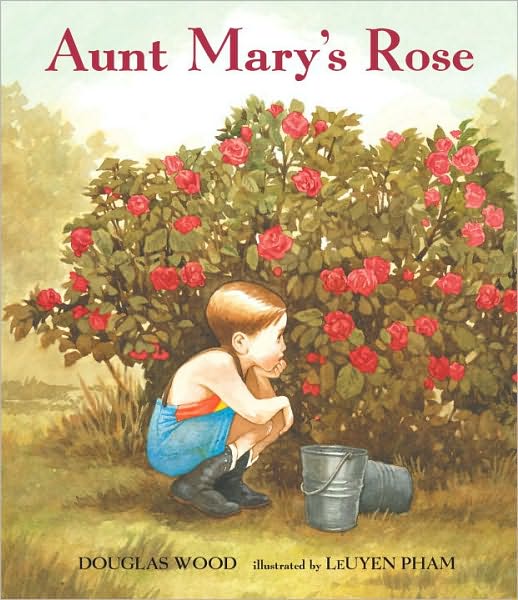
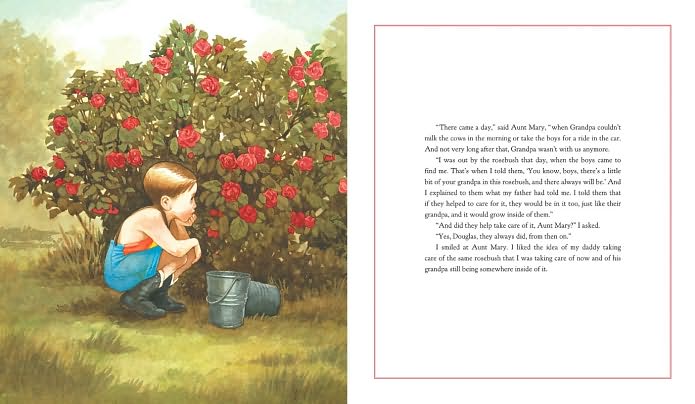
Aunt Mary's Rose. By Douglas Wood. Illustrated by LeUyen Pham. 2010. March 2010. Candlewick Press. 32 pages.
I looked all over the rosebush in Aunt Mary's backyard, the bush she had asked me to water.
I looked at the blossoms. I looked at each petal. I looked at the leaves. At the stems. I even looked around the roots.
"Take care of the rose, Douglas," Aunt Mary had said, "and one day there will be a little bit of you inside of it. And a little bit of the rose inside of you."
I had just poured two pails of water on the rosebush, pulled out some crabgrass, and plucked off a couple of old blossoms and some yellow leaves.
Now I looked it over very carefully, and all I saw was...rosebush.
Douglas Wood's Aunt Mary's Rose is a quiet, intimate portrayal of a family through the decades. A story of what it's like to grow up in a certain time and place. A family story as well. About the bonds a family share and create. About memories. About the stories a family passes on. About family legacies. About the connections we make that last forever. It's a story about love.


It's definitely a picture book for older readers because there is a great deal of text. But for those readers that realize that picture books don't always have to be for the little ones, don't have to be about babyish things, there is much to appreciate here.

I have been a big fan of LeUyen Pham for years. I just love, love, love her work. I do. So anytime I see her name, I just have to read the book!

© Becky Laney of Young Readers

Thursday, February 18, 2010

My Name is Phillis Wheatley


My Name is Phillis Wheatley: A Story of Slavery and Freedom. Afua Cooper. 2009. Kids Can Press. 152 pages.

The green silk gown does me well, likewise the white bonnet. My mistress had insisted that I dress plainly.

A fictional account (I'm assuming) of the life of poet Phillis Wheatley. Covering her childhood through her death, it tells the bittersweet story of a slave girl whose poems were published. It tells of her struggles and heartaches. Too "genius" to mix with the slaves, too "inferior" to mix with the whites, her life definitely knew of loneliness. Even though her master and mistress were kind (relatively speaking) never for a minute does the reader get the idea, the impression, that being a slave was a good thing. (She was freed after her book was published, by the way).

I found this one to be emotional and powerful in places. The description of her crossing is especially moving.

© Becky Laney of Young Readers

Saturday, August 22, 2009

Nathaniel Fludd: Flight of the Phoenix


LaFevers, R.L. 2009. Nathaniel Fludd: Beastologist: Book One: Flight of the Phoenix. Houghton Mifflin. 136 pages. September 2009.

It was one of the most important moments in Nathaniel Fludd's young life, and he was stuck sitting in the corner.

I love that first line. (What say you? Does it make you want to know more?) Nathaniel Fludd, our hero, is about to learn that his parents have died--they're presumed dead at least. They left him several years earlier--in the care of his governess, Miss Lumpton--and went off adventuring. Promising him that they'd write. That they'd send for him when he was old enough to have gotten an adventurous spirit (and heart.)

"You need a little more time to grow up," his father had said. "When you're old enough to travel well and your sense of adventure has developed, we'll send for you then."
Time had passed. On his eighth birthday, Nate had been excited, but nervous, too. He wasn't sure his love of adventure had shown up yet. But his parents' letter asking him to join them never showed up, either. "Just as well," Miss Lumpton had sniffed. "Their job is much too important to have a youngster tagging along, getting in the way."
On his ninth birthday Nate had been hopeful. Miss Lumpton told him not to be silly. His parents' work was much too dangerous for a young boy. Especially a young boy like himself, one who liked quiet walks, reading, and drawing. Clearly he wasn't suited to a life of adventure. Nate was a little disappointed--he thought he had felt the smallest beginning of an adventurous spark.
By his tenth birthday, Nate had buried the memory of his parents and never took it out anymore. Much like a toy he'd outgrown, he told himself. But the truth was, thinking of them hurt too much. (3-4)
After Miss Lumpton is given a tidy sum, Nate is sent to live with his father's cousin, Phil A. Fludd. Phil, surprise, surprise, is a woman. But that doesn't mean she can't live up to the Fludd name and be a great adventurer. She's a bit shocked that Nate hasn't been taught the trade, he knows nothing about being an adventurer, about living an exciting and dangerous life. But she's determined to train him up right!

Thus the adventure begins...

I liked this one. It features black and white illustrations by Kelly Murphy. It's a nice blend of mystery, adventure, and humor.


© Becky Laney of Young Readers

Tuesday, April 8, 2008

Time Spies: Bones in the Badlands


Ransom, Candice. 2006. Time Spies: Bones in the Badlands.

Bones in the Badlands is book two in the Time Spies series, a series geared toward younger readers just emerging into the chapter book genre. The main characters are Alex, Mattie, and Sophie, a set of siblings, gifted with a magical spyglass that transports them back in time. They're not touring history unguided, however. Their parents own a quaint-but-fabulous historical inn. Now and then, guests visit the inn that are more than they seem. These guides leave notes--hints--that prepare the children for their next adventure. In Bones in the Badlands, their travel guide is a woman, a paleontologist. This adventure sees the siblings (and Ellsworth the elephant of course) traveling back to Wyoming in 1898 to help out on a historic dig. The siblings must help Walter Granger dig for dinosaur bones. Readers will learn a few things alongside our heroes including how to make a plaster cast of tracks.

I am really enjoying this series. I am looking forward to reading more and squeezing these reviews in as I get the chance!

Friday, October 19, 2007

A Song for Harlem


Patricia McKissack's Scraps of Time: 1928: A Song for Harlem.

A Song for Harlem is a chapter book--historical fiction chapter book--for young readers. Apparently, this is one in a series of books, but I haven't read the rest of the series. (The first apparently is Scraps of Time: 1960: Abby Takes A Stand. The second book is Scraps of Time: 1879: Away West. As far as I can tell, they can stand alone quite well. The main premise is that two children are going through things in the attic (or some other activity done with grandma) and are hearing stories about their family's past. In this particular book, the children are learning about their great-aunt (or maybe great-great aunt) Lilly Belle who spent a summer in Harlem going to a writer's workshop with Zora Neale Hurston as one of her teachers. The book is about Lilly's journey to finding her voice. It is a good read. And I would definitely recommend this series for young readers. Patricia McKissack is great like always.