Showing posts with label social studies. Show all posts

Thursday, May 2, 2024

67. Five Stories


Five Stories. Ellen Weinstein. 2024. 48 pages. [Source: Library] [picture book for older readers]

First sentence: Buildings are like people: each one has a story. This building is over a hundred years old and holds thousands of stories about the people who have lived here on New York's Lower East Side. Lots of families have come to the Lower East  Side from different parts of the world and made it their home. And though their reasons for being here are different, they still share many of the same questions, fears, hopes, and dreams. And each generation contributes tastes, stories, and sounds to the neighborhood.

Premise/plot: Five Stories tells the story of five immigrant families--five decades/generations, five cultures, one apartment building in one neighborhood. The Epsteins (1914), The Cozzis (1932), The Martes (1965), The Torresses (1989), and The Yes (present day). Each story has a child at the center: Jenny Epstein, Anna Cozzi, Jose Marte, Maria Torres, and Wei Yei. Their narratives give a slice of life view to their times and culture. There are plenty of similarities--for example--though the means of communication with loved ones change, all families want to hold onto and remember the loved ones left behind when they immigrated.  

My thoughts: This is a picture book for older readers. Definitely a good fit for elementary school students. I don't think it would be as good a fit for younger readers. I definitely liked this one. I would LOVE, LOVE, LOVE if this idea had been a chapter book so we could follow the families more--longer. The concept was good. The author's note reveals she is a descendant of Jenny Epstein.

© 2024 Becky Laney of Young Readers

Thursday, August 25, 2022

134. Word Travelers and the Taj Mahal Mystery


Word Travelers and the Taj Mahal Mystery. Raj Haldar. Illustrated by Neha Rawat. 2022. 112 pages. [Source: Library]

First sentence: Eddie jumped out of bed as soon as the sun came up. He ran to the bedroom window and grabbed his end of the tin-can telephone, connected by string all the way to his friend Molly-Jean's house next door.

Premise/plot: Eddie and Molly-Jean are best, best, best friends (and neighbors). Every weekend, they have sleepovers. On the particular weekend this novel opens, the two are getting ready for (yet another) sleepover. But...this sleepover will be different. A seemingly innocent question...where did the word pajamas come from...will lead to a BIG adventure. And (of course it does) it involves a magical/enchanted book. (Officially it is the Awesome Enchanted Book). Soon these two find themselves in India...helping another kid solve a BIG mystery...and learning about a dozen words (give or take) that the English language inherited from India. (Inherited isn't the right word. I know. But Indian words that have directly influenced English words.) 

My thoughts: This one has a little bit of everything: some action, some mystery, some nerdy word-love, and perhaps a little geography as well. I definitely liked it. It was fun. I enjoyed seeing which words were introduced/highlighted throughout the story. (For example, the word shampoo...which comes from the Hindi word champo, meaning "to press or knead.") I felt like I was learning, but it wasn't so dinky or cheeseful that I hated it for being didactic.


© 2022 Becky Laney of Young Readers

Tuesday, February 15, 2022

30. The People's Painter


The People's Painter: How Ben Shahn Fought for Justice with Art. Cynthia Levinson. Illustrated by Evan Turk. 2021. [April] 48 pages. [Source: Library]

First sentence: From the time he could grasp a pencil, Ben Shahn yearned to draw everything he saw in his village in Lithuania.

Premise/plot: The People's Painter is a picture book biography of Ben Shahn. 

My thoughts: I love learning. I do. And picture books are a great format for learning new-to-me stories. I had never heard of Ben Shahn, a Jewish artist and activist before reading this award-winning picture book. I am SO glad I read it. I thought it was packed with information--in an age appropriate way. The art and text work together so well. (As you'd expect in a picture book about an artist.)


© 2022 Becky Laney of Young Readers

Thursday, January 10, 2019

Meet Miss Fancy

Meet Miss Fancy. Irene Latham. Illustrated by John Holyfield. 2019. Penguin. 32 pages. [Source: Review copy]

First sentence: Frank loved elephants. He loved drawing elephants and talking about elephants. He loved their hosepipe trunks and their flap-flap ears, their tree-stump feet and their swish-swish tails. But not once, not ever, had Frank seen a real elephant.

Premise/plot: This picture book is set in Birmingham, Alabama, in 1913. It is loosely based on a true story. There was an elephant, Miss Fancy, whom schoolchildren helped to purchase from a circus for Avondale Park. Miss Fancy lived in her new home from 1913 to 1934. Birmingham, Alabama, as adult readers will no doubt know was segregated at that time--only whites were allowed. Frank, our fictional hero, is not allowed in the park nor allowed to visit Miss Fancy. But where there's a will, is there a way? 

My thoughts: I loved this one. First I just have to say that I love, love, love Frank. We're kindred spirits. I also love, love, love elephants. I love their hosepipe trunks and their flap-flap ears. Which brings me to the second thing I love: the writing or the narrative. What else did I love? The illustrations. The author's note. The fact that this is based on a real elephant and keepers. I found it a satisfying read. Frank did find his own way. In all honesty, I enjoyed it all.

The book is a good example--in my humble opinion--of an author showing instead of telling.

Text: 5 out of 5
Illustrations: 5 out of 5
Total: 10 out of 10

© 2019 Becky Laney of Young Readers

Monday, September 26, 2011

All The Way to America

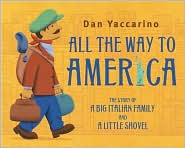
All The Way to America: The Story of a Big Italian Family and a Little Shovel. Dan Yaccarino. 2011. Random House. 40 pages.

My great-grandfather Michele Iaccarino grew up on a farm in Sorrento, Italy. When he was a boy, his father gave him a little shovel so he could help tend the zucchini, tomatoes, and strawberries that his family sold in the village. They worked very hard but were always very poor. And so when he was a young man, Michele left Italy and went all the way to America in search of new opportunities. "Work hard," his father told him, handing him the little shovel. "But remember to enjoy life." "And never forget your family," his mother said. She hugged him and gave him their few family photographs and her recipe for tomato sauce. 

Dan Yaccarino tells a very personal story in All the Way to America. He shares his family history--the history of four generations: his great-grandparents, his grandparents, his parents, and himself, how he's passing on the legacy to his own children. It's a picture book that celebrates family, family values, and life. The good advice being passed on through the generations just as much as that one little shovel. It was a very simple, very sweet story. (I really liked seeing how the shovel was used by each generation.)

I would definitely recommend this one. I really loved it.

Text: 4 out of 5
Illustrations 4 out of 5
Total: 8 out of 10

© 2011 Becky Laney of Young Readers

Monday, November 15, 2010

The Hallelujah Flight

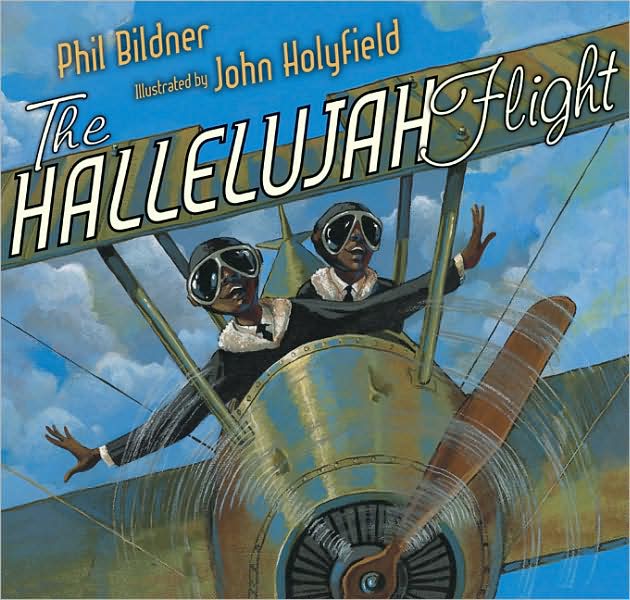
The Hallelujah Flight. Phil Bidner. Illustrated by John Holyfield. 2010. Penguin. 32 pages. 

The day I first met James Banning, he said, "Mr. Allen, my dream is to fly a plane from sea to shining sea, and this here 0XX6 Eagle Rock is our plane. But first I'll need you to overhaul the engine." 
I just about coughed up my coffee. "Replace the entire engine? How will we pay for that?" Times were hard, and most folks didn't have a nickel to spare.
"I've got an idea," Banning replied. "Whenever people give us food, fuel and supplies along the way, they can write their names on the tip of the wing.They'll fly into the history books right along with us!"
"That might just work," I declared.

Though The Hallelujah Flight is a work of fiction--historical fiction--it is based on a true story. It is based on the story of the first African American pilot to complete a transcontinental flight of the U.S. (Also, the first black aviator to obtain a license from the United States Department of Commerce.) The year is 1932, and the story is told from the point of view of his copilot-mechanic, Thomas Allen.

I liked this one. I really liked it. The author mentions how he was shocked that this story hasn't been told before--that it's not widely known--at least not as known as it should be. And I agree. I think more stories like this need to be written, brought to light.

I loved the illustrations. I just LOVED them. I think they are wonderful!

© Becky Laney of Young Readers

Monday, September 13, 2010

Nonfiction Monday: Sit-In


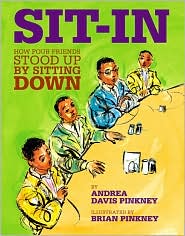
Sit-In: How Four Friends Stood Up By Sitting Down. Andrea Davis Pinkney. Illustrated by Brian Pinkney. 2010. February 2010. Little, Brown. 40 pages.

"We must...meet hate with love."
These were Dr. Martin Luther King Jr.'s words that got them started.
Four hungry friends. Eager to eat.
Each took a seat at the Woolworth's lunch counter
in Greensboro, North Carolina.
David, Joseph, Franklin, and Ezell sat quiet and still.
With hearts full of hope.
With Dr. King's words strong and close.
They were college students with a plan.
It was February 1, 1960.
This picture book very simply, very eloquently presents the story of one aspect of the Civil Rights Movement. The focus is on the peaceful protests, the sit-ins. It tells how four college students inspired others--many others--to join in the nonviolent fight for equal rights, for integration.

I thought the writing was great. I enjoyed the style very much.
This was the law's recipe for segregation.
Its instructions were easy to follow:
Do not combine white people with black people.
Segregation was a bitter mix.
Now, it was the friends' turn to ignore and refuse.
They ignored the law, and refused to leave until they were served.
Those kids had a recipe too.
A new brew called integration.
It was just as simple:
Combine black with white
to make sweet justice.
For them, integration was better than any chef's special.
Integration was finer than homemade cake.
For readers looking for more information, more background, the book features a Civil Rights Timeline and a bibliography.

© Becky Laney of Young Readers

Monday, October 12, 2009

Nonfiction Monday: If America Were A Village


Smith, David J. 2009. If America Were A Village. Illustrated by Shelagh Armstrong. Kids Can Press.

I loved this book. Loved the concept of it. What is it about? The author imagines America as a village of a hundred people. That still didn't come out quite right. I'll let the publisher help:

Today there are 306 million people living in America. This enormous number can be difficult to grasp, especially for a child. But what if we imagine America as a village of just 100 people?
"Each person in this village will represent more than 3 million Americans in the real world."

So the author then provides an overview of our village on a wide range of topics including:

  • Who are we?
  • Where do we come from?
  • Where do we live?
  • What are our families like?
  • What religions do we practice?
  • What do we do?
  • How old are we?
  • How wealthy are we?
  • What do we own?
  • What do we use?
  • How healthy are we?

For example, on "Where Do We Come From?" We read,
America is a country of immigrants. Almost every person in the United States can trace ancestors back to other parts of the world.

If the America of today were a village of 100:
15 would be of German ancestry, 11 would be of Irish ancestry, 9 African, 9 English, 7 Mexican, 6 Italian, 3 Polish, 3 French, 3 Native American, 2 Scottish, 2 Dutch, 2 Norwegian, 1 Scotch-Irish, and 1 Swedish. The rest have other backgrounds.

That is quite a change from when the first U.S. census was taken in 1790. If America had been a village of 100 in 1790, 53 would have come from England, 19 from Africa (most of them slaves), 11 from Scotland and Ireland, and 7 from Germany. The rest had various backgrounds including French, Swedish, and Native.

Early on, most immigrants came from Europe, but that began to change after 1900:

In 1900, 96 percent came from Europe, 1 percent from Latin America, and 3 percent from other places.
In 1950, 53 percent came from Europe, 40 percent from Latin America, 6 percent from Asia and 1 percent from other places.
In 2000, 15 percent came from Europe, 49 percent came from Latin America, 31 percent from Asia, and 5 percent from other places.
The information presented is interesting and simple enough to grasp, yet it isn't too simple. It still gives you plenty to think about, to digest or absorb.

This is David J. Smith's second book, his first was If The World Were A Village. After reading this one, I'm thinking that I should probably seek out his first book.

© Becky Laney of Young Readers