Showing posts with label world war ii. Show all posts

Sunday, November 3, 2024

149. The Tree of Life

149. The Tree of Life: How a Holocaust Sapling Inspired the World. Elisa Boxer. Illustrated by Alianna Rozentsveig. 2024. 41 pages. [Source: Library] [nonfiction; j nonfiction] [5 stars]

First sentence: In a season of sadness, hope came to the children as a tiny tree, tucked inside a boot. It was winter, World War Two, and the boot belonged to a prisoner in a ghetto called Terezin. There were children in the ghetto too. The prisoner saw they were scared and separated from their families.

Premise/plot: Nonfiction picture book for older readers. (Older readers being mid-elementary school on up). It tells the story of a tree--a sapling--nurtured by those in great peril. Despair perhaps was the easier choice, but hope the better one. This is the story of how the tree survived...and continued to inspire hope for generations.

My thoughts: Definitely worth reading. Words don't really do justice. I don't even know what to say beyond that. 


© 2024 Becky Laney of Young Readers

Monday, June 12, 2023

131. Gertie, The Darling Duck of WWII


Gertie, The Darling Duck of WWII. Shari Swanson. Illustrated by Renee Graef. 2023. [March] 40 pages. [Source: Library]

First sentence: One April morning in 1945, when the world was weary of war, a duck flew to the top of a tall post poking out of the Milwaukee River near a big drawbridge and settled in. People smiled at the plucky duck nesting on a perch so high above the water in the middle of a busy, noisy city.

Premise/plot: Nonfiction. History. World War II. Picture book. Gertie, a duck, becomes famous at the end of the Second World War. She warms hearts and features front and center (perhaps not literally) in newspapers around the globe. Everyone, apparently, wanted updates on this darling duck, and her nest of eggs. The place she's chosen for her nest is precarious, at best. Will all be well?

My thoughts: I'd not heard of Gertie. I'm going to guess that the book's intended audience will be unfamiliar as well. This book was a DELIGHT. I absolutely loved this narrative nonfiction text. I loved the illustrations. I loved the end pages that include "more of the story."


© 2023 Becky Laney of Young Readers

Wednesday, April 12, 2023

89. Stars of the Night


Stars of the Night: The Courageous Children of the Czech Kindertransport. Caren Stelson. Illustrated by Selina Alko. 2023. [February] 40 pages. [Source: Library]

First sentence: When we were seven or eight or nine or ten, our home was the old city of Prague. In the summer when the sun lit up the sky, our mothers brought us to the city parks. We counted the boats on the river and had picnics of dark bread with cheese and slices of our mothers' sweet honey cake.

Premise/plot: Nonfiction picture book for older readers. (Mid-to-upper elementary grades). Narrative nonfiction--history--set around the Second World War. This picture book is unusual/unique in that it is told in first person plural; it is a collective story; it uses we and our pronouns. The book tells of the kindertransport--a mission to rescue Jewish kids and get them OUT of Nazi-occupied countries. (In this case, Czechoslovakia). 

My thoughts: I'd read a book for an adult audience on this subject matter. I'd watched a documentary as well. I was fairly familiar with the subject. This is such an emotional story. But I don't mean that it has added melodrama or theatrics to history. The plain, bare facts are enough to break your heart as you read. I think the collective "we/our" works with this one. I don't want to say it "makes" it personal or more personal. But I think it helps with empathy. 

There are not that many picture books about the Holocaust and the Second World War. There are a handful for sure. But not hundreds. (I can think of several starring Anne Frank. It is always refreshing to see a book that doesn't limit the story to being just Anne's story.) There are so many voices, so many stories--each one deserving of being heard.


© 2023 Becky Laney of Young Readers

Sunday, March 26, 2023

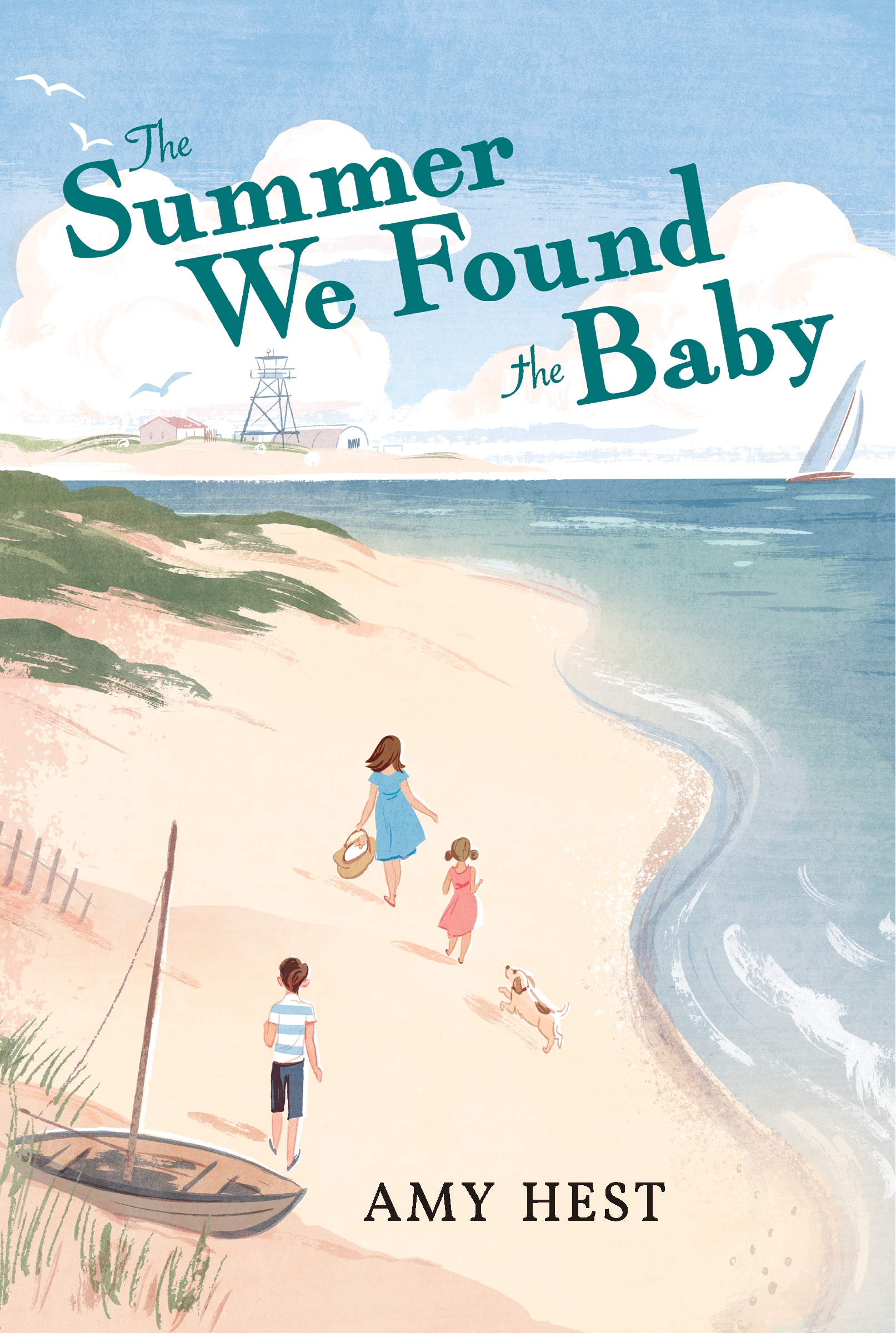
73. The Summer We Found the Baby


The Summer We Found The Baby. Amy Hest. 2020. 192 pages. [Source: Library]

First sentence: I'm the one who found her. A real, live baby girl and I saw her first. I saw the basket. Right over there, on the steps of the new children's library. A tiny little baby! All by herself in that basket! She was so brave, though. She wasn't even crying. I just wanted to hold her awhile. I didn't mean to take the baby.

Premise/plot: This children's book is set during the Second World War. It opens on a summer day--August 31. Three children (Julie and Martha Sweet, and their neighbor, Bruno Ben-Eli) find a baby in a basket on the steps of the [new] children's library. Each chapter features narration by all three--Julie, Martha, Bruno. Each chapter reveals details fleshing out their story. Everything leads to the big day--August 31. As you might have guessed, this one is not a linear or chronological story. Readers learn about the characters, the story, the setting--slowly but surely. 

My thoughts: I really loved this one! I did. There were a few [subtle] moments of sadness. But nothing overwhelming or heavy. Observant readers can read behind the lines as to how the characters might be feeling. It has a great premise--children finding an 'abandoned' baby on the steps to the public library. It has dimensional characters--I really loved getting to know all three protagonists. I loved the complex relationships. Readers learn relatively early on that Bruno and Julie have fallen out; they were friends once, but no more. I love how human all these characters are. I felt empathy for all three.


© 2023 Becky Laney of Young Readers

Thursday, May 26, 2022

61. Just A Girl


Just a Girl: A True Story of World War II. Lia Levi. Illustrated by Jess Mason. Translated by Sylvia Notini. 2022. 144 pages. [Source: Library]

First sentence: My name is Lia (if you look at the cover of this book, you'll find my name on it!) and I want to tell you the story of when I was a little girl. Mama, Papa, my two younger sisters, Gabriella and Vera, and I lived in a city in Italy called Turin.

Premise/plot: Just A Girl is a memoir for young readers. The memoir chronicles her time as a Jewish girl growing up in Italy during the Second World War. It spans the second world war. Childhood is full of plenty of changes, but, during this time in history especially so. Some of the changes happen subtly, some abruptly. 

Throughout the book, Lia sees herself as a "Jewish girl." It is her Jewishness that marks her. Her life is turned upside down and inside out because she is Jewish. Every single change--all of them damaging and devastating--is because she (and her family) were/are Jewish. But by the end of the book, by the end of the war, she can be JUST A GIRL. She no longer has to be labeled and defined. She can just be herself. 

My thoughts: I definitely enjoyed this one. I do think books about the second world war, and specifically books about Jewish experiences during the second world war, should be written for ALL age audiences. There are plenty that are appropriate (you could even argue necessary and important) for middle school audiences on up. There are fewer books written for elementary audiences, in particular for third to fourth graders. 

I thought the book had a good, strong narrative. I felt it was gentle at times. But it was definitely straightforward as well. It didn't paint it as a lovely-lovely glorious time. It didn't shy away from the harshness of the times.

© 2022 Becky Laney of Young Readers

Saturday, February 12, 2022

27. Nazi Prison Camp Escape


Nazi Prison Camp Escape (Great Escapes #1) Michael Burgan. Illustrated by James Bernardin. 2020. 128 pages. [Source: Library]

First sentence: On a summer morning in 1942, Bill Ash joined the other prisoners trudging across the sandy ground toward a small concrete building. The men were being held at a German prisoner of war (POW) camp called Stalag Luft III.

Premise/plot: Nazi Prsion Camp Escape is the first in a new series called Great Escapes. Each book, I believe, will be a stand alone, but all books will feature...'a great escape.' This first book stars real life RAF (Royal Air Force) pilot, Bill Ash. (This American--like some others--joined the War before the United States and volunteered their services to the Allies.) After his plane went down, he was captured and sent to a Prisoner of War Camp. This book doesn't feature one "great escape." But multiple maybe-not-so-great escapes. He was good at escaping, maybe not so great at avoiding capture afterwards. Regardless, the book contains his adventures/misadventures in a war-torn Europe.

My thoughts: The book is too fiction-y to be purely nonfiction. And it is too non-fiction-y to be purely fiction. It is packed with facts. For the right reader, those facts are fascinating. You might even find readers say more please. For the wrong reader, well, those facts might come across as "dry" or "boring." Though the plot is action-packed, so there's that. Still, you can't deny that the text is full of info-dumps. Again, to the right reader these facts are interesting/fascinating. The info dumps are mostly necessary in my opinion. Especially with the audience of the target reader. You need background information for context, context, context. You can hardly talk about the Second World War without explaining all these layers. 

It has been pushed--in the jacket copy at the very least--as being for fans of the I Survived series. Is this fair? Yes. No. Maybe. See, it depends on if you are talking about narrative style/approach OR if you are talking about subject--big events from history. 

There are obviously differences. The I Survived stories are very fiction-y. They feature young protagonists. There's almost always inserted back story that has very little to do with the actual I Survived event. (Like in the Blizzard book, there was a flashback to him encountering a snake.) The chapters are written in such a way to keep you turning pages.

I haven't read the others in the series. But this one is mostly nonfiction. It is packed with information. It is written in a more engaging/appealing style than a history text book. But it isn't necessarily a page-turner UNLESS (and this is key) history is one of the things that excites you. For some readers, history is EXCITING and FUN. I know that is a novel thought. But some people actually enjoy it.

If you read I Survived because you have an interest in HISTORY and the BIG EVENT in the story, then, yes, this series might appeal.

© 2022 Becky Laney of Young Readers

Tuesday, February 1, 2022

18. Nicky & Vera


Nicky & Vera: A Quiet Hero of the Holocaust and the Children He Rescued. Peter Sis. Illustra 2021. [January] 64 pages. [Source: Library]

First sentence: Nicky was born in 1909, into a century full of promise.

There aren't a lot of picture books about the Holocaust. Nicky & Vera is one such book. It tells the story of Nicholas Winton. His work saved over six hundred [Jewish] children trapped in Nazi-occupied Czechoslovakia. Vera (of the title) was one such child he rescued. Nick never made a big deal--or a little deal--about his effort to save lives during the second world war, but, in the 1980s he was reunited (on television) with some of those he had rescued decades before.


I read this in e-book format (library e-book). I do think it would have been an even better reading experience for me if I'd read it as a book-book. I think with many books one format is just as good as the other. But that wasn't the case with this one. Picture books have spreads (obviously) two pages working together visually as one. Sometimes a sentence would be spread out over both pages. So your narrative wouldn't make sense until you "turned the page" of the e-book. 

Definitely worth reading for the text and the illustrations. (Though the illustrations are not my personal cup of tea.) They are the kind of illustrations that while I personally may not love them often tend to win acclaim and awards from other people. 

© 2022 Becky Laney of Young Readers

Thursday, November 11, 2021

163. The Bookshop of Dust and Dreams


The Bookshop of Dust and Dreams. Mindy Thompson. 2021. [October 26] 272 pages. [Source: Library]

First sentence: The bookshop is feeling blue today. I sense it the moment my brother James and I arrive home from school. The lights are low, the ever-shifting wallpaper is a cheerless dark gray, with somber books on display--Wuthering Heights, Old Yellow, A Little Princess. The gloom sinks into my bones.

Premise/plot: The Bookshop of Dust and Dreams has an intriguing premise. It is set during the Second World War--1944 to be precise. But its main setting is a bookshop. Rhyme and Reason is one of a handful of magical bookshops. "Our shop isn't a normal bookshop, it belongs to the world of magic ones. Just like the others, Rhyme and Reason finds people from outside of our time and brings them to our door. It searches a hundred years into the future and the past to find customers who need the light and hope it can offer through books and community. Papa says bookshops are good for broken souls and wounded hearts." Poppy, our heroine, is quite a bookworm. She loves, loves, loves, loves her family's bookshop. She loves meeting all the customers--all ages of customers--from all time periods. But the shop has been acting weird, strange, out of sorts, unpredictable, moody. And Poppy feels called--in more ways than one--to try to mend the shop and set things right again. But that process is complicated. How does one *know* what the right thing to do is? There can be a subtle difference between something feeling right and being right. And sometimes doing what is right breaks your heart--shatters it. Still the fate of the bookshop may be in her hands--as incapable and unsure as she feels. 

My thoughts: This book had the potential to be super-fluffy and just pure delight OR the potential to be a weighty complex read. It was certainly heavier than I imagined it might be. The premise is pure delight: a MAGICAL bookshop. Customers coming into the shop from ALL time periods. Being able to read books from other time periods. Books finding the right reader at the right time. Books connecting people together. A true sense of community between readers--no divisions or divides. Pure delight. But it goes beyond that and ventures into more familiar territory perhaps--the battle between good and evil, light and dark. The magic that makes the bookshop possible is more complex than you might think. Magic comes with a price--in the words of Rumpelstiltskin from ONCE Upon A Time. There is a showdown between light and dark in The Bookshop of Dust and Dreams. And the book has more layers than you might expect. I found myself accurately predicting a few things, but it held some twists and turns that I did not guess, would never have guessed.

© 2021 Becky Laney of Young Readers

Thursday, August 5, 2021

104. History Smashers: Pearl Harbor


History Smashers: Pearl Harbor (History Smashers #3) Kate Messner. Illustrated by Dylan Meconis. 2021. [January] 224 pages. [Source: Library]

First sentence: People often tell the story of Pearl Harbor as if the Japanese attack in Hawaii happened completely out of the blue, with no warning and nothing to suggest there might be trouble.

Premise/plot: What you see is what you get. This is a nonfiction book written for young readers (elementary aged) about the attack on Pearl Harbor. Yet the book doesn't just tell the story of the events of December 7, 1941. No, the book does a good job of providing context for understanding everything surrounding Pearl Harbor. What was the relationship like between Japan and the United States leading up to Pearl Harbor? Why was there tension between the two nations? Where there signs in the months leading up to the attack? What were those signs? How did everything play out on that day? (In other words, what was the timeline for everything unfolding?) It details Pearl Harbor, of course, as you'd expect. But it also shifts to the war itself. How were Japanese-Americans treated after Pearl Harbor? Towards the end, it shifts yet again to the dropping of the two atomic bombs to end the war with Japan.

My thoughts: The subject is a heavy one. But I think it is handled with respect. I would imagine that most--if not all--of these facts will be new to the intended audience. (Particularly those facts about using Japanese-American soldiers as test subjects--aka DOG BAIT--so army dogs could be trained to sniff out "the enemy" and attack to kill. If I hadn't read a YA novel about it, I wouldn't have known. I believe the project was hush-hush at the time.) As an adult who has read widely on the subject of World War II, I didn't learn anything truly new-to-me. Yet what was presented was done well. I loved the organization, layout, presentation. I loved the blend of text and graphic panels. I loved the amount of detail.


© 2021 Becky Laney of Young Readers

Friday, February 12, 2021

16. War and Millie McGonigle


War and Millie McGonigle. Karen Cushman. 2021. [April] 224 pages. [Source: Review copy]

First sentence:  George lifted the slimy creature to his mouth and bit it right between the eyes. I’d seen him and the other Portuguese octopus fishermen do that a hundred times, but it still made me shudder. “Doesn’t that taste muddy and disgusting?” “Nah,” he said, wiping his mouth on his sleeve. “Only salty. I told you, this way he don’t die but only sleeps, stays fresh ’til he’s cooked.” George threw the octopus into a bucket and slid over to another hole in the mud.

Premise/plot: War and Millie McGonigle is a coming of age middle grade historical novel set in California in late 1941 and early 1942. Our heroine, Millie McGonigle, is struggling. Why? Perhaps the better question may be why not?!?! Her grandmother has died. Her sister, Lily, is sick and "stealing" all the attention and love of her parents. Horrible things are happening around the world. What if America enters the war? What if there are really Japanese or German spies? 

Millie takes all her anxiety and directs it to her BOOK OF DEATH. Yes, this young heroine likes to make a list of the dead and/or to draw the dead she discovers. She strolls along the beach and sketches all the dead things she finds. (And she's sure to make a great first impression on all the new people she meets as she interrogates them to find out if anyone has died lately so she can record it for her book.)

My thoughts: The cover isn't nearly morbid enough to match the contents of this weird coming of age novel. (If I'm being honest I feel the cover is being intentionally deceptive.) Millie is obsessed with death. OBSESSED. 

Her parents don't seem to notice how morbid their daughter has become since the grandma's death. Perhaps because authentically enough the whole family is struggling emotionally and mentally. It's the Depression. They're barely barely making enough money to get by. They eat fish every single day. And one of their daughters is sickly and always needing extra care, extra attention, extra money. Again they are broke, broke, super broke. So perhaps the fact that they're not really connected enough to notice Millie's morbidity isn't all that surprising. 

So the whole book is about Millie drawing dead things (like dead dogs, dead octopi, dead flowers, etc.) and making lists of dead people. 

It stays dark for so long--despite the cheerful looking cover--that when Millie does finally, finally, finally see some hope for the future....you may be out of patience. 

S

P

O

I

L

E

R

This book has a disturbing BEYOND DISTURBING hideously EVIL AND WRONG chapter where her brother brings her a DEAD AND DECAYING DOG that he and his friend have dug up to bring her so that she has something new to draw for her book. Think about it. DISTURBING on so many levels. Even worse is that this is a detailed, descriptive chapter so if you have even the teeny tiniest liking for dogs you'd be disgusted, outraged, and ready to throw the book across the room. 

© 2021 Becky Laney of Young Readers

Thursday, January 21, 2021

7. My Chocolate Year


My Chocolate Year: A Novel with Twelve Recipes to Make Your World A Little Sweeter. Charlotte Herman. Illustrated by LeUyen Pham. 2008. 176 pages. [Source: Review copy]

First sentence: "Fifth grade with Miss Fitzgerald is going to be the best grade ever!" I said to my friend Sunny Shapiro as I tried balancing myself along the curb.

Premise/plot: Dorrie Meyers stars in this lovely coming-of-age novel set during the 1945/46 school year in Chicago, Illinois. The war has ended, but its effects are far from over: especially for this Jewish American family. 

Dorrie hears or overhears much. Her family is concerned about their relatives in Europe. Did they survive the war? Were they among those murdered by the Nazis? Not knowing weighs on the family. Dorrie is just getting to the age where she's thinking beyond herself to others. But much of her thinking is consumed with the SWEET SEMESTER. Mrs. Fitzgerald, a fifth grade teacher, is known for putting on THE SWEET SEMESTER, a celebration of their time spent together. Each student brings ONE DESSERT that they prepared all by themselves. An essay is also involved. A 'best' dessert and 'best' essay will be recognized...

My thoughts: I enjoyed this historical middle grade novel! I did. It follows the whole school year. It contains plenty of family scenes and school scenes. I loved the characters. I loved the story. I would definitely recommend this one.

As far as age appropriateness--that depends on the child. Readers learn through the dialogue of the characters the fate of some of the extended family. To the overly sensitive child who has never learned anything at all about the Holocaust, it may come as a bit of a shock. It is not melodramatic or manipulative, in my opinion. The fate of those relatives is not the one and only point of the novel. 

You certainly can't please everyone. As I'm scrolling through the reviews on GoodReads I'm struck by two camps: HOW DARE A BOOK ABOUT CUPCAKES TALK ABOUT THE HOLOCAUST vs. HOW DARE A BOOK ABOUT THE HOLOCAUST TRIVIALIZE IT BY TALKING SO MUCH ABOUT CHOCOLATE. Life is complex. A girl can both LOVE, LOVE, LOVE desserts and spending time with her family and friends and listening to her most favorite radio programs AND be concerned about her extended family. 

© 2021 Becky Laney of Young Readers

Monday, January 7, 2019

Real Stories From My Time: Pearl Harbor

Nanea, Real Stories From My Time: Pearl Harbor (American Girl) Jennifer Swanson. 2018. Scholastic. 112 pages. [Source: Review copy]

First sentence:  When most people think of Hawaii, they picture a lush, tropical island with miles of sandy beaches and palm trees swaying in the warm breeze--and that picture is pretty accurate!

Premise/plot: This AmericanGirl chapter book blends nonfiction and fiction together to teach young readers about the bombing of Pearl Harbor.

The first three chapters give young readers a background on Hawaii. The remaining chapters focus on the attack itself and the aftermath.

Most chapters include a brief section set apart as Nanea's Story. This fiction story is set in a different font. There's no mistaking what is fiction and what is nonfiction in this one.

My thoughts: I haven't read many--if any--American Girl chapter books. I liked this one. Part of me can't help wishing that it was all nonfiction or all fiction. The Magic Treehouse series, I believe, often has a fiction book and a nonfiction companion book that go together.

Original audience born circa 2009 to 2011. 

© 2019 Becky Laney of Young Readers