Showing posts with label folk tales. Show all posts

Sunday, October 23, 2022

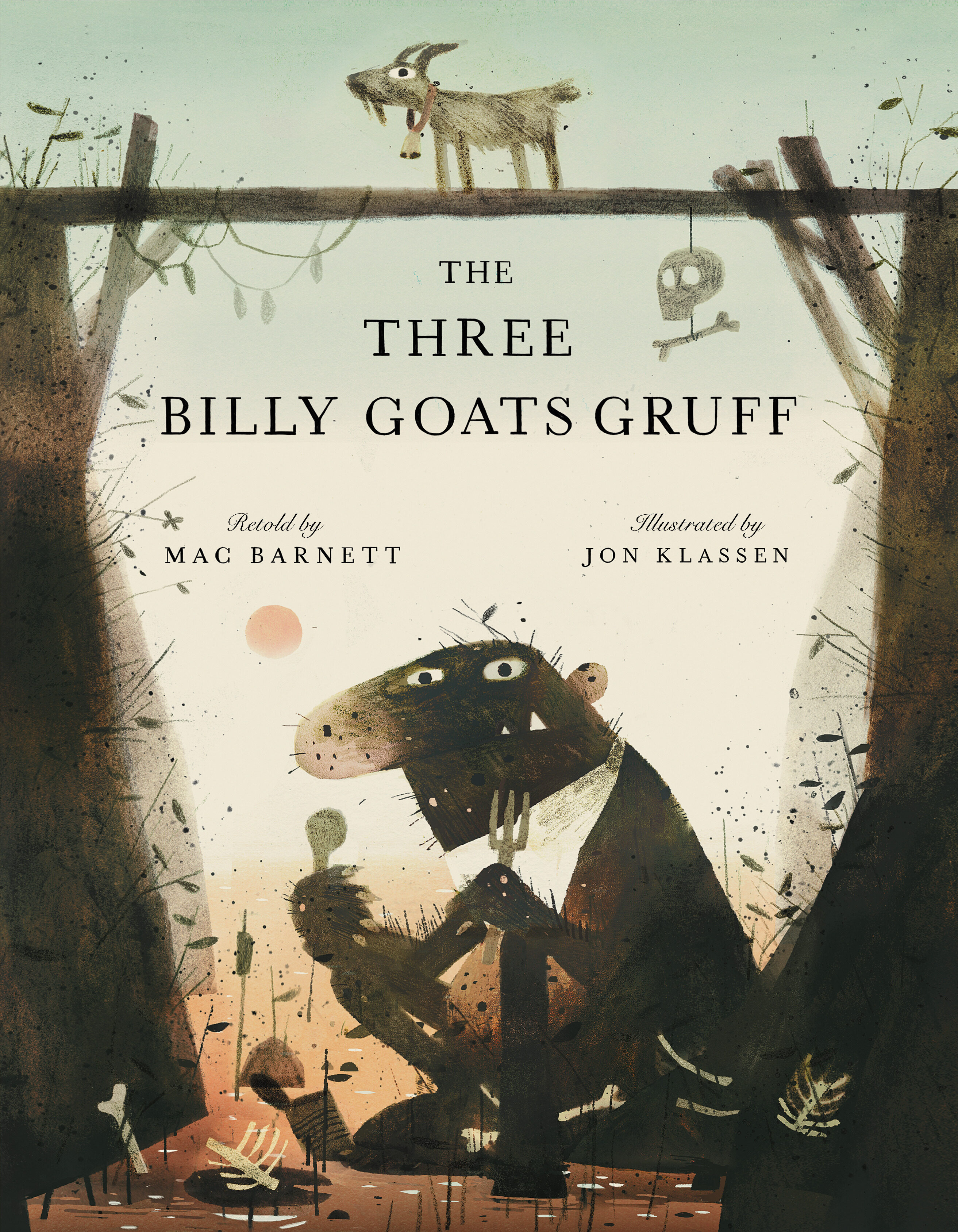
172. The Three Billy Goats Gruff


The Three Billy Goats Gruff. Mac Barnett. Illustrated by Jon Klassen. 2022. [October 18] 48 pages. [Source: Library]

First sentence: Once upon a time there was a bridge. And beneath that bridge, there lived a troll. 

Premise/plot: The troll who is "practically starving" narrates Klassen's adaptation of the folk tale The Three Billy Goats Gruff. It has many--if not most--of the traditional elements of this one, including all the clip, clop, clip, clops. But it adds a bit more as well--the troll's perspective for one. The goat LOVES to 'count the ways' he likes to prepare (and eat) goat. But it is the lengthier ending that allows for the most creative expression.

 My thoughts: I really enjoyed this one! I'll have to recommend it to my sister who does a folk/fairy tale unit. I really liked that they kept the bare bones of this story. It isn't too 'out there' of an adaptation. But I also really love the originality in it! I love the ending. I think it works well. 


© 2022 Becky Laney of Young Readers

Thursday, November 18, 2021

165. The Cat on the Dovrefell


The Cat on the Dovrefell: A Christmas Tale. Illustrated by Tomie dePaola. Translated by George Webbe Dasent. 1979/2021. 32 pages. [Source: Library]

First sentence: Once upon a time, in the faraway land of Finnmark, a man caught a great white bear. "This bear will be a great gift for the king of Denmark," he said. So he set off.

Premise/plot: A picture book retelling of a traditional fairy tale from Norway. A man (and his bear) take refuge in a couple's home. But the couple are fleeing from their home because of TROLLS that come every year to eat their Christmas feast. The man (and his bear) are welcome to stay, however. They do. The trolls come...and well...let's just say it might be their last time to come visiting this particular house.

My thoughts: What a strange, strange book. I knew absolutely nothing when I picked it up at the library. I was expecting, well, I was expecting an ACTUAL CAT. If you've read the story, you know there isn't really a CAT to be found in the story. I wasn't expecting a traditional folk tale that has been translated (multiple times) into English. I was definitely NOT expecting trolls. So the book caught me off guard as far as what I was expecting versus what I got. That being said, if you weren't reading the book looking for an adorable little kitty kitty, then you probably would end up enjoying it more than I did!


© 2021 Becky Laney of Young Readers

Wednesday, February 26, 2020

31. Red Riding Hood

Red Riding Hood, Retold by Beatrix Potter. Illustrated by Helen Oxenbury. 2019. 48 pages. [Source: Library]

First sentence: Once upon a time there was a village child who was so pretty—so pretty as never was seen. Her mother was fair silly about her, and her granny was sillier still.

Premise/plot: Beatrix Potter’s retelling of the folk tale is newly illustrated by Helen Oxenbury. Don’t expect a happy ending for granny or Little Red.

My thoughts: This story is dark, dark, very dark. I won’t say it’s unrealistic. Sadly, it is. Not about wolves eating and cross dressing, but in people going missing, or being murdered. The world can be dangerous and dark; not all wolves appear as wolves.

I appreciated the language especially in the beginning before the darkness descends.

Text:4/5
Illustrations:4/5
Total:8/10


© 2020 Becky Laney of Young Readers

Wednesday, November 8, 2017

The Little Red Hen

The Little Red Hen. Lucinda McQueen. 1985. Scholastic. 32 pages. [Source: Bought]

First sentence: Once upon a time there was a little red hen who shared her tiny cottage with a goose, a cat, and a dog.

Premise/plot: This is a traditional telling of The Little Red Hen illustrated by Lucinda McQueen.

My thoughts: I enjoyed this one. I like the illustrations very much. I particularly love the illustrations of the cat and the dog. The text is traditional. There are no big surprises with the text. The Little Red Hen doesn't have a change of heart, she doesn't decide to share with the cat and the dog.

Text: 3 out of 5
Illustrations: 4 out of 5
Total: 7 out of 10


© 2017 Becky Laney of Young Readers

Saturday, April 3, 2010

The Little Red Hen and the Passover Matzah


The Little Red Hen and the Passover Matzah. By Leslie Kimmelman. Illustrated by Paul Meisel. 2010. February 2010. Holiday House. 32 pages.
The year was passing. The Little Red Hen could feel the change of the seasons in the tips of her tail feathers. She could smell it in the barnyard air. She could see it on her calendar...
"Oy gevalt!" exclaimed the Little Red Hen, thinking ahead to spring. "Before I know it, it will be time for Passover. I will need some matzah for my Seder dinner, and that begins with some grains of wheat."
You're probably already familiar with the story of the Little Red Hen. But in The Little Red Hen And The Passover Matzah, Leslie Kimmelman puts a unique twist on a familiar story. What if The Little Red Hen and all of her friends--the horse, the sheep, the dog--were Jewish?
Before she knew it, it was spring, the morning of the first night of Passover. The Little Red Hen had cleaned her house, top to bottom. There wasn't a crumb of bread to be found anywhere.
"Time to make the matzah," the Little Red Hen announced to her friends. "Who wants to help?" Everyone deserves a second--or fourth chance, she reminded herself. But what do you think the Little Red Hen heard?
I liked this one. I really liked it. I thought it added some much-needed character to the original story!

The book does include a recipe for matzah. In addition there is a glossary of Yiddish words used in the book.

I believe it has received two starred reviews, one in School Library Journal, the second in Publishers Weekly.


© Becky Laney of Young Readers

Wednesday, June 17, 2009

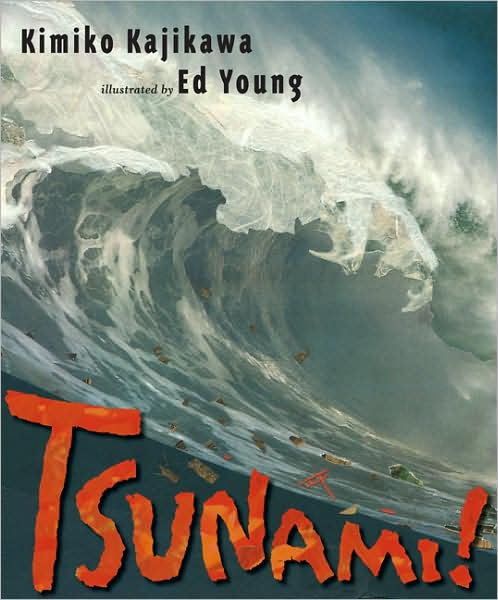
Tsunami


Kajikawa, Kimiko. 2009. Tsunami! Illustrated by Ed Young. Penguin.

I really enjoyed this one. It's a strikingly illustrated picture book of a folk tale.

Long ago in Japan, there was a wise old rice farmer who lived near the sea. The people in the village called him Ojiisan, which means "grandfather." Even though Ojiisan was the wealthiest person in the village, he lived a very simple life. His thatched cottage stood high on the mountain, overlooking the village and the sea. People often climbed the long zigzag road up the mountain to ask Ojiisan's advice.
Tsunami is the story of how one man through great cost to himself saved the village from an approaching tsunami. Though the village was destroyed, the villagers were saved due to the quick-thinking of a wise old man.

Ojiisan turned his keen old eyes anxiously toward the sea. It had darkened suddenly and was moving against the wind. THE SEA WAS RUNNING AWAY FROM THE LAND! The beach grew before Ojiisan's eyes. He had never seen anything like this, but he remembered what his grandfather had told him when he was a child. Ojiisan shivered. "Tsunami--the monster wave," he whispered. But none of the villagers realized the danger they were in. Ojiisan watched as the whole village ran to the beach, and even beyond the beach, to watch the sea.
How can one man save a village? What must he do to get their attention? Read and see for yourself in Tsunami!


© Becky Laney of Young Readers