Showing posts with label Reading. Show all posts

Monday, February 13, 2023

42. Once Upon a Book


Once Upon a Book. Grace Lin and Kate Messner. 2023. [February] 40 pages. [Source: Library]

First sentence: Alice was tired of heavy sweaters and thick socks and staying inside with nothing to do. "I wish I were someplace that wasn't so frozen and gray!" she grumbled to her mother. She began to stomp away, but something flapped nearby. It was the pages of a book. Curious, Alice began to read.

Premise/plot: Alice, our protagonist, spends the afternoon [or morning, or day] IN a book--literally and figuratively. The illustrations show her stepping right into a book and truly LIVING and EXPERIENCING the action/story of the book[s]. She goes from story to story meeting all sorts of characters--mainly animals, if not exclusively animals. Her landscape is ever-changing. 

My thoughts: I wanted to love this one. I did. I love, love, love books about books. I didn't quite love this one despite me wanting to absolutely do so. I think that is mainly all on me. It is not at all fair to judge a book based on your expectations, what you want the book to be. But the book I desperately wanted this one to be would have Alice stepping into familiar books and stories--meeting characters, being thrown into stories. Instead, it was almost let's travel the globe and learn about different habitats and animals. Yet it wasn't even quite that. [Not nonfiction-y enough to be an informative book]. The illustrations were bright, bold, colorful.

An artistic choice that I personally didn't love was Alice's ever-changing dress. She starts off with a dress imprinted with words. But her dress blends into EVERY landscape. It changes with each story. At first glance--at least my first glance--it looks like arms, legs, head and shoulders--just floating disconnected. Again, that could be 100% just me. Yes, upon a double-take I saw she was still wearing a block-y dress. But it was distracting/disconcerting to me. Again a nitpicky thing. I probably am the only reader who will feel this way.


© 2023 Becky Laney of Young Readers

Sunday, September 26, 2021

151. A Walk in the Words


A Walk in the Words. Hudson Talbott. 2021. 32 pages. [Source: Library]

First sentence: Drawing always came naturally to me. I drew all the time. I just did it, like breathing.

Premise/plot: Hudson Talbott shares his own story--one that perhaps many, many children (and adults) can relate to--of how learning to read and actually reading was difficult for him. He contrasts his experiences with words with his experiences drawing. He describes his experiences with great detail and imagery--making use of art. The picture book is very visual. "A whole page of text looked like a wall--keeping me out." What he realized is that both art and text can tell stories--great, wonderful, marvelous, amazing stories worth experiencing.

While reading felt overwhelming and exhausting, his approach was practical and ultimately inspiring. "I grabbed overwhelm and broke off over so it just said whelm. It meant the same thing but was more my size. Now I could whelm the words before they overwhelmed me. I'd just read at my own pace. After all, it was my walk in the words. I took time to look for words that I knew. There they were! Like stepping stones leading me onward."

My thoughts: I loved the art. It was so visual, so essential, so fundamental to the story. I loved the text. The story is ultimately a love song to stories...to storytellers...to books. I would recommend it to teachers and parents especially.

© 2021 Becky Laney of Young Readers

Tuesday, August 3, 2021

99. My Very Favorite Book in the Whole Wide World


My Very Favorite Book in the Whole Wide World. Malcolm Mitchell. Illustrated by Michael Robertson. 2020. [December] 32 pages. [Source: Library]

First sentence: Hi! I'm Henley. And this is a story about finding my very favorite book in the whole wide world.

Premise/plot: Reading doesn't come easily or naturally to Henley. He'd be hard-pressed to answer the question "What is your favorite book?" So when that exact question is asked for a homework assignment, he struggles. He visits the library, the bookstore, talks to his parents. But he's got a trick up his sleeve...maybe his favorite book in the whole wide world doesn't exist yet...because he hasn't written it yet.

My thoughts: I liked this one. I didn't love it. I do like that Henley found his voice and authored his own story. There's something cute and adorable about that. 

Yet at the same time, I wanted him to have an actual actual favorite book. You don't have to read yourself to have a favorite book. You don't. Plenty of kids have a stack of favorite books that they've only heard read aloud, that they've only "read" by looking at the pictures. His not having a favorite book makes me sad. Sad that he didn't have a favorite book at home already in his room, by his bed, a book part of his routine.

 I admit that I may be overthinking this a thousand percent. I do that.

© 2021 Becky Laney of Young Readers

Monday, May 21, 2018

Thin Ice

Thin Ice. Jerrold Beim. Illustrated by Louis Darling. 1956. 46 pages. [Source: Bought]

First sentence: Lee and his brother Bobby went to school in the morning. Bobby was in the kindergarten and Lee was in the second grade. Lee liked everything about school except--reading!

Premise/plot: Lee struggles with his reading. It is his least favorite subject in school. Honestly, he's not sure what is all that great about reading. But he changes his mind after a close call on the skating pond. He reads the sign: KEEP OFF! THIN ICE! in time to warn his younger brother, Bobby.

My thoughts: I enjoyed this one. I bought it at a local charity shop. The first thing I noticed were the illustrations by Louis Darling. (I find vintage illustrations hard to resist.) The illustrations alternate between black and white and color: three colors to be precise: blue, red, and maroon. My favorite illustration is the HUGE smile on Lee's face when he finally 'gets' reading and is able to read a page in front of his reading group.

The story itself is about a boy who struggles with reading. The book provides a snapshot of how reading was taught in the 1950s.

Text: 4 out of 5
Illustrations: 4 out of 5
Total: 8 out of 10

© 2018 Becky Laney of Young Readers

Wednesday, September 29, 2010

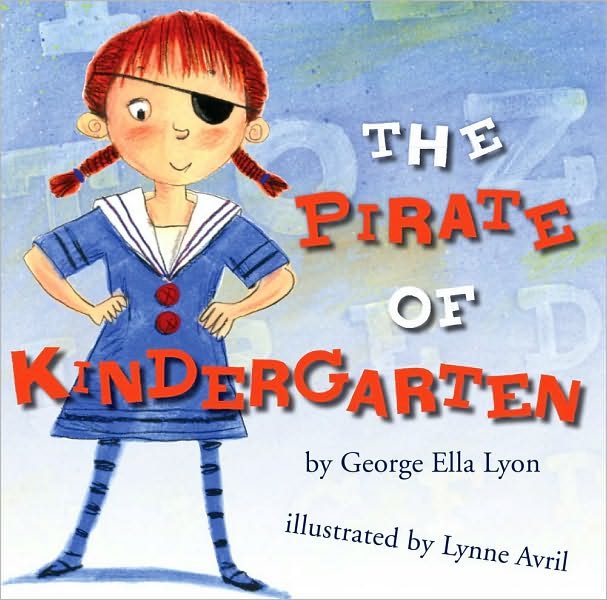
The Pirate of Kindergarten


The Pirate of Kindergarten. George Ella Lyon. 2010. June 2010. Simon & Schuster. 40 pages.

Ginny loved Reading Circle.
Getting there was hard, though, with all those chairs.
She knew only half of them were real, but which ones?
She always ran into some. Someone always laughed.


Don't expect a pirate adventure. The Pirate of Kindergarten is about a little girl, Ginny, who has double vision. But it isn't until her vision is tested--at school--that she learns just why she has so much trouble seeing things clearly and correctly. The end result is that Ginny starts wearing an eye patch and her vision problems are corrected.

The book is based on the author's own experiences. And it's a good story--very heartfelt.

© Becky Laney of Young Readers

Thursday, August 26, 2010

It's A Book


It's A Book. Lane Smith. 2010. August 2010. Roaring Brook Press. 32 pages.

What do you have there?
It's a book.
How do you scroll down?
I don't. I turn the page. It's a book.
Do you blog with it?
No, it's a book.
So a monkey and a jackass are having a discussion about a book the monkey is reading. The jackass is a bit clueless as to what a book is, what it does, what it's for, etc. And so the monkey is having to explain it over, and over, and over again. Will this donkey ever get it?

The publisher's synopsis says this is a "delightful manifesto on behalf of print in the digital age." And that description sums it up well.

I liked it. I thought it was cute. I'm not sure it's for everyone. But for the right audience, it works.


© Becky Laney of Young Readers

Monday, August 2, 2010

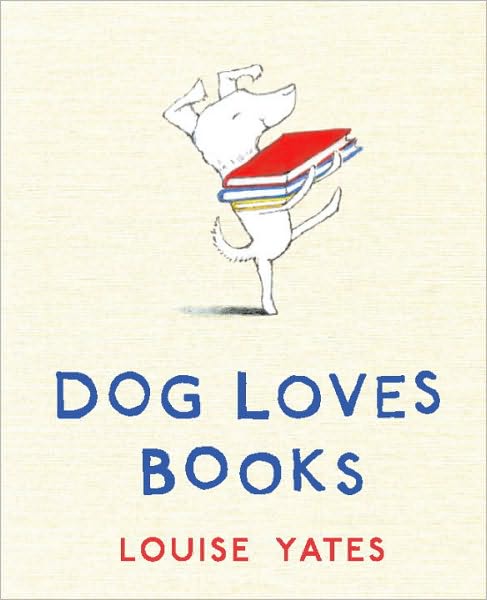
Dog Loves Books


Dog Loves Books. Louise Yates. 2010. July 2010. Random House. 32 pages.
Dog loved books.
He loved the smell of them,
and he loved the feel of them.
He loved everything about them...
Dog loved books so much
that he decided to open his own bookstore.
Dog is a dog that loves to read. He loves books. He wants to share this love of reading with everyone. At first, Dog is disappointed that his new bookstore has no customers. NO real customers at least. (A man asking for directions does not count!) But Dog isn't one to feel discouraged for long. He'll just do what he loves best--read a good book or two or three. When the time comes when a real customer finds his store, Dog knows just what to do. He knows the perfect books to recommend!

It's a cute book. A simple book. I liked it.

© Becky Laney of Young Readers

Wednesday, July 28, 2010

How Rocket Learned to Read


How Rocket Learned to Read. Tad Hills. 2010. July 2010. Random House. 40 pages.
Rocket loved to play. He loved to chase leaves and chew sticks. He loved to listen to the birds sing.
Every fall morning, after chasing leaves, Rocket would lie down in his favorite spot under his favorite tree. There he'd sniff the neighborhood smells and settle in for a good nap.
One day--while Rocket is happily snoozing--he is interrupted by a small yellow bird. A bird who proclaims herself a teacher. A bird who says that his favorite favorite napping spot is her classroom. Rocket never meant to become so interested in reading--in learning--but he finds the stories Bird reads to be irresistible. He can't help but want to learn to read after hearing her read such great books. So the instruction begins...

I loved How Rocket Learned to Read. I thought it was adorable. Not adorable in the oh-how-precious way. But in the that was so fun, so charming way. I found Rocket and his teacher, the little bird, to be a charming pair. I loved the bird's enthusiasm and passion. Like Rocket, I see how this teacher-bird would be difficult to argue with! I loved Rocket's growing enthusiasm as well. I loved how bird was able to gently tease him into her classroom. (That spread was my favorite.)

I loved the illustrations for this one as well.

© Becky Laney of Young Readers

Thursday, May 13, 2010

Miss Brooks Loves Books! (And I Don't)


Miss Brooks Loves Books (And I Don't) by Barbara Bottner. Illustrated by Michael Emberley. 2010. March 2010. Random House. 32 pages.

The star of this one is a little girl who does NOT like to read books. She does not quite understand what makes Miss Brooks--her librarian--so head-over-heels in love with books. Why does she get so excited? Excited enough to dress up in costumes for reading time? Why does she keep insisting that there is a book out there that she WILL love. That she (the girl, the reluctant reader) just hasn't found it yet. It may take a Book Week celebration for her to understand! Because during Book Week, each child has to share a book they love with the class. Will this reluctant reader find the book that is oh-so-right for her? A book to love at last?

I really enjoyed this one right from the start.

Miss Brooks is our librarian. She loves books. A lot.
She loves The Runaway Bunny. And Babar. And Where The Wild Things Are.
And The Very Hungry Caterpillar.

I ask Miss Brooks why she dresses up for reading circle.
"I want you to get as excited about books as I am," she says.
I think Miss Brooks gets a little too excited. And I bet her costumes itch.
I thought this one was a fun book!

© Becky Laney of Young Readers

Saturday, March 20, 2010

I Love My Little Storybook


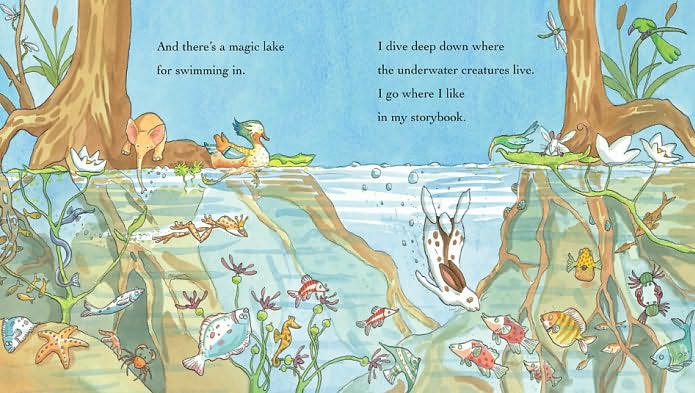
I Love My Little Storybook. By Anita Jeram. 2010. February 2010. Candlewick Press. 32 pages.
I love my little storybook.
I love the way it looks.
I love the way it feels.

I love the places
I can go to in my
storybook.
This little bunny just loves to read. So is it any wonder that he (or she) love, love, loves his (or her) storybook?!

This one is cute and charming. If you pay special attention to the illustrations, you'll realize quite a lot is happening! Do you notice the bunnies with fairy wings?! How about the tiny elephant?! It may take a few readings to pick up on every little thing! But that's what makes picture books so fun!


I think this one says quite a lot about the joys of reading and the joys of having a very active imagination! Both are things to be celebrated (and encouraged), in my opinion, so I am definitely happy to recommend this one.

© Becky Laney of Young Readers

Tuesday, February 10, 2009

Have You Seen This?


Recently there was an article in the New York Times about Scholastic book clubs. I seem to remember a previous article that spoke out against Scholastic book clubs, but this is a fresh one. The article was about if Scholastic's inclusion of toys and games negates any good they might be doing. Some in the article feel the book club entirely too commercial and not literary enough. I can see the point being made--in a way--a video game is a video game is a video game. But lumping stickers, posters, educational board games (teaching math and whatnot) and craft books (be it oragami or necklace-making with beads) into the same 'evil' category seems a bit much. Okay, stickers and posters may not engage the mind, but are they harmful? With the educational board games and craft books I'm a bit stumped as to what the harm could be? See, both of those would be engaging the mind. It takes brain power to learn how to do a craft, and to actually do it. It is engaging your hands and your mind. And it is bound to be 'better' for the brain that watching television, playing on the computer, or playing video games. I'm curious now actually, the article is saying that kids may be ordering things just to get these goodies. Ordering a book...just to get a page of stickers. Really? I'm not saying that it couldn't happen. It might be happening. But while stickers are appealing--to some more than others--stickers are available in multiple places. It's not like there's a shortage of stickers. My thinking is at least it's not candy. I could see the outrage if it was order this book and I'll give you a bag of candy. But a page of stickers?

Personally, I'm a book girl. If a book came with something else--usually something I thought was silly or useless--that was besides the point.

If you're going to make a case against Scholastic--and I'm not saying you should--I would think that you'd target the kinds of books being included. The fluffy items of little literary value. The celebrity tie-ins. The movie-and-tv-show tie ins. The toy-tie-ins. They're a waste of money--in my humble opinion. Barely worth the paper they're printed on. Of course, there may be exceptions to the rules. And if the movie-was-a-book-first, I don't have a problem with the movie-tie-in book being included. If it's still the same book underneath.

But the bigger issue here is judgements. Who has the right to judge in this case? Is there any harm if a child chooses a fluffy un-literary book (High School Musical, Miley Cyrus, etc.) over something more literary? Is reading a book reading a book? Don't we all go through a phase where we're interested in the book-equivalent of junk food? Don't we all have to go through that phase at one point or another? Don't we all come out of it...in our own time...in our own way. For some readers, it may last a month or two...in others it might last a year or two. But things do get old....and tastes change...improve. If I'm honest I'd much rather a child pick up a book that I deem 'worthy' but really the point is that they're reading something, excited about something.

A further thought...who's doing the choosing here...and who should be doing the choosing? Isn't it up to the parents as to what they spend their own money on? Parents have the power--and ability--to say yes or say no (or say not now, not this month.) They can order quality books--yes, there are still quality books in these book orders. They can order junk--yes, there's plenty of junk. They can order a bit of both. They can let their kids pick out a book or two that may not be the best book in the entire world...but they can also order something else to balance it all out.

Is literacy being damaged by the book club? Or is it being encouraged? It really is a matter of balancing choices. As my mother says, food in and of itself isn't bad. It's your choices about food that can be good or bad. Some foods are better choices than others. But all food--in moderation, of course--can be okay. If you choose to buy junk food at the grocery store...who is responsible? The grocery store? The food manufacturers or companies? Or you? Do they all share the blame? I suppose you could always argue that Scholastic could be doing a 'better' job offering 'better' choices. And that would be true enough. But it's also equally true, that just because they offer junk, you don't have to choose it. No one forces you to give Scholastic money. Parents can make 'better' choices too if they're concerned about what their kids may be getting.

And for older kids, those that may have money on their own to spend. It can be a lesson--good or bad--on money management. If you buy something, and you're disappointed with it. Or you don't end up loving it as much as you thought you would. Or if it turned out to be a dud, poorly made, not worth what you spent on it...then that is a lesson. And it's something that you've got to learn on your own. You've got to be allowed to make these kinds of mistakes. And if you end up loving it, even if others don't understand just how you could...then that's a lesson too. Everyone has to learn personal responsibility and accountability for their choices.

What do YOU think? If you've got thoughts on this issue, please leave a comment...

© Becky Laney of Young Readers

Monday, February 9, 2009

A Mighty Fine Time Machine


Bloom, Suzanne. 2009. A Mighty Fine Time Machine. Boyds Mill Press. March 2009.

Meet Samantha the anteater, Grant the aardvark, and Antoine the armadillo. These three star in Suzanne Bloom's latest picture book A Mighty Fine Time Machine. Can three friends make the impossible happen? Can they turn a seemingly ordinary box into a time machine? They can sure try! But Samantha's determination along with her keen insights make this one a fun read.

In what will probably be a rare occurrence, A Mighty Fine Time Machine had me at hello. Here's how it starts off,

"Boys," said Sam, "you've been bamboozled."
Grant and Antoine did not know what to say. They had just traded twenty Yummy Gummys and a bag of Buggy Bonbons for a time machine.


I love the language. It is so expressive. So intelligent. I'm not sure intelligent is the right word. Is there a word that means clever but that also means really, really fun? The language and style has a rhythm to it. It just makes for a fun read-aloud because the words--the sounds--are so fun to say.

For example,

They plotted and planned. They mixed and matched.
They stood back and admired their work.
It was a mighty fine time machine, and it was ready to launch.

Grant set the dials to another time and place. Sam counted backward. Antoine made blast-off noises. Flippers flapped. Wings whapped. Nothing happened.

"We're still here," said Grant.
"It's still now," said Antoine.
"Maybe we've miscalculated," said Sam.
"Maybe it's not a rockety kind of time machine."
"It's rickety," said Grant.
"It's rackety," said Antoine.
But definitely not rockety, they all agreed.
"Back to work, boys."


I just loved this one cover to cover. The language. The style. The characters. The premise. And the magical ending. Not that I'll ever tell you if this group succeeds on their mission!

Definitely recommended!

© Becky Laney of Young Readers

Wednesday, September 17, 2008

Our Library


Bunting, Eve. 2008. Our Library.

Typically I love almost everything Eve Bunting writes. She's a prolific writer, and last year some of her books were among my favorites. But I must say that my impression of Our Library was...well, let's just say all aboard for dinkyville. I hope that doesn't sound too harsh. I do think *some* readers will read it and appreciate it for what it is...an enthusiastic message-oriented book exclaiming the praises of books, reading, and libraries. And community activism. I do think, however, that there will be a few critics that think it crosses the line into both didacticism and dinkiness.

I love reading. I love books. I love libraries. So what's the problem? It's a bit silly, a bit unrealistic, a bit too gung-ho maybe.

Here's how it starts off,
Miss Goose stamped my library book. She leaned across her desk. "Our library is going to close forever," she whispered.
"Oh, no!" I said. "Why?"
"It's too old. It needs a new roof. And new paint," Miss Goose said sadly.
"Hmm," I said.
We turn the page...
We checked out two books. [How to Lay A Perfect Roof. Library Painting for Beginners.]
We read by day, and we read by night.
Turn the page...
The next morning, we got started.
We laid a perfect roof.
We painted the library buttercup-yellow, with sky-blue trim and a grass-green door.
But the library's problems don't end there. For each and every problem, there is a book that fixes it in no time at all. It takes complex issues--real-life problems--and simplifies them too much. It gives cutesy answers to actual problems. It's all about wish-fulfillment.

The library needs money to operate? Read "How To Make Money Fast." The land the library is built on is owned by a mean old goat who wants it back so he can do something else with it... Read "How to Move From One Place To Another." Find the perfect place for the library's new home...only it's owned by a grumpy beaver who just became a grandpa? Read "Read to Your Grandkids" and "How To Speak Wisely and Well To Grumpy Old Beavers."

The message of this one is that for every problem, you can read your way to a solution. And furthermore, not only will reading provide you with the answers and solutions...it will guarantee success. Guaranteeing success and solving all of life's problem by picking up a book or two may be just fine in this fictional world where animals wear clothes, but it doesn't translate well into the real world. Life isn't that simple.

Not that I'm one of those party-poopers that demands realism in all books, I can suspend my disbelief a good bit of the time.

But it seemed a bit too sweet, too cute, too simple, too dinky for my own tastes. The book has its own logic. And it's cute enough. I'll admit some of the book titles the library has are cute and a bit funny. And some people earnestly do like simple and sweet and cute and good. So it's not that the book is badly written. It just didn't work for me personally. Though as I said earlier, her previous books often do. And the strange thing is that they some of them use cute clothes-wearing animals being sweet and lovey-dovey too. So I don't know why this one didn't work for me.

I did enjoy the illustrations by Maggie Smith. I thought they complimented the text well. And they were very charmingly done.

© Becky Laney of Young Readers

Friday, September 12, 2008

The Best Book To Read


Bertram, Debbie & Susan Bloom. 2008. The Best Book To Read. Illustrated by Michael Garland.

This book is the follow up to two previous books: The Best Place to Read and The Best Time to Read. I haven't read those books. However, I did enjoy this one. While it flirts with the idea of being didactic, I think it works to a certain extent. In other words, it's a message book that everyone can generally agree is a message book, yet it has a few charming qualities about it that make you okay with the fact that it's all about the message. If that makes any sense.

The writing. I was on the fence with this one to be honest. At least in the very beginning. There are places where it seems to have rhythm, to really flow, and then there are a few places where it doesn't quite make it. Still, there are no awkward places.

Hooray! It's a trip to the library today.
We line up as we get off the bus.
We've been specially invited. Our class is excited!
The librarian is welcoming us.

See, maybe it's not the *best* poetry out there (Adam Rex comes to mind), but it's far from awkward.

"Hello, boys and girls," the librarian says.
"I see faces I've seen here before.
Finding books can be fun!
You may choose more than one.
And my job is to help you explore--

This is the kind of text that had to grow on me. I had to read it (in my head) several times, but then it clicked and I found the beat. (Which is just one of *many* reasons, adults should practice before they read aloud--well, if it's part of their job--teacher, librarian, etc.)

Picture books, chapter books, books that pop up,
nonfiction, and fairy tales, too.
You may look by yourselves.
Take some books from the shelves.
Then check out the best book for you."

The librarian character then proceeds to highlight certain books--certain types of books really--from her collection to show kids that there are many different books for many different kinds of readers.

It's a message that is close to my heart. I do believe that every book has the potential to be *the book* (a.k.a. the best book ever) for some reader out there. One person's "best book" is another person's worst. And librarians do have the joy of potentially matching readers with their "best book ever" and changing a life or two along the way. Sometimes all it takes is one magic book to turn a non-reader or a struggling reader or a reluctant reader into someone who loves reading.

That being said, the message is clearly good. The only question is will readers (adults and children alike) feel that they're being preached at? Is the message hitting you over the head with a hammer, in other words? That's something every person will have to decide for themselves. I liked this one. I don't know that I loved it as much as say The Boy Who Was Raised by Librarians. But it is infinitely better than Born to Read.


I love how perfectly the illustrations match the text. On one side of the spread, the librarian is holding up a book and describing it. And the other half of the spread, is an action spread. For example, when the librarian talks about bug books--entomology--then the next page, the second half of the spread, shows kids actually out gathering and collecting bugs. When the librarian is talking about dog books--dog training books to be exact, the next page shows a little boy trying to control his dog from jumping on the bed. So some of the pages illustrate the fact that reading is practical, is useful, is applicable to daily life. That you can read to learn. But at the same time, there are examples the librarian gives of people (children) reading for pleasure, to escape. So both types of reading are applauded. And I really loved that aspect of it. I'm sure it was intentional on the author's part, yet I'm not sure it is as obvious to readers--at least not the first time round.

If you ask a roomful of people--kids, preteens, teens, adults--to name what they think "the best book to read" is you'll hear many different answers, responses, books. Everyone has their own personal idea of what "the best book to read" is. And this book reflects that in a way that is clear and concise and fun.

© Becky Laney of Young Readers