Showing posts with label music appreciation. Show all posts

Tuesday, August 18, 2026

65. Shy


65. Shy. Julie Andrews and Emma Walton Hamilton. 2026. 52 pages. [Source: Library] [4 stars, picture book, animals, music appreciation]

First sentence: Shy was the smallest and quietest pup at the shelter. She seldom made a sound. Not at suppertime. Not at walk time. Not even at playtime.

Premise/plot: Shy finds her forever home. BUT her new human is a musician who loves to play the piano. Shy loves, loves, loves this. She loves it because she can join in with her own song to match his (her human) own. But when it comes time for him to perform on stage, will Shy join him? Does he want her to?

My thoughts: I enjoyed this one. It's a sweet story lightly inspired by a dog in Julie Andrews life that liked to sing along. Definitely enjoyable if you like music OR dogs OR both.


© 2026 Becky Laney of Young Readers

64. WhoHQ: The Beatles


64. WhoHQ: The Beatles. Ellen Labrecque. Illustrated by Fanny Liem. 2026. 40 pages. [Source: Library] [4 stars, j nonfiction, j biography, music appreciation]

First sentence: Four young musicians with "mop top" hair stood onstage in black suits.

Premise/plot: This one is a Who HQ biography book for young children. It is a biography of The Beatles: John Lennon, Paul McCartney, Ringo Starr, and George Harrison. It mainly focuses on their career as THE Beatles with only a little bit of what came before and after. (Which is fair). It also gives a little bit of context about the 1960s in general.

My thoughts: There was a time when I loved, loved, loved, loved, loved the Beatles and read anything and everything I could on the Beatles. This one didn't teach me anything new, however, I didn't expect it to. This one is for young readers not adults who have read half a dozen or so books on the Beatles and watched the Beatles Anthology and other documentaries multiple times. It is a good introduction to the group. I'm not sure if this is a book young readers would pick up on their own. It might be one they'd choose if there was an assignment maybe? It would be fascinating to hear from school librarians (and children's librarians in the public library) to see if this one is being checked out by kids and how frequently.

© 2026 Becky Laney of Young Readers

Monday, September 2, 2024

114. The Fastest Drummer

114. The Fastest Drummer: Clap Your Hands for Viola Smith. Dean Robbins. Illustrated by Susanna Chapman. 2024. 40 pages. [Source: Library] [Nonfiction picture book] [5 stars]

First sentence: Five girls played together in the Smith Sisters Orchestra. Irene on trombone. Erma on vibraphone. Edwina on trumpet. Mildred on violin. Lila on saxophone. Was there a spot for the sixth sister, Viola? Almost every instrument was taken...except for the drums. 

Premise/plot: The Fastest Drummer is a nonfiction picture book biography of Viola Smith. It celebrates music, jazz, women's history, and history-history. 

My thoughts: I have a weakness for music-related picture books, especially jazz-focused picture books. (I blame Hand, Hand, Fingers, Thumb one of the greatest early readers ever.) This one is a biography of a musician, a drummer, Viola Smith. I had not heard of Viola Smith, however, famous drummers--particularly jazz drummers--aren't something I'm particularly familiar with at all.  

What I LOVED about this one was the narrative. The storytelling AND in particular the descriptive word choices make for a super rhythmic read aloud. I loved, loved, loved how the narrative combines with the illustrations to make for a fantastic read.

© 2024 Becky Laney of Young Readers

Thursday, April 25, 2024

62. Everything a Drum


Everything a Drum. Sarah Warren. Illustrated by Camila Carrossine. 2023. 24 pages. [Source: Library] [picture book]

First sentence:  You bang and bash. Ta-tum! tum! tum! The trash goes crash! pa-pum! pum! pum! You turn the world into a drum. You turn the world into a drum. The muffin tin says plink! plink! plink! The doggy dish says tink! tink! tink!

A young toddler makes a drum out of everything--literally. The book is written in rhyme and has a certain amount of rhythm to it. Mind you, it will never take the place of Hand, Hand, Fingers, Thumb (the most perfectly perfect book ever). But it was an enjoyable read for me. The narration definitely worked for me. Lots of onomatopoeia throughout. Plenty of repetition--which is thematically appropriate when talking about beats and rhythm. I didn't love the art, however, art is the most subjective thing about picture books.

I personally think this would be a good board book.


© 2024 Becky Laney of Young Readers

Tuesday, August 8, 2023

212-215. Picture Book Parade


212. When Rubin Plays. Gracey Zhang. 2023. 56 pages. [Source: Library] [picture book; music appreciation; cats]

First sentence: In a small town by a big forest, there was a little orchestra...a little orchestra that played beautiful sounds. Rubin loved these sounds. They drifted around him and lifted him up, warm and light. Rubin felt like flying. 

Premise/plot: Rubin LOVES, LOVES, LOVES music. He finds it incredibly emotionally moving. He wants to learn to play the violin. But he needs practice. Lots and lots of practice. The sounds the violin makes when he plays it...well...less than ideal...for a human audience. But he plays to a VERY appreciative audience of cats. When it is time to perform for humans, well, the kitties may just crash the party to the delight of all.

My thoughts: I enjoyed this one! I liked the story and the art. I absolutely loved the color palette of the illustrations. Absolutely beautiful! I was so happy to see all the kitties!!! 


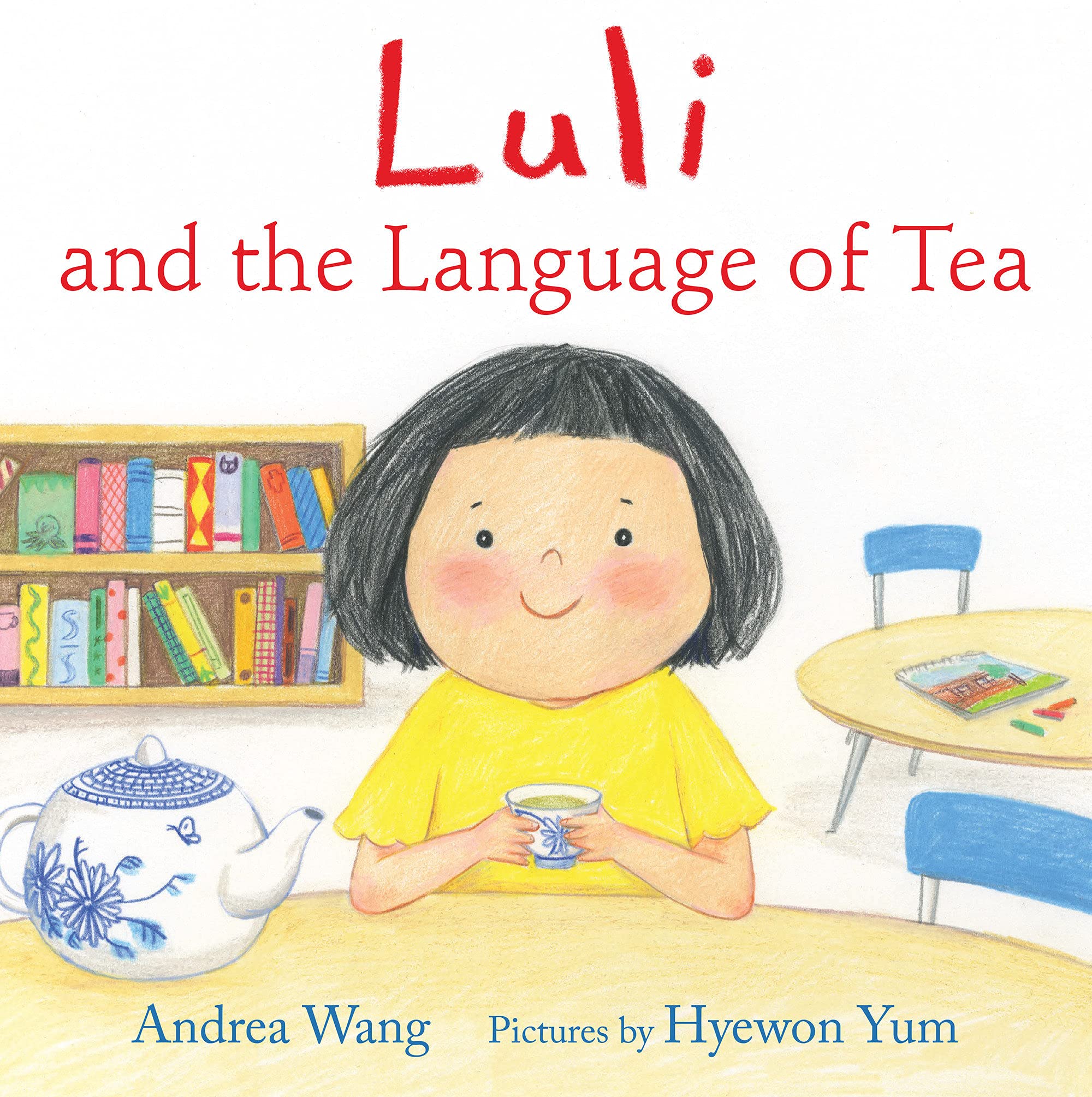
213. Luli and the Language of Tea. Andrea Wang. Illustrated by Hyewon Yum. 2022. 40 pages. [Source: Library] [picture book]

First sentence: The playroom was quiet. Luli couldn't speak English. Neither could the others. All around the room, children played alone. Last time, Luli had played by herself too, until she had an idea. 

Premise/plot: The setting for this new picture book is the free childcare at a place offering English as a Second Language lessons for adults. Luli, the protagonist, has the idea to make friends and bring them closer together by offering tea--“Chá!”

All of the other kids recognize this word and are delighted to join her because of the similarities between many, many languages for tea.  

My thoughts: I liked this one. I had never thought of tea as a universal language before, but, it makes sense once you read the book and the back matter. I also don't necessarily link tea--actual tea--with children. But I think this depends completely and totally on one's culture. The book celebrates diverse cultures and SHARING. 


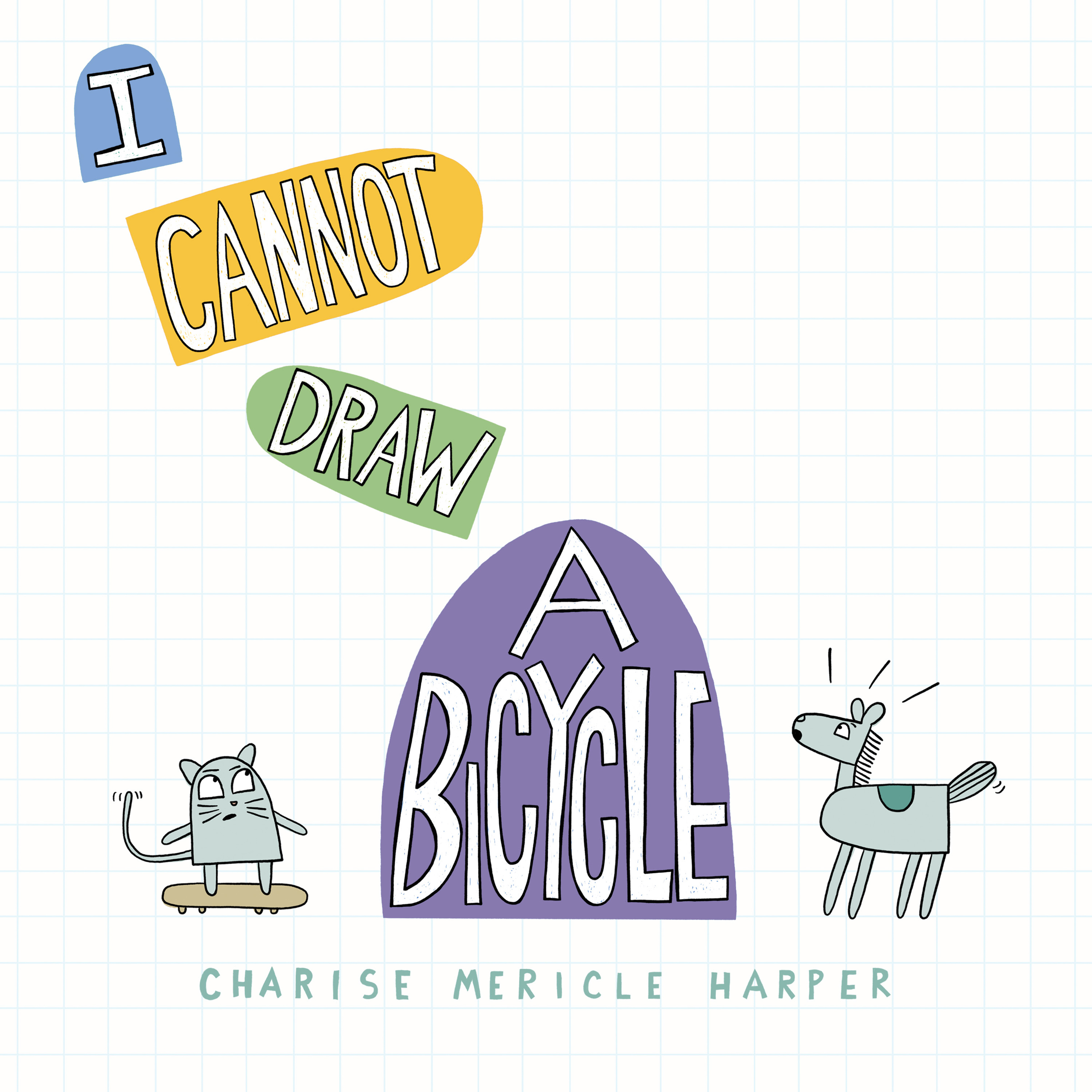
214. I Cannot Draw A Bicycle. Charise Mericle Harper. 2023. 48 pages. [Source: Library] [picture book]

First sentence: This is my shape. My shape can make a lot of things. I can draw a cat. I can draw a skateboard. I can draw a horse. 

Premise/plot: Cat and Horse star in this silly picture book. Horse wants the book to draw a bicycle. The book can't having never seen one. Horse doesn't seem to have a clue how to draw a bicycle either. The book tries...and tries...and fails.The end.

My thoughts: I want my time back. I'm sure this book will find readers who are happy to have read it. There will probably be at least a few who will giggle at the silly antics. But for me personally, this was odd and strange in a way that didn't quite work. I'm not really sure why "the book" is an invisible entity interacting with the characters. When I first read it, I thought it was a dialogue between Cat and Horse. I didn't "get" that Book was also a character. I still don't get *why* that is. I found it unfunny the first time. But a puzzler the second time. 


215. YOU Can't Be a Pterodactyl! James Breakwell. Illustrated by Sophie Corrigan. 2023. 32 pages. [Source: Library] [picture book]

First sentence: "You can be anything you want to be," the teacher said to the class.

Premise/plot: Did the teacher mean what she said? If she did, why did she and ALL the students in the class make fun of Tommy (the protagonist) for saying he was going to be a pterodactyl when he grew up???? The book essentially explores why he wants to be a pterodactyl when he grows up. His dad is supportive of his imagination and even joins in. 

My thoughts: This book makes no sense at the end. It has a twist ending. But I can't unpack what it means. Perhaps because I'm too literal, too stuck in my ways. It's impossible for a boy to grow up to be a pterodactyl. 

The book is silly but I'm not sure if there is a hidden message there. 


© 2023 Becky Laney of Young Readers

Friday, April 7, 2023

84. The Story of the Saxophone


The Story of the Saxophone. Lesa Cline-Ransome. Illustrated by James E. Ransome. 2023. [March] 40 pages. [Source: Library]

First sentence: The story of the saxophone doesn't begin with Dexter Gordon or Charlie Parker. This story isn't told by Lester Young and Coleman Hawkins. It didn't start on a New Orleans street corner with Sidney Bechet. It began in 1814, far, far away, across the seas, in Dinant, Belgium. The story began with a young boy named Joseph-Antoine Adolphe Sax, the only son of an instrument maker. Everyone called him Adolphe. 

Premise/plot: Nonfiction picture book. Picture book biography. Music appreciation. Narrative nonfiction. This one is the story--starting with its invention--of a musical instrument--the saxophone. 

My thoughts: I enjoyed this one. I don't know that I find the opening sentences super compelling. But once the focus turns to the past, I found myself hooked. I enjoyed reading about the ups and downs--the trials--of this newfangled, "new" noise-maker. It wasn't always appreciated or accepted. I liked seeing Sax's determination and gumption. I liked seeing his hardwork pay off. I liked tracing the journey of the saxophone from the past to the present.


© 2023 Becky Laney of Young Readers

Saturday, February 4, 2023

26. Chicken Karaoke


Chicken Karaoke. Heidi E. Y. Stemple. Illustrated by Aaron Spurgeon. 2023. [January] 32 pages. [Source: Library]

First sentence: Duck arrives, ducklings in tow. She warms up her voice with notes high and low.

Premise/plot: Duck is SUPER excited to be participating in karaoke. But the night doesn't exactly go as planned....what surprises are in store for Duck????

My thoughts: I enjoyed this humorous early reader. It is a silly, enjoyable animal fantasy. It is a 'ready to read' level one book.


© 2023 Becky Laney of Young Readers

Monday, November 7, 2022

187. The First Notes: The Story of Do, Re, Mi


The First Notes: The Story of Do, Re, Mi. Julie Andrews and Emma Walton Hamilton. Illustrated by Chiara Fedele. 2022. [November] 48 pages. [Source: Library]

First sentence: A thousandyears ago, in the small community of Pomposa, Italy, a boy named Guido was sent to a monastery to begin his schooling. In those days, a monastery was considered the best place to receive an education. The monks who lived and taught there were studious and wise.

Premise/plot: The First Notes is a picture book biography of Guido d'Arezzo, a Benedictine monk who invented musical notation. Guido loved music. Loved it. But it involved a lot of memorization. You learned a song by memory. There was no "reading" music--or "writing" music. There was no way to notate musical notes. Until Guido made a little discovery and invented his own way of writing music so others could read it. 

My thoughts: Julie Andrews--and her daughter, Emma--have written the story of 'do, re, mi.' And though I never thought about the history of musical notation [and scales and such], I really loved reading this story. I found it fascinating. I learned so much.


© 2022 Becky Laney of Young Readers

Monday, October 3, 2022

154. How To Build An Orchestra


How To Build An Orchestra. Mary Auld. Illustrated by Elisa Paganelli. 2020. [October] 48 pages. [Source: Library]

First sentence: This is Simon. Simon loves music. He loves to listen to it, and loves to make it. Sometimes Simon hums to himself, sometimes he sings and occasionally he whistles. But that really isn't enough for him--he wants to share music with everyone. That's why he is a conductor. A conductor is the person who leads an orchestra.

Premise/plot: What you see is what you get. The premise of this one is that Simon, the conductor, is holding auditions for the London Symphony Orchestra. The readers "listen in" on these auditions and subsequently have the opportunity to learn all about how to build an orchestra. 

My thoughts: Packed with facts--that's how I'd describe this one. The story is very loosely structured. The story holds up, I suppose, to a certain degree. But plenty will be able to guess this is just a "fun" way to teach young(er) readers to orchestra and orchestral music. I appreciate the layout and organization of this one. It is so structured. There are facts here, there, and everywhere. I'm definitely leaning towards this one being for older readers (upper elementary school).


© 2022 Becky Laney of Young Readers

Sunday, June 5, 2022

65. Before Music: Where Instruments Come From


Before Music: Where Instruments Come From. Annette Bay Pimentel. Illustrated by Madison Safer. 2022. [June] 88 pages. [Source: Review copy]

First sentence: Music doesn't come out of nothing. It always starts somewhere... Before music, water drip...drip...drips. It washes away soil and eventually fractures the rock underneath. Someone selects a few of the stones....and strikes their edges tink tink tink listening as he shapes the stone. He is making... a rock gong.

Premise/plot: Before Music is a global exploration of the history of musical instruments and music. It is arranged according to the materials from which the instruments are made. (Of course, some instruments are made from multiple materials. Probably many are made from multiple materials). This over-sized picture book (trust me, it is VERY oversize), also spans time--thousands and thousands and thousands of years. 

My thoughts: So much information is packed into this picture book. Proof that you should never make a quick judgement about picture books and who they are written for. I think music lovers of all ages will find something of interest in this one. 

If I could change one thing about this one, I think it would have been super helpful if it had had a table of contents. The book is clearly organized and arranged in a specific order. There was method involved. 

If I could amend that to changing TWO things about this one, I would add that it would have been great if it had had page numbers. Those two things would have gone a long way in making this one more useful as a reference book. 

When I say reference book, I don't mean it a negative way. I don't mean "boring" or "dull" or even "taste specific." I mean that it is packed with so much information that one can keep coming back to it again and again and absorbing it at your own pace. 

The general arrangement

ROCKS
FOUND OBJECTS
CLAY
GOURDS
STRINGS
METAL
WOOD
REEDS
FLEXIBLE SHEETS (leather, felt, etc.)
HUMAN VOICE

I think for the right reader this one could be fascinating. I wish it had a few more helps in it. Pronunciation guide for instruments (since it spans the globe and spans time). Sure everyone knows how to say drum or piano or saxophone, but there are hundreds of instruments that will be brand new to readers (no matter your age). 

© 2022 Becky Laney of Young Readers

Friday, January 21, 2022

14. ¡Mambo Mucho Mambo! the Dance That Crossed Color Lines


¡Mambo Mucho Mambo! the Dance That Crossed Color Lines. Dean Robbins. Illustrated by Eric

The illustrations were wonderful!!! 


© 2022 Becky Laney of Young Readers

Tuesday, September 21, 2021

148. Jazz for Lunch


Jazz for Lunch! Jarrett Dapier. Illustrated by Eugenia Mello. 2021. [September] 48 pages. [Source: Library]

First sentence: Struttin' with Auntie Nina
down to a club,
We're gonna hear some music
and then eat some grub.

Premise/plot: Jazz for Lunch! celebrates jazz music, food, and family. Auntie Nina and her nephew have a special relationship. She shares her love for cooking and her love for JAZZ with her young nephew...teaching him both how to cook and how to appreciate jazz.

This book--entirely written in rhyme--starts with the two going to a jazz club. But it also has the two going to her place to cook a great meal (while listening to jazz).

Jazz for LUNCH!
The beats got SOUL!
Jazz for LUNCH!
Ham on a ROLL!
Jazz for LUNCH!
The tunes got swing!
Jazz for LUNCH!
Shout, dance, and sing!

(Jazz for lunch being the refrain carried throughout the picture book.)

My thoughts: This book celebrates so many things. Yet it never seems too busy. It feels natural--right. The end papers--if you pay close attention--can serve as an introduction to readers of all ages of some jazz legends.


© 2021 Becky Laney of Young Readers

Thursday, July 18, 2019

Board book: I Love Mozart!

I Love Mozart: My First Sound Book. Marion Billet. 2019. Scholastic. 10 pages. [Source: Review copy]

First sentence: Let's celebrate Mozart's music!

Premise/plot: This board book "introduces" little ones to six selections of classical music from Wolfgang Amadeus Mozart. The songs included are: "Sonata for Violin and Piano," "Clarinet Concerto," "Sonata Facile," "Symphony No. 40," "Eine Kleine Nachtmusik," and "Twelve Variations on Twinkle, Twinkle Little Star."

My thoughts: One of my favorite things about this one is that there is an off/on switch. Board books with batteries are tricky. On the one hand, they are usually fun. On the other hand, the batteries won't last all that long. The more beloved a book is, the quicker the battery dies. Then it is just SAD, SAD, super-sad. Little fingers can touch the 'buttons' on each spread to start and stop the music. Each song lasts under a minute.


Mozart is my favorite composer.


© 2019 Becky Laney of Young Readers

Saturday, May 5, 2018

The Composer is Dead

The Composer is Dead. Lemony Snicket. Illustrated by Carson Ellis. Music by Nathaniel Stookey. 2009. HarperCollins. 36 pages. [Source: Review copy]

First sentence: The composer is dead. "Composer" is a word which here means "a person who sits in a room, muttering and humming and figuring out what notes the orchestra is going to play." This is called composing. But last night, the Composer was not muttering. He was not humming. He was not moving, or even breathing. This is called decomposing.

Premise/plot: An investigator has been called in to investigate the 'mysterious' death of the composer. WHO murdered the composer and why? Is the murderer to be found in the strings? the brass? the woodwinds? the percussion section?

"I swear on my own intelligence and good looks; I will solve this terrible crime against humanity and/or classical music."

My thoughts: I love, love, LOVE this one. I love the strong narrative voice. The writing is fun and clever. The text is LIVELY.
The Violins answered first, of course. The violin section is divided into the First Violins, who have the trickier parts to play, and the Second Violins, who are more fun at parties. "We were performing a waltz," said the Violins. We played graceful melodies so the ladies and gentlemen could spin around and around and around until they felt dizzy and somewhat nauseous. This kept us busy all night. AHA the Inspector cried, making a note in his notebook. "Perhaps you murdered the Composer for making you play so much." "Don't be ridiculous!" the Violins said. "Violins are the stars of any orchestra. If we killed the Composer, we would have to find work at square dances or in romantic restaurants."  
It is packed with plenty of information about orchestras. Yet at its heart is a dramatic--perhaps melodramatic--STORY.

I love the audio book included with the book. Together the music and the book create a lovely and dark atmosphere. It is an invitation to play and create.

I also love that it's a MYSTERY. So many detective/mystery stereotypes are in play in the narrative. If you love that genre then this one is just giddy-making.

Text: 5 out of 5
Illustrations: 3 out of 5
Music: 5 out of 5
Total: 13 out of 15

© 2018 Becky Laney of Young Readers

Tuesday, December 19, 2017

The Nutcracker in Harlem

The Nutcracker in Harlem. T.E. McMorrow. Illustrated by James Ransome. 2017. 32 pages. [Source: Library]

First sentence: It was snowing in Harlem on Christmas Eve. The party at Marie's house swirled with colors, gold and red and green. Mama and Poppy were dancing. Miss Addie sang, and Uncle Cab played the piano. Marie loved the sound of Christmas.

Premise/plot: This picture book is an adaptation of The Nutcracker. In this adaptation, the story is set in Harlem during the 1920s. Marie, the heroine, is a bit shy or hesitant; she hasn't found her confidence yet to sing or dance, to join in the vibrant life of her family and community. All that will change one magical Christmas Eve.

My thoughts: I liked this one. I liked this creative retelling.

This book would pair well with Duke Ellington's Nutcracker Suite by Anna Harwell Celenza. The two books set out to do different things. One is a retelling of a traditional story in a new setting. The other is based on a true story, of how Duke Ellington transformed the Nutcracker Suite into JAZZ.

But both celebrate LIVING LIFE. Even if you don't seek out this other picture book, do give Ellington's Nutcracker Suite a listen. I do think the music would provide a great soundtrack for McMorrow's picture book.  

Text: 5 out of 5
Illustrations: 4 out of 5
Total: 9 out of 10


© 2017 Becky Laney of Young Readers

Thursday, November 16, 2017

88 Instruments

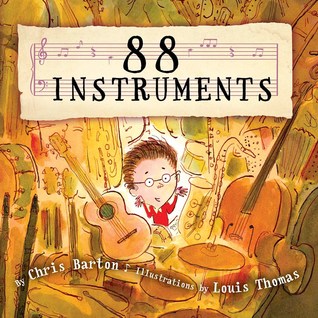
88 Instruments. Chris Barton. Illustrated by Louis Thomas. 2016. 32 pages. [Source: Library]

First sentence: 88! That's how many pounding, surrounding, astounding-mound-of-sounding instruments are in this shop. But...I can take lessons on only one. Not 75, or 64, or 33, or 12. "One," says Dad. "For now," says Mom. "Your pick!" says Dad. "Within reason," says Mom. How am I supposed to pick just one? Do I pick the squeeziest? The wheeziest?

Premise/plot: The narrator of 88 Instruments is having a tough time deciding on ONE instrument from the music shop. What instrument should he learn to play first? One thing is for certain, he is going to look at ALL of his options and not just pick the first thing he sees.

My thoughts: I loved this one. I loved the descriptive language. I loved the dialogue. It worked really well, in my opinion. I loved the passion and enthusiasm. Which technically I suppose you'd call the narrative voice. I thought Barton did great at capturing that magic moment.
plink! It's so clear. PLUNK. So right. PLUNNNNNNNNK! So right for me. I'm going to learn the plinkiest...the plunkiest...and, here to there, the spunkiest--the PIANO!
The illustrations are nearly (but not quite) as expressive as the text.

Text: 5 out of 5
Illustrations: 3 out of 5
Total: 8 out of 10


© 2017 Becky Laney of Young Readers

Monday, September 26, 2011

Be Quiet, Mike!

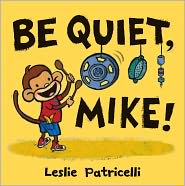
Be Quiet, Mike! Leslie Patricelli. 2011. Candlewick. 40 pages.

This is a story about a monkey named Mike, who started drumming as a tiny little tyke. He played with his fingers; he played with his feet--a funky little monkey with a beat, beat, beat.
Bing, bong, bing, his rhythms would sing, but poor Monkey Mike heard only one thing...
He heard it from his parents; he heard it from his sis; he heard it from the neighbors, and it sounded like this:
BE QUIET, MIKE!

At first I wasn't sure about this one. It was never a case of liking or not liking; no, it was a do I like this?, do I really like this? or do I love it? Leslie Patricelli is one of my favorite authors for young readers. I've loved--often loved, loved, loved--many of her simpler books like Higher, Higher; Tubby; Potty; Yummy Yucky; Quiet Loud; No No Yes Yes; Baby Happy Baby Sad; The Birthday Box, etc. Be Quiet, Mike definitely has more words than any of those books I just mentioned!

But the more I read Be Quiet, Mike! the more I liked it. And I think it is because of the rhythm of it. It's a simple story of a loud little monkey who has to find the right way to express himself. He finds it through music--a drum set--as you might have guessed. Anyway, there is something musical about Be Quiet, Mike. I'm not saying that it is as musical, as magical, as say Hand, Hand, Fingers, Thumb by Al Perkins (one of my favorite, favorite, favorite, favorite books of all times), but it works. There is something fun about reading this one.

Text: 4 out of 5
Illustrations: 3 out of 5
Total: 7 out of 10

© 2011 Becky Laney of Young Readers

Friday, January 28, 2011

For the Love Of Music

For the Love of Music: The Remarkable Story of Maria Anna Mozart. Elizabeth Rusch. Illustrated by Steve Johnson and Lou Fancher. 2011. February 2011. Random House. 32 pages.


When Maria Anna Mozart was a child, her life thrummed with music. Court musicians trumpeted French horns, choruses tra-la-la'ed, and countless fingers skittered up and down scales. 
"Oh father," Maria pleaded, "please teach me to play!"
And so he did.

I'm not quite sure what I liked more--the text or the illustrations. Truth is, both are wonderful! I have been a big, big fan of Steve Johnson and Lou Fancher for years! But there was something just right about the narrative of this one. I found it quite poetical, quite creative, very rich in description.

It's a picture book biography of Maria Anna Mozart, the older sister of Wolfgang Mozart. (Did you know that she was just as musical as her brother? Just as talented and charismatic? I've read novels--one adult, one young adult--on the subject. But I was pleased to see this as a subject of a picture book.)

The biography is presented in a unique way--her life is arranged into sonata movements. And the book definitely illustrates and defines many musical terms. For example, The First Movement: Where musical themes are introduced; Allegro: The fast tempo of the first movement; Development: Where the themes of the first movement are explored; Recapitulation: Where the themes of the first movement are reviewed; Coda: An Ending.

I would definitely recommend this one.

Text: 3 out of 5
Illustrations: 4 out of 5
Total:  7 out of 10

© 2011 Becky Laney of Young Readers
Friday, November 26, 2010

Poetry Friday: The Carnival of the Animals


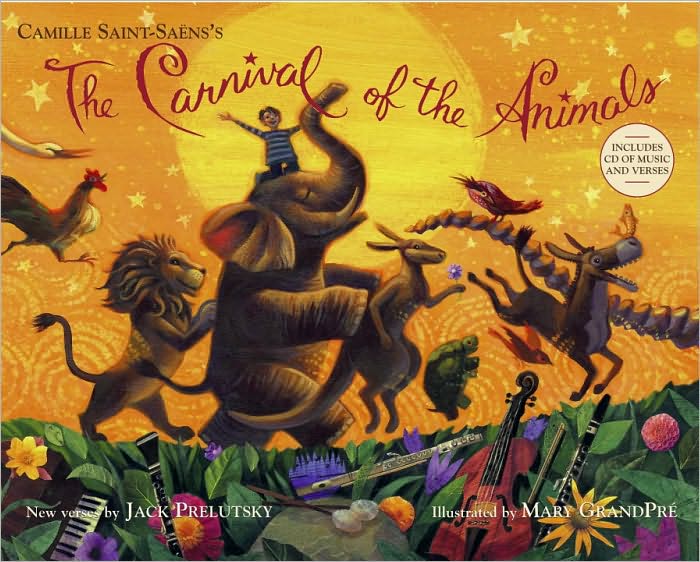
Camille Saint-Saens's The Carnival of the Animals. Jack Prelutsky. Illustrated by Mary GrandPre. 2010. Random House. 40 pages.


Inspired by Camille Saint-Saens' "The Carnival of the Animals", Jack Prelutsky has written a new collection of verses. In the accompanying CD, readers get the opportunity to listen to the poems and to the musical pieces that inspired those poems. (If you prefer an uninterrupted introduction to "The Carnival of the Animals," it is the last track of the CD.)

From the jacket,
The Carnival of the Animals has long been recommended as a playful way to introduce preschoolers to classical music. Children will enjoy acting out the animals roles as they listen to the music and the verses.
Poems include, "The Lion," "Rooster and Hens," "The Donkeys of the Wild," "The Tortoise," "Elephants," "Kangaroos," "Aquarium," "Personages with Long Ears," "The Cuckoo," "Birds," "Pianists," "Fossils," "The Swan." (Also an Introduction and Finale).

My favorite poem?
Personages with Long Ears

They love to loudly bray and bray,
And bray away both night and day.
Determined that their brays be heard,
They're both obnoxious and absurd.

They bray when it is calm and warm,
They bray throughout a raging storm.
To fill the world with coarse hee-haws
(Sometimes without the briefest pause)
Appears to be their only cause.


© Becky Laney of Young Readers
Saturday, July 4, 2009

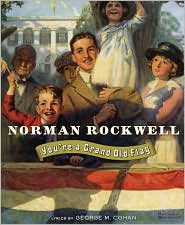
You're A Grand Old Flag


Cohan, George M. 2008. You're A Grand Old Flag. Featuring the art of Norman Rockwell. Simon & Schuster.

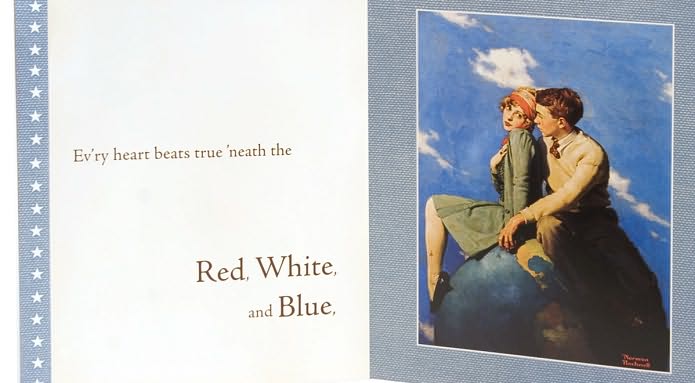
Norman Rockwell art is paired with the patriotic song "You're A Grand Old Flag" in this beautiful, celebratory picture book. Fourteen illustrations capturing the 'spirit' of America have been chosen to appear alongside George M. Cohan's lyrics. These illustrations span seven decades: the earliest being 1918, the latest being 1971.

It's a book that is enjoyable on several different levels. I love looking at the art. Studying all the details. Imagining the stories-behind-the-art. Rockwell art has a way of making me curious. Of making me want to know more.


© Becky Laney of Young Readers